Where data centers are being built, what was decided, and who said what.
How many
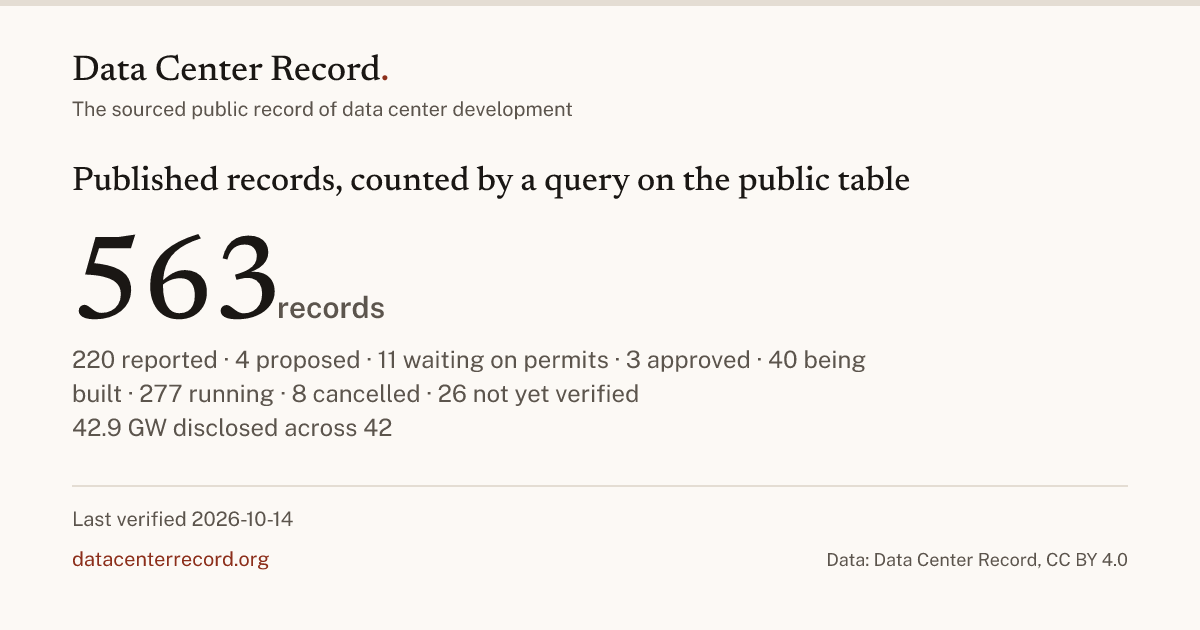
563 published records. A record is one data center site: where it is, what stage it has reached, what has been disclosed about it, and the source for every line. How records are counted.
Also on the map: 26 sites not yet verified. For each, a public permit shows the site exists; its current status has not been confirmed from a record. They are not in the count above. Why
Details
Published records on October 7, 2026: 2 reviewed in depth by a person (a full history, every fact sourced) and 587 built from one source each and not yet reviewed. 1 of the 63 states and provinces watched has a record reviewed in depth, and 48 more have records built from one source only. The count reads low until coverage is complete. 563 records and 0 buildings on them, with 26 sites not yet verified named apart from the count; a site is one record, and its buildings are not counted apart (why). How records are counted.
The eight statuses and how each rolls up into the four words above:
- Running 277
- running 277. The facility, or its first phase, is serving load.
- Being built 40
- being built 40. Site work or building construction has begun and the facility is not yet running.
- Proposed 238
- reported 220, proposed 4, waiting on permits 11, approved 3. Named and not yet built: reported, proposed, waiting on permits and approved together.
- Stalled or cancelled 8
- stalled 0, cancelled 8. Paused by the developer or a public body, or withdrawn, refused or lapsed.
Reported means the record has found the project named in reporting and no public filing for it yet. What each status means.
How to read this page. Every number here is counted from the published records when the page is built, and every item links to its source. The rules the record keeps are under How the record works.
Latest changes
-
Federal roll call H.R. 9340: Ratepayer Protection Act, Congress
U.S. Senate, roll call 254, On Cloture on the Motion to Proceed H.R. 9340: Cloture on the Motion to Proceed Rejected, 57 yea, 43 nay.
-
Moratorium Milwaukee, Wisconsin
Milwaukee City Plan Commission held public hearing and discussion on proposed one year moratorium on new data center developments
-
Moratorium adopted Palm Beach County, Florida
Palm Beach County commissioners unanimously approved one year moratorium on large scale data centers (50+ megawatt peak load); moratorium expires September 24, 2027 or when code...
-
Court ruling Butte-Silver Bow County, Montana
Montana Supreme Court granted injunction on September 23, 2026 allowing ballot initiative to appear on November ballots requiring two thirds voter approval for future data centers...
-
Moratorium Denton, Texas
Denton City Council held first public hearing on proposed moratorium on September 23, 2026.
-
Moratorium adopted Kershaw County, South Carolina
Kershaw County Council voted unanimously to pass the final reading of the data center moratorium ordinance on Tuesday night
Find a town
Proposed projects
- AIDEA Mat-Su Industrial Park (Houston)Houston, Matanuska-Susitna County, AKreported
- Brookwood Proposed Data CenterBrookwood, Tuscaloosa County, ALreported
- Cedar Rapids Third Data Center (Southwest Side)Cedar Rapids, Linn County, IAreported
- Delta Forge 1Boyce, Rapides County, LAreported
- NorthMark Spartanburg County Data CenterSpartanburg County, SCreported
The Daily Record
-
Louisiana Public Service Commission will hold three day evidentiary hearing October 7, 2026 on Entergy's power expansion proposal for Meta's Richland Parish data center
businessreport.com local outlet Also reported by tech-insider.org. (planned date, from the content)
-
The public comment period on the South Brunswick data center air permit closes October 7, 2026.
patch.com local outlet (planned date, from the content)
-
DataBank Minneapolis data center
DataBank acquired the building housing MSP2 data center at 3255 Neil Armstrong Boulevard in Eagan Minnesota
PR Newswire local outlet
-
Google Michigan City data center
Google launched a Facebook page dedicated to its Michigan City data center for community engagement
wimsradio.com local outlet
-
The Senate rejected cloture on the motion to proceed to H.R. 9340, the Ratepayer Protection Act, 57 to 43; three fifths were required.
senate.gov primary source
The number on a state is how many data centers it has on the record.
Tap a state to open it, then a pin for the data center, a county for its rules
- Running277
- Being built40
- Proposed238
- Stalled or cancelled8
- Not yet verified26
- Dashed: exact site unknown, from the county zoom
- 12Several together: the count, tap to split
Details
States are one tone, a shade darker where a state has a published record. Color means a pin's stage and nothing else. How each state's rules treat data centers is on the laws page and on each state's scorecard, and the States page can shade the map by them.
Tap a state to open it here; its counties and pins are tappable at once, and the corner link opens its page. Tap a pin for its facts and the link to its record.
Power and water
In 2023, data centers used 4.4 percent of all the electricity used in the United States, according to a 2024 report to Congress by the Lawrence Berkeley National Laboratory. The same report expects 6.7 to 12 percent by 2028.
That came to 176 terawatt hours, about as much electricity as 17.2 million average American homes use in a year.
42 of 563 published records say how much power they plan to use, and 4 say how much water. The rest have not disclosed either figure in any filing the record holds.
The figures, the sources and the arithmetic, on the numbers page
What was said
Trump said data centers 'benefit local communities' and that turning them off would send them to China during a campaign rally in Ohio on October 3, 2026
Oklahoma Representative Mark Chapman held an interim study examining data center expansion, water usage, and impact on utility rates.
Amazon says direct data center water consumption accounts for 0.5% of all industrial water usage in the United States
What the record covers
- Projects. Proposals, approvals, construction and openings, from the first filing to the day a site serves load, with histories that are never overwritten.
- Power and water. Grid connections, on site generation and water commitments from utility filings and permits, each figure with the basis its source gave.
- Jurisdictions. How states, provinces, counties and cities handle data centers: the votes, ordinances, moratoriums and tax rules, each rated from open to closed by what it has decided.
- What people said. Statements by officials, executives, advocates and residents, recorded as said, dated and sourced, with no verdict.
The record watches every state and every Canadian province and territory. 49 of them have at least one published record so far. United States · Canada
How the record works
- Primary sources first. Filings, dockets, meeting records and official disclosures outrank secondhand reporting, and every source shows its tier.
- Never estimate. A figure that is not in the public record reads not disclosed; when someone else estimated, the record says who.
- Sources shown. Every fact links to where it came from, so the record can be checked line by line.
- Corrections published. A fix is added in the open and logged, never made quietly.
- No pay to play. No company can pay to appear in, rank in, or be removed from the record.
The full method, the license and the corrections process are on the methodology page. Data: Data Center Record, datacenterrecord.org, CC BY 4.0.
Bill data from LegiScan, licensed CC BY 4.0. The record chooses the bills, writes each stage in its own words and cites the legislature's own page for every bill.