Virginia decides case by case. From the state's own rule: In Virginia, state lawmakers in the General Assembly passed legislation this year to tighten restrictions on backup generators and introduce a new energy consumption tax, January 1, 2026.
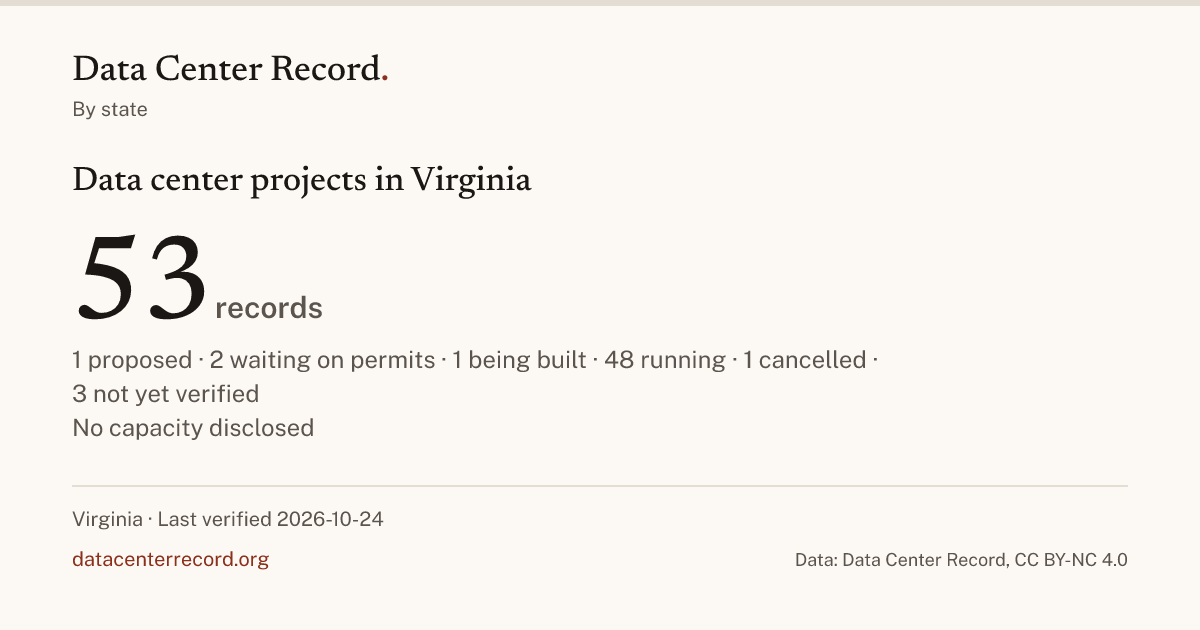
State register coverage: Virginia's air permit, parcel, utility, water, and operator registers name 53 facilities; 53 are on the record (88 buildings where disclosed), and 3 sit not yet verified.
3 sites the EPA's registry shows and no record has verified are on the map apart from the count. What not yet verified means.
How to read this page. Every count comes from the records on this page and links to where it is counted. Nothing is published until a person reads its source, and a figure no source gives reads Not disclosed; nothing is estimated. A rating changes only when a person sets it.
A blank cell means not disclosed by any source on file. Power is the developer's figure or a permit's, each linked on the record. All 53 Virginia projects.
Every Virginia record53 records, and 3 sites not yet verified listed apart · sort by any column · blank cell: not disclosed
Tier 1: an official or company source. Tier 2: a news report resolving to the outlet's own page. Located: a site coordinate from a permit, a parcel or an address, or the county or town centroid. Verified: the last day a person read the source. A blank cell means not disclosed by any source on file.
Every Virginia county (133)
15 of 133 counties have a record. A county without one is listed, not linked, until its first published record.
A blank rating cell means no person has set one for the county. A county without a record is listed, not linked.
112 counties with no records yet
Accomack County
Albemarle County
Alexandria city
Alleghany County
Amelia County
Amherst County
Appomattox County
Arlington County
Augusta County
Bath County
Bedford County
Bland County
Botetourt County
Bristol city
Brunswick County
Buchanan County
Buckingham County
Buena Vista city
Campbell County
Caroline County
Charles City County
Charlotte County
Charlottesville city
Chesapeake city
Clarke County
Colonial Heights city
Covington city
Craig County
Cumberland County
Danville city
Dickenson County
Dinwiddie County
Emporia city
Essex County
Fairfax city
Falls Church city
Floyd County
Fluvanna County
Franklin city
Frederick County
Galax city
Giles County
Gloucester County
Goochland County
Grayson County
Greene County
Greensville County
Halifax County
Hampton city
Harrisonburg city
Henry County
Highland County
Hopewell city
Isle of Wight County
James City County
King and Queen County
King George County
King William County
Lancaster County
Lee County
Lexington city
Lunenburg County
Lynchburg city
Madison County
Manassas Park city
Martinsville city
Mathews County
Middlesex County
Nelson County
New Kent County
Newport News city
Northampton County
Northumberland County
Norton city
Nottoway County
Orange County
Page County
Patrick County
Petersburg city
Pittsylvania County
Poquoson city
Portsmouth city
Powhatan County
Prince Edward County
Prince George County
Radford city
Rappahannock County
Richmond city
Richmond County
Roanoke city
Rockbridge County
Rockingham County
Russell County
Salem city
Shenandoah County
Smyth County
Southampton County
Spotsylvania County
Staunton city
Surry County
Sussex County
Tazewell County
Virginia Beach city
Warren County
Washington County
Waynesboro city
Westmoreland County
Williamsburg city
Winchester city
Wise County
Wythe County
York County
The rules in Virginia16 rows · rating rests only on a binding act in force
What the state and its counties and cities have decided. Each row is rated by what it has decided, open, case by case, restrictive or closed, never by whether that is good or bad.
In Virginia, state lawmakers in the General Assembly passed legislation this year to tighten restrictions on backup generators and introduce a new energy consumption tax.virginiamercury.com (opens in a new tab)local outlet · Jan 1, 2026 · 40 acts on this rowEvery act on the Virginia row
event
Governor Spanberger proposed ending state subsidies for data centers in site development programs
Order directs Virginia Department of Environmental Quality to submit a study by March 17, 2027 evaluating cumulative impact of emissions from backup diesel generators at data centers
Framework directs that large load users carry equitable share of generation and transmission costs, preventing residential customers from absorbing bulk of infrastructure built for data centers.
Spanberger signed a bill by Del. Rip Sullivan that increased Virginia's energy storage goals to 1,600 megawatts of storage capacity at homes and businesses.
Virginia created an Artificial Intelligence Task Force through Executive Order 22 focused on workforce displacement, data privacy and cybersecurity as part of Data Center Accountability Framework.
For any data center air permit application submitted on or after July 1, 2026, DEQ may not issue the permit unless it establishes emissions limits for engine generator sets equal to or less than emissions achieved by a Tier 4 equivalent, with selective catalytic reduction, diesel oxidation catalyst, and diesel particulate filter or equivalents.
Governor Spanberger issued executive order tasking legislature to write regulations on data center transparency, environmental protections, energy costs, clean energy, and local worker focus
Spanberger signed Executive Order 22 banning non disclosure agreements between executive branch agencies and data center developers, creating a new AI Task Force, and speeding up work on new noise regulations for data center operations
Virginia unveiled a Data Center Accountability Framework on September 18 requiring data centers to cover infrastructure costs, meet water and environmental standards, and provide financial protections against stranded infrastructure.
Virginia Governor Abigail Spanberger announced Data Center Accountability Framework and signed Executive Order 22 directing state agencies to increase transparency and environmental oversight
Framework sets and enforces water use standards for data centers and ensures data center investment in projects that compensate for the water they take
Governor Spanberger released a framework banning non disclosure agreements that shield data center development and requiring local input and support before larger data center projects move forward
Governor Spanberger signed Executive Order 22 banning state agencies from non disclosure agreements on data center projects, establishing stronger standards for noise, emissions, water use, and reviewing backup power generation operations
Governor Spanberger signed Executive Order 22 on September 18, 2026, establishing Data Center Accountability Framework requiring transparency, environmental protections, clean energy acceleration, worker benefits, and banning nondisclosure agreements on data center projects.
Governor Spanberger unveiled a Data Center Accountability Framework on Friday with five pillars: transparency, environmental protections, lowering energy costs, promoting clean energy, and protections for local workers
Governor announces statewide data center accountability framework including transparency requirements, mandated full payment of energy costs, and creation of statewide AI task force
An AI Task Force was created to develop policies on workforce displacement, data privacy, and cybersecurity risks from AI, led by Dave Wilkinson, Matt McGuire, and Traci DeShazor.
Governor Spanberger signed Executive Order 22 on September 18, 2026, establishing Virginia's Data Center Accountability Framework with five pillars: engage transparently with communities, protect the environment, improve affordability for Virginians, advance clean energy and grid reliability, and deliver a better deal for the workforce.
Microsoft fined $2.499 million penalty for emissions permit violation; largest civil penalty Virginia Department of Environmental Quality has secured from a data center.
Microsoft filed notice of appeal on August 28, 2026 with Virginia Supreme Court to preserve ability to challenge the SCC decision on transmission cost assignment
Virginia's new budget established a first of its kind electricity consumption tax on data centers of 1.1 cents per kilowatt hour, began July 1 and is capped at $600 million in annual collections.
Virginia imposed a new $0.011 per kilowatt hour tax on data center electricity consumption in 2026 while preserving the exemption for qualifying data center equipment.
In Virginia, state lawmakers in the General Assembly passed legislation this year to tighten restrictions on backup generators and introduce a new energy consumption tax
The Interstate Commission on the Potomac River Basin assessed data center consumptive water use in the Washington metropolitan area at about 4 million gallons a day on average in 2025 and 15 million on the peak day, projected about 22 million a day on average and over 80 million at peak by 2050 under baseline assumptions, and noted that summer demand arrives when river flows are lowest
Virginia Beach approved one year moratorium on data centers.hanfordsentinel.com (opens in a new tab)local outlet · Sep 18, 2026 · 1 act on this rowEvery act on the Virginia Beach row
moratorium adopted
Virginia Beach approved one year moratorium on data centers
Community town hall held on August 18, 2026 at Studio Two Three in Richmond focused on data center expansion opposition.styleweekly.com (opens in a new tab)local outlet · Aug 18 · 1 act on this rowEvery act on the Richmond row
hearing
Community town hall held on August 18, 2026 at Studio Two Three in Richmond focused on data center expansion opposition
Chesapeake implemented eight month moratorium on data center applications.hanfordsentinel.com (opens in a new tab)local outlet · Sep 18, 2026 · 2 acts on this rowEvery act on the Chesapeake row
moratorium
Chesapeake implemented eight month moratorium on data center applications
Carroll County Board of Supervisors passed emergency ordinance to regulate hyperscale data centers on Monday September 14 at called meeting; vote was 5 to 1 against Jody Early.thegazette.com (opens in a new tab)local outlet · Sep 14, 2026 · 1 act on this rowEvery act on the Carroll County row
ordinance
Carroll County Board of Supervisors passed emergency ordinance to regulate hyperscale data centers on Monday September 14 at called meeting; vote was 5 to 1 against Jody Early.
Chesterfield County supervisors voted on allocating tax revenue from planned Google data center campuses.yahoo.com (opens in a new tab)national outlet · Sep 23 · 1 act on this rowEvery act on the Chesterfield County row
event
Chesterfield County supervisors voted on allocating tax revenue from planned Google data center campuses.
Planning officials recommended application be refused.datacenterdynamics.com (opens in a new tab)trade press · Reported Feb 3 · 1 act on this rowEvery act on the Hanover County row
denial
Planning officials recommended application be refused
Loudoun County Board of Supervisors voted 7-1 on motion to pause data center applications for 12 months, effective immediately.datacenterdynamics.com (opens in a new tab)trade press · Sep 18, 2026 · 5 acts on this rowEvery act on the Loudoun County row
event
Virginia Loudoun County moved future projects to special exception process
Phase one of Loudoun County data center policy overhaul was approved in March 2025 and ended by right data center development except for already approved projects
On Thursday, the Montgomery County Board of Supervisors and Planning Commission met to hear a presentation on data centers and discuss how the county will treat their development.roanoke.com (opens in a new tab)local outlet · Sep 17 · 1 act on this rowEvery act on the Montgomery County row
hearing
On Thursday, the Montgomery County Board of Supervisors and Planning Commission met to hear a presentation on data centers and discuss how the county will treat their development
Several high profile projects in Prince William County were recently halted due to sustained community opposition.ground.news (opens in a new tab)national outlet · Sep 18, 2026 · 13 acts on this rowEvery act on the Prince William County row
ordinance
Prince William County Board of Supervisors approved changes ending by right data center development and shrinking Data Center Opportunity Zone Overlay District from 9,698 acres to 3,641 acres
Prince William Board of County Supervisors voted 8-0 on September 22, 2026 to end by right data center development countywide, requiring special use permits for future projects
Supervisors voted 8-0 to reject a comprehensive plan amendment for Dulles South Innovation Center, a proposed campus covering about 1,940 acres with 43 million square feet of data center space
At least 25 people attended the meeting with 11 speaking during public comment period, all in opposition to potential data center.cardinalnews.org (opens in a new tab)query feed · Reported Sep 11 · 1 act on this rowEvery act on the Roanoke County row
hearing
At least 25 people attended the meeting with 11 speaking during public comment period, all in opposition to potential data center
Scott County Planning Commission tabled proposed zoning amendment allowing data centers on September 14, 2026 after two hours of public opposition.virginiastar.net (opens in a new tab)local outlet · Sep 14 · 1 act on this rowEvery act on the Scott County row
event
Scott County Planning Commission tabled proposed zoning amendment allowing data centers on September 14, 2026 after two hours of public opposition
In 2024, the Stafford County Board of Supervisors approved the Stafford Technology Campus, the largest data center project in county history.youtube.com (opens in a new tab)video · Feb 26, 2026 · 4 acts on this rowEvery act on the Stafford County row
denial
Stafford County Planning Commission voted 5-0 to recommend Board of Supervisors deny Potomac Creek Campus data center due to cemetery concerns
Reported: the source's date; the item names no day of its own. A month with no day: the source names the month and not the day. A rating rests only on a binding act in force; "not rated" means no person has set one. A blank cell means the record holds nothing for it.
77 bills tracked in the Virginia legislature, 27 of them signed into law, grouped by where each stands. A row opens its own page; the Virginia laws page has what each law requires.
Department of Energy; use of waste heat from data centers; findings and recommendations; work group; report. Directs the Department of Energy to lead efforts to accelerate the use of waste heat from data centers in the Commonwealth by making certain findings and recommendations and convening a work group to provide expertise, assistance, and feedback on the Department's efforts. The bill requires the Department to submit a report of its efforts, findings, legislative proposals, and recommendations no later than September 1, 2026. As published by the legislature, found through LegiScan.
Permit requirements for data centers; emission limits for certain engine generator sets. Prohibits the Department of Environmental Quality from issuing an air permit for any application submitted for a data center on or after July 1, 2026, unless the emission limit for each engine generator, defined in the bill, established by such permit is equal to or less than the emissions achieved by a Tier 4 equivalent engine generator. As published by the legislature, found through LegiScan.
Siting of data centers; site assessment; high energy use facility. Provides that, prior to any approval of a rezoning application, special exception application, or special use permit for the siting of a new high energy use facility (HEUF), as defined in the bill, a locality shall require that an applicant perform and submit a site assessment to examine the sound profile of the HEUF on residential units and schools located within 500 feet of the HEUF property boundary. The bill also allows a locality to require that a site assessment examine the effect of the proposed facility on (i) ground and surface water resources, (ii) agricultural resources, (iii) parks, (iv) registered historic sites, and (v) forestland on the HEUF site or immediately contiguous land. The provisions of the bill shall not apply to a site with an existing legislative or administrative approval where an applicant is seeking an expansion or modification of an already existing or approved facility and such expansion does not exceed an additional 100 megawatts or more of electrical power. Finally, the bill provides that its provisions shall not be construed to prohibit, limit, or otherwise supersede existing local zoning authority. This bill incorporates SB 130 and is identical to HB 153. As published by the legislature, found through LegiScan.
Certain data from water users; water use consumption for domestic, commercial, and industrial purposes and from data centers. Requires any water user required to register water withdrawal and use data to the State Water Control Board that provides water to another person offsite to include in its report, submitted on its regular reporting schedule, the total volume of potable water and, reported separately, the total volume of reclaimed water, as defined in the bill, provided during each month for each of the following categories: (i) a data center with an air permit issued by the Department of Environmental Quality and (ii) to the extent available without utility billing system modifications, (a) domestic purposes, (b) commercial and industrial purposes, separately or combined as available, and (c) all other non categorized purposes. The bill has a delayed effective date of January 1, 2027. This bill is identical to SB 553. As published by the legislature, found through LegiScan.
Certain data from water users; water use consumption for domestic, commercial, and industrial purposes and from data centers. Requires any water user required to register water withdrawal and use data to the State Water Control Board that provides water to another person offsite to include in its report, submitted on its regular reporting schedule, the total volume of potable water and, reported separately, the total volume of reclaimed water, as defined in the bill, provided during each month for each of the following categories: (i) a data center with an air permit issued by the Department of Environmental Quality and (ii) to the extent available without utility billing system modifications, (a) domestic purposes, (b) commercial and industrial purposes, separately or combined as available, and (c) all other non categorized purposes. The bill has a delayed effective date of January 1, 2027. This bill is identical to HB 496. As published by the legislature, found through LegiScan.
Electric utilities; data center cost allocation. Directs the State Corporation Commission to initiate proceedings to determine if the current allocation of costs among different customer classifications of electric utilities requires customers that are not data centers to unreasonably subsidize the costs of customers that are data centers. If the Commission determines that the current allocation of costs requires customers that are not data centers to unreasonably subsidize the costs of customers that are data centers, the bill directs the Commission to promulgate such rules as necessary to eliminate or minimize such unreasonable subsidies to the maximum possible extent. As published by the legislature, found through LegiScan.
Policy of the Commonwealth; data centers. Provides that it is the policy of the Commonwealth to encourage the responsible operation of data centers in the Commonwealth while supporting grid reliability, affordability, and the deployment of renewable resources. The bill provides that in furtherance of this policy, the Commonwealth shall (i) promote coordination between data centers, state agencies, and regional grid operators to share information on energy usage, interconnection timelines, and barriers to rapid deployment of renewable and flexible energy resources; (ii) incentivize data centers to participate in demand response programs, implement energy storage and management systems, and leverage automated technologies to reduce peak demand and support grid stability; (iii) encourage flexible energy practices that allow data centers to adjust energy consumption in real time in alignment with available renewable generation; (iv) ensure large scale data centers pay their fair share of infrastructure investments, mitigating impacts on residential and small business ratepayers; (v) require data centers to report water and aggregated energy usage, sustainability measures, and participation in grid support programs to appropriate state and federal agencies; and (vi) promote cybersecurity, physical security, and supply chain security measures to protect Virginia data center operations from foreign adversary access or compromise. As published by the legislature, found through LegiScan.
Conveyances of interests in real property; public hearing required. Requires localities disposing of any permanent easements or rights of way for the construction of (i) new electric transmission or distribution facilities of more than 69 kilovolts, (ii) data center operations or supporting electric transmission or distribution facilities of more than 69 kilovolts, or (iii) any commercial or industrial facility that requires electric service through facilities described in clause (i) to hold a public hearing prior to disposing of any such real property interest. The bill requires that such public hearing include a disclosure of the proposed use, anticipated impacts to the community and environment, and any alternative locations considered by the governing body. Finally, the bill mandates that no vote on any action intended to dispose of any real property interest may be taken until a public hearing is held. As published by the legislature, found through LegiScan.
Retail sales and use tax; exemption for data centers. Requires a data center operator, in order to be eligible for the existing data center sales and use tax exemption, to (i) beginning July 1, 2027, not use co located generating facilities that emit carbon dioxide, other than backup generators; (ii) beginning July 1, 2029, contract for a certain percentage of energy, capacity, and renewable energy certificates from clean energy resources, as evidenced by a certification from the State Corporation Commission, or contracts and service agreements; (iii) utilize only non carbon dioxide emitting backup power sources, such as energy storage resources, beginning on a date dependent on the data center's initial service date; and (iv) demonstrate, for any new data center issued a final certificate of occupancy or its equivalent on or after January 1, 2030, or for any data center operator seeking an amended memorandum of understanding, sufficient investment in environmental management and energy efficiency measures to provide system wide benefits, as defined in the bill. Finally, the bill has a delayed effective date of July 1, 2027. As published by the legislature, found through LegiScan.
State Corporation Commission; data center generators. Directs the State Corporation Commission to evaluate the impact of requiring data centers to limit the use of Tier 2 generators and prioritize the use of Tier 4 equivalent or better generators. The bill requires the Commission to submit a report on any findings to the Chairs of the Senate Committees on Finance and Appropriations and Agriculture, Conservation and Natural Resources and the House Committees on Appropriations and Agriculture, Chesapeake and Natural Resources no later than October 15, 2026. As published by the legislature, found through LegiScan.
Cloud Computing Cluster Infrastructure Grant Fund; reclaimed water usage. Requires data center operators applying for grant payments from the Cloud Computing Cluster Infrastructure Grant Fund to utilize reclaimed water, defined in the bill, for water dependent cooling processes at data center and cloud computing cluster operations facilities. The bill gradually increases the reclaimed water utilization requirement at such facilities from 60 percent of all water dependent cooling processes beginning on July 1, 2027, to 100 percent on and after July 1, 2031. As published by the legislature, found through LegiScan.
Retail Sales and Use Tax; lowers job threshold to receive exemption for certain computer equipment.
77 bills tracked in Virginia; 2026 Special I, legislature in session; last checked October 26, 2026. The last check found no bill not already tracked; the 77 tracked bills stand. Search terms: data center, data centre, large load, hyperscale, computing facility, server farm, high load factor (indirect), energy intensive facility (indirect), large electric load (indirect), digital asset mining (indirect), cryptocurrency mining (indirect), qualified technology facility (indirect), colocation (indirect), moratorium (with another term), sales tax exemption (with another term). The search on LegiScan. (opens in a new tab)
H.R. 9340, Ratepayer Protection Act: U.S. House of Representatives, roll call 312, September 16, 2026. On Motion to Suspend the Rules and Pass, as Amended. Passed, 417 to 3. Virginia's members: 11 yea, 0 nay. How each member voted
Member
Party
Position
Beyer
D
Yea
Cline
R
Yea
Griffith
R
Yea
Kiggans (VA)
R
Yea
McClellan
D
Yea
McGuire
R
Yea
Scott (VA)
D
Yea
Subramanyam
D
Yea
Vindman
D
Yea
Walkinshaw
D
Yea
Wittman
R
Yea
A blank party cell means the clerk's roll gives none.
H.R. 9340, Ratepayer Protection Act: U.S. Senate, roll call 254, September 30, 2026. On Cloture on the Motion to Proceed H.R. 9340. Cloture on the Motion to Proceed Rejected, 57 to 43. Virginia's members: 0 yea, 2 nay. How each member voted
Member
Party
Position
Kaine (D-VA)
D
Nay
Warner (D-VA)
D
Nay
A blank party cell means the clerk's roll gives none.
159 more on this page, one per speaker and claim; 175 statements in all
"My own work relies on AI technology. And whether or not they're built here or another smaller town or community, somebody's gonna bear the cost and detriment to the environment."
"The prohibition is meant to give planning staff time to engage with other localities and residents, given the impact data centers have on communities."
Subramanyam expressed concerns that community members are seeing power lines run through their homes and schools, spikes in their utility bills, and environmental impacts from data center development
US Representative Suhas Subramanyam proposed a National Data Center Plan requiring data centres to pay for their own power needs and to establish guardrails on development to ensure communities are not subsidizing power infrastructure
Christina Anne Knight opposes the Dominion NextEra merger and argues that data centers should build their own electricity infrastructure and cooling sources, including using desalination plants near oceans rather than tapping regional fresh water sources
Democratic candidate Beth Macy said Republican incumbent Ben Cline attended a weekend gathering with lobbyists from Google and Nvidia at an $800 a night winery resort in Napa Valley on October 10, 2026, instead of meeting constituents.
Macy supports a moratorium on new data centers until there are clear rules that will bring transparency to the process, protect water, keep energy prices in check, force companies to pay for renewable energy and contain AI
Warner argued the Ratepayer Protection Act does not go far enough and urged consideration of his Data Center Tax Accountability and Disclosure Act instead
Warner's Data Center Tax Accountability and Disclosure Act would require greater public disclosure of data centers' energy and water consumption, backup power systems and environmental impacts.
Little River District Supervisor Laura TeKrony said Loudoun County should limit data center development to industrial areas and stated she has not voted for any data center application since her term started in 2024.
Warner stated his Data Center Tax Accountability and Disclosure Act would condition access to accelerated depreciation tax benefits on developers meeting standards related to energy, water, building efficiency, setbacks, and community transparency
Laura TeKrony, Loudoun County supervisor for Little River District, testified that data center demand, not general load growth, is the driver behind the Morrisville Wishing Star transmission project.
Senator Mark Warner called on Congress to enact mandatory protections for communities facing data center expansion, including enforceable requirements on energy costs, water usage, transparency, and community impacts
U.S. Senator Mark Warner called for stronger federal requirements for data centers, arguing the Ratepayer Protection Act does not go far enough to protect communities and utility customers.
Michael Turner, vice chair and supervisor of the Ashburn District in Loudoun County, Virginia, identified six factors with highest impact on communities: noise, power, water, emissions, setback, and appearance
Lieutenant Governor Ghazala Hashmi said data center developers should be responsible for paying for their own water and energy use rather than putting those costs on taxpayers
Beth Macy, Democratic candidate for Congress, calls for federal moratorium on new data centers until clear rules established for transparency, water protection, energy pricing, renewable energy procurement and AI regulation.
Gov. Abigail Spanberger announced a new framework to regulate data centers seeking to review noise regulations and backup power generators and establish guidelines for grid reliability
Letter writer Mike Host argues Virginia has absorbed far more than its fair share of data centers and that some localities have rewritten their zoning rules to grant essentially automatic approvals for new data centers, bypassing public input and side stepping their own elected leaders in the process
Macy argues Congress must establish national rules for data center construction, contradicting incumbent Ben Cline who voted for 10 year moratorium on state local regulation that fell short in Senate.
Virginia Governor Abigail Spanberger calls on Congress for federal AI rules addressing workforce impacts, data privacy and resource use for data centers.
Ryan McDougle, Senate Minority Leader, said the framework echoes concerns about energy generation dynamics and that Virginians across parties are experiencing higher power bills.
McGuire voted for HR 1 which included tax breaks that data centers have used; Perriello claims this was a $362 billion corporate tax break for data centers
Senator Mark Warner expressed concerns about AI agents potentially taking over banks, hospitals, or water systems and called for government safety testing of AI
Virginia Department of Environmental Quality given 180 day timeline to develop proposals on regulations for data center noise and emissions from backup generation.
Virginia Governor Abigail Spanberger unveiled a Data Center Accountability Framework that includes an executive order banning non disclosure agreements between data center projects and state officials or agencies.
Governor Spanberger said Virginia's Data Center Accountability Framework is the most comprehensive and aggressive data center accountability effort in the country.
The Framework includes five core requirements: Increasing Transparency, Strengthening Environmental Protections, Lowering Energy Costs, Bolstering our Clean Energy Economy, and Delivering a Better Deal for Virginia Workers.
Sen. Lashrecse Aird called the framework a critical first step in proper management of data centers with emphasis on protecting ratepayers and natural resources while strengthening local oversight
Virginia Chamber of Commerce raised concerns about portions of Gov. Spanberger's data center accountability framework, warning that additional restrictions could affect Virginia's ability to attract data center investment.
Virginia legislative priorities for 2027 include eliminating by right approval and requiring local approval of any data center using more than 25 megawatts of power.
Terry Kilgore, House Minority Leader, said the proposal is internally contradictory regarding data centers' power sources and grid support obligations.
Mike Doble of Piedmont Environmental Council said the framework does not address existing and pipeline data centers and called for a moratorium instead.
John McAuliff, Virginia Delegate, called the framework an enormous step forward in protecting communities and putting Virginia as the national leader on data center regulation.
IBEW Local 26 President Thomas Myers wrote that Virginia's data center boom is creating high paying skilled trades jobs, strengthening communities and giving electricians upward mobility.
Piedmont Environmental Council calls for moratorium on new data center development, arguing state lacks comprehensive plan for massive new power demand.
Bert Mizusawa, U.S. Senate candidate (R Virginia), says he will support local community veto power over data centers and advocates for nuclear reactor deployment for energy
Virginia Senate President pro tempore L. Louise Lucas said data centers are paying $100,000 to $150,000 a year and appear to be drawing workers away from other jobs including residential construction.
Mark R. Warner, U.S. Senator (D Virginia), says he introduced legislation to require transparency about data center energy and water use, make data centers pay for grid upgrades, and condition tax benefits on efficiency standards
Rep. Suhas Subramanyam warned the data center industry that if they do not address community concerns, a national moratorium on data centers will likely pass state by state rather than at the federal level.
Representative Morgan Griffith said communities in Virginia's Ninth District should not 'foot the bill' for data centers' electricity costs and that costs should be passed on to data centers rather than household ratepayers.
Phyllis Randall, Board Chair, said the measure is not a moratorium but a way to give the county time to develop new laws addressing data centers and their effects on nearby communities
Subramanyam's Data Center Fair Share Act directs states to develop a tariff on data centers and other large load users to pay for energy infrastructure, with loss of federal highway funds if a state fails to adopt a tariff
U.S. Rep. Subramanyam introduced the Responsible Data Center Siting Act, directing federal government to create comprehensive guidelines for siting data centers to protect residents and environment.
Juli Briskman, Algonkian District Supervisor, said data center development has moved faster than land use policies and raised concerns about noise, air quality, water, substations and power lines affecting schools and communities
Greg Riegle, McGuireWoods partner and leader of the firm's Data Centers Practice Area, said Virginia's sales and use tax exemption for data center equipment is a pivotal driver of the industry's rapid growth in Virginia
U.S. Rep. Suhas Subramanyam and U.S. Sen. Mark Warner introduced bills to create standards for siting data centers, amplify transparency about power and water use, and protect communities from international threats
Google and other tech companies voluntarily agree to pay for all new power delivery infrastructure upgrades required to service their data centers under the Ratepayer Protection Pledge
Warner and Subramanyam pitched bills requiring data centers to publicly disclose information about energy and water use, emissions, backup generation and other environmental impacts
Leo Rogers, Loudoun County Attorney, said a moratorium is not allowed under Virginia law but the board can pause consideration of legislative applications for good reason
Dominion Energy created a GS5 rate class requiring data centers to meet contractual obligations and payment percentages for generation, distribution and transmission costs.
Greg Riegle said local governments don't have the requisite authority from the General Assembly to enact a moratorium on data centers in the traditional sense
U.S. Sen. Mark Warner and U.S. Rep. Suhas Subramanyam introduced bills requiring data centers to publicly disclose energy use, water use, emissions and backup generation impacts.
U.S. Senator from Virginia; Suhas Subramanyam, U.S. Representative, Virginia's 10th Congressional District Virginia Mercury (opens in a new tab)local outlet
Context & source notes
Provenance: Paraphrased; said in the source itself.
Andrew Power said pledges by Anthropic, OpenAI and xAI for a slowdown in AI development do not mean pencils down for AI and the real estate that supports it
The Responsible Data Center Siting Act would direct the Department of Energy to develop national best practices for deciding where data centers should be built
The measure ties implementation to federal highway money by directing the U.S. transportation secretary to withhold funds from states that have not implemented the large load standard
McGuire and Nash voiced their dissent in a joint statement, saying supporting growth and economic development does not mean approving every project or type of development
The Data Center Fair Share Act would require utilities to recover full cost of generation, transmission, and distribution upgrades from nonresidential electricity customers with combined peak demand of at least 100 megawatts at a single site or campus
The Data Center Fair Share Act would require states to establish utility rates to make data centers pay full incremental grid upgrade costs, with loss of federal highway funding as penalty for non compliance.
Rep. Suhas Subramanyam introduced The Responsible Data Center Siting Act to direct the secretary of energy to establish best practices for locating new data centers
The Responsible Data Center Siting Act would direct the secretary of energy to establish best practices for selecting data center locations considering energy availability, effects on utility bills, water and electricity consumption, environmental consequences, community impacts including noise and workforce needs, and national security considerations.
Rep. Suhas Subramanyam introduced the Data Infrastructure Energy Measurement and Standards Act directing NIST to develop technical standards for measuring data center energy and water use
The Data Center Fair Share Act would require data centers to pay the full cost of the power generation and grid upgrades needed to serve them, with states adopting large load tariffs designed to ensure data centers pay for electricity infrastructure rather than residents, or lose access to federal highway funds.
U.S. Representative Suhas Subramanyam introduces National Data Center Plan on September 8, 2026, consisting of four bills: Responsible Data Center Siting Act, Data Center Fair Share Act, Data Infrastructure Energy Measurement and Standards Act, and Data Infrastructure Risk Reduction Act
Rep. Suhas Subramanyam introduced the Data Infrastructure Risk Reduction Act to require development of a strategy to protect communities living around data infrastructure from adversaries
The Data Infrastructure Risk Reduction Act would require the development of a strategy to protect communities near data centers and related infrastructure from adversarial threats.
Virginia congressman proposing federal rules aimed at controlling where data center facilities are built and who pays for infrastructure required to support them
Beth Macy came out against a proposed data center in Roanoke County in September, saying Big Tech will continue to run roughshod over communities until there are guardrails on data center construction
Drew Baglino, Vlad Troy, Michael Polsky and Varun Sivaram propose that AI data centers should do no harm to the grid, offer flexibility when stressed, and help bring new generation and storage into service
Drew Baglino (Heron Power), Vlad Troy (NVIDIA), Michael Polsky (Invenergy), Varun Sivaram (Emerald AI) Utility Dive (opens in a new tab)trade press
Context & source notes
Provenance: Paraphrased; said in the source itself.
Dominion Energy Virginia proposed first base rate increase since 1992, adding approximately $8.51 per month in 2026, driven largely by data center infrastructure.
Neil Osnato, founder of Persistence Analytics Group, stated data centers are becoming an active variable in bulk system operations, not simply another source of electricity demand
Cemetery on Potomac Creek Campus site includes four known Seddon family burials and indications of 12 or more unmarked burials believed to be enslaved individuals
Protect Stafford is a grassroots coalition working to ensure data center development in Stafford County is responsible, community informed, and sustainable.
How many data center projects are on the record in Virginia?
53 projects are on the record in Virginia: 1 proposed, 2 waiting on permits, 1 being built, 48 running, 1 cancelled and 3 not yet verified. Each is listed under Projects with its status history and sources. Resources: the questions people ask about data centers
Which counties and cities in Virginia have rules about data centers?
15 county and city rows are on the record, 6 of them rated: Virginia Beach is rated restrictive: Virginia Beach approved one year moratorium on data centers, September 18, 2026, source (opens in a new tab), Chesapeake is rated restrictive: Chesapeake implemented eight month moratorium on data center applications, September 18, 2026, source (opens in a new tab) and Carroll County is rated case by case: Carroll County Board of Supervisors passed emergency ordinance to regulate hyperscale data centers on Monday September 14 at called meeting; vote was 5 to 1 against Jody Early, source (opens in a new tab). The state's own row is rated case by case, with 40 dated acts listed under the scorecard. Resources: the questions people ask about data centers
answered from the rows above
What is proposed or being built near me in Virginia, by county?
A blank cell means no record in Virginia disclosed the figure. Third party figures on the same metrics are listed apart below; a figure a project disclosed about itself is never mixed with them.
Figure
Disclosed total
Disclosed
Without a figure
Basis
Power
0
53
Water, stated per year
311,241,276 gallons a year
3
50
3 measured
Permanent jobs
0
53
Tax each year
0
53
A blank total means no record disclosed the figure; the count without one says how many.
Summed only where a record disclosed the figure; a record with no figure adds nothing and is counted as not disclosed. Water is summed per day and per year separately, as the sources stated it, and never converted. A tax claim given as a range is summed at both ends.
The disclosed totals are in the table above.
No source on file states what any of the 53 tracked facilities in Virginia are for. 3 sites not yet verified are named apart and are not in that number.
What each use disclosed
Use
Records
Power
Water
Jobs
Tax each year
No stated use
53
311,241,276 gallons a year
A blank cell means no record with that use disclosed the figure.
A record that lists several uses counts once under each. Each cell is the sum over the records with that use, disclosed rows only.
Method
Facilities
Share of facilities
Evaporative
1
2%
Closed loop liquid
2
4%
No stated cooling type
50
94%
53 facilities in Virginia. 3 sites not yet verified are named apart and are not counted here. A facility carries one cooling method; nothing here is estimated.
Sources read for Virginia
37 sources
37 sources are read for Virginia:
Newspapers
Richmond Times-Dispatch, The Virginian-Pilot
Public broadcaster
VPM
Economic development
Virginia Economic Development Partnership
Search feeds
33 news searches
Every feed, with its kind and tier
What the monitor reads for Virginia: feeds every four hours, pages daily.
FiguresOnly what a source states, with its basis. Nothing is estimated, and a figure no source gives reads not disclosed.
LicenseData CC BY-NC 4.0 (opens in a new tab); free for personal, academic, civic and newsroom reporting with attribution. Commercial, enterprise, financial or AI training use needs a commercial license. Prose stays under copyright.
Cite this pageData Center Record, "Data centers in Virginia", https://datacenterrecord.org/states/va, updated October 24, 2026.CSV · JSON · GeoJSON
Data Center Record, "Data center records in Virginia", https://datacenterrecord.org/states/va. Data: Data Center Record, datacenterrecord.org, CC BY-NC 4.0.
The structured rows are CC BY-NC 4.0. Link to this page; that is what turns a reuse into a citation. Prose stays under copyright.
proposed 1, waiting on permits 2, being built 1, running 48, cancelled 1, not yet verified 3
Located records
43 located, 10 at a centroid, 0 without coordinates
Researcher view · Virginia · 53 data center sites, 88 buildings where disclosed, 16 rule rows, 77 bills · basis and source tier on every row · verified October 24, 2026