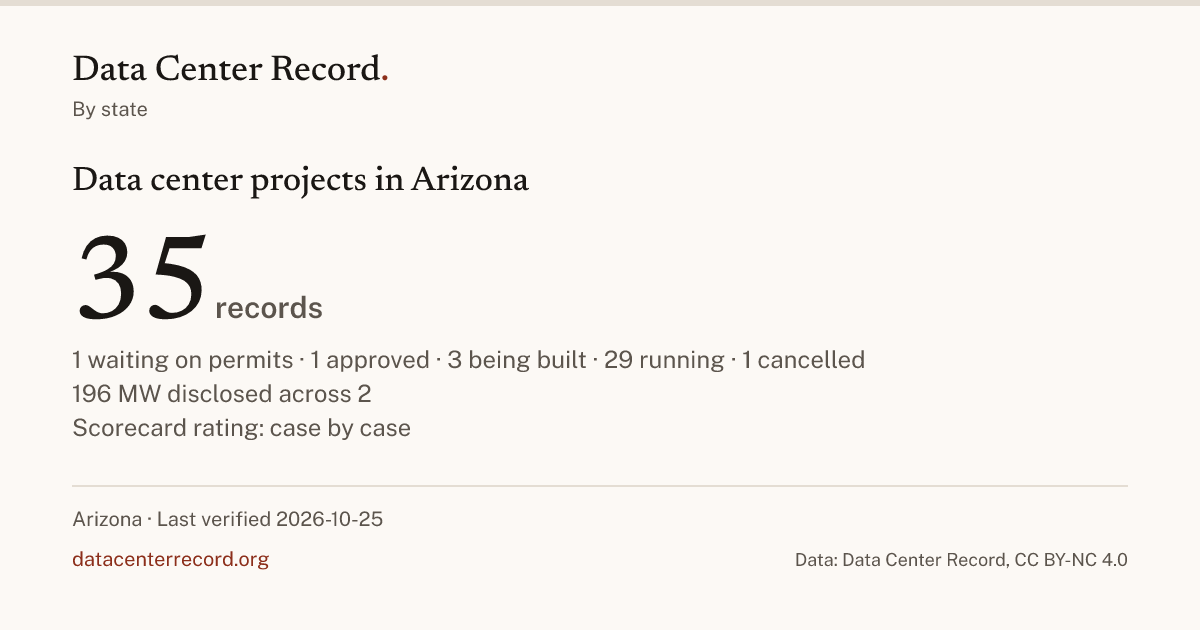
Arizona decides case by case. From the state's own rule: Arizona Corporation Commission approved an Energy Supply Agreement between Tucson Electric Power and the developers of Project Blue, December 10, 2025.
State register coverage: Arizona's air permit, parcel, utility, water, and operator registers name 35 facilities; 35 are on the record (88 buildings where disclosed), and 0 sit not yet verified.
How to read this page. Every count comes from the records on this page and links to where it is counted. Nothing is published until a person reads its source, and a figure no source gives reads Not disclosed; nothing is estimated. A rating changes only when a person sets it.
A blank cell means not disclosed by any source on file. Power is the developer's figure or a permit's, each linked on the record. All 35 Arizona projects.
Every Arizona record35 records · sort by any column · blank cell: not disclosed
Tier 1: an official or company source. Tier 2: a news report resolving to the outlet's own page. Located: a site coordinate from a permit, a parcel or an address, or the county or town centroid. Verified: the last day a person read the source. A blank cell means not disclosed by any source on file.
Every Arizona county (15)
2 of 15 counties have a record. A county without one is listed, not linked, until its first published record.
A blank rating cell means no person has set one for the county. A county without a record is listed, not linked.
The rules in Arizona10 rows · rating rests only on a binding act in force
What the state and its counties and cities have decided. Each row is rated by what it has decided, open, case by case, restrictive or closed, never by whether that is good or bad.
Arizona Corporation Commission approved an Energy Supply Agreement between Tucson Electric Power and the developers of Project Blue.news.azpm.org (opens in a new tab)local outlet · Dec 10, 2025 · 15 acts on this rowEvery act on the Arizona row
event
Corporation Commissioner Kevin Thompson demanded APS communications regarding a news investigation into data center energy costs.
Arizona lawmakers introduced Senate Bills 1463 and 1467 and House Bill 2820 to repeal tax breaks for data centers by eliminating the state's data center certification program.
Glendale Commission recommended rezoning for a data center plan.linkedin.com (opens in a new tab)social media · Sep 28 · 1 act on this rowEvery act on the Glendale row
statement
Glendale Commission recommended rezoning for a data center plan.
The modernized ordinance updated how the county defines a data center and restricts them to industrial areas.kjzz.org (opens in a new tab)local outlet · Dec 11, 2025 · 3 acts on this rowEvery act on the Maricopa County row
ordinance
Maricopa County adopted a new ordinance clarifying guidelines for data center development
Mesa City Council unanimously approved data center amendments on July 8, 2025, with two members absent.themesatribune.com (opens in a new tab)local outlet · Jul 8, 2025 · 2 acts on this rowEvery act on the Mesa row
event
Mesa City Council unanimously approved data center amendments on July 8, 2025, with two members absent
On Aug. 26, Pima County Board of Health passed unanimous motion advising supervisors to adopt the 120 day moratorium to prevent irrevocable public harm.tucson.com (opens in a new tab)local outlet · Aug 26, 2026 · 15 acts on this rowEvery act on the Pima County row
moratorium adopted
Pima County has imposed a 120 day moratorium on new data center development
Pima County Supervisors approved a 120 day data center moratorium with a 3-2 vote on Tuesday (September 23, 2026), with Supervisors Steve Christy and Rex Scott opposing.
Pima County Board of Supervisors voted Tuesday to approve a temporary moratorium on data center development in unincorporated parts of the county for 120 days
Pima County proposed zoning code changes (Title 18) to define data centers, establish formal development review process, and set design and development standards including noise studies, mitigation plans, and Conservation Lands System compliance.
Pima County expanded environmental review policy to include large water and electricity users, defining large water users as those estimating use of 10,000 centum cubic feet or above
On Aug. 26, Pima County Board of Health passed unanimous motion advising supervisors to adopt the 120 day moratorium to prevent irrevocable public harm.
Pinal County Board of Supervisors voted 4-1 against rezoning land for Vermaland data center project south of Eloy.azfamily.com (opens in a new tab)local outlet · Aug 26, 2026 · 3 acts on this rowEvery act on the Pinal County row
denial
Pinal County rejected a controversial data center project near Eloy.
Tucson City Council approved strict data center zoning rules in a 6-1 vote on August 8, 2026.tucson.com (opens in a new tab)local outlet · Aug 8 · 1 act on this rowEvery act on the Tucson row
ordinance
Tucson City Council approved strict data center zoning rules in a 6-1 vote on August 8, 2026
Reported: the source's date; the item names no day of its own. A month with no day: the source names the month and not the day. A rating rests only on a binding act in force; "not rated" means no person has set one. A blank cell means the record holds nothing for it.
18 bills tracked in the Arizona legislature, 4 of them signed into law, grouped by where each stands. A row opens its own page; the Arizona laws page has what each law requires.
No official summary on file for any of these 9 measures; each row links to the legislature's page for the text.
Fifty-second Legislature - Second Regular Session (2016)
Signed
2016-05-19
Data center tax relief; qualification
18 bills tracked in Arizona; Fifty-seventh Legislature - Second Regular Session (2026), legislature adjourned; last checked October 26, 2026. The last check found: 14 bills matched the watch terms as of October 26, 2026. Search terms: data center, data centre, large load, hyperscale, computing facility, server farm, high load factor (indirect), energy intensive facility (indirect), large electric load (indirect), digital asset mining (indirect), cryptocurrency mining (indirect), qualified technology facility (indirect), colocation (indirect), moratorium (with another term), sales tax exemption (with another term). The search on LegiScan. (opens in a new tab)
H.R. 9340, Ratepayer Protection Act: U.S. House of Representatives, roll call 312, September 16, 2026. On Motion to Suspend the Rules and Pass, as Amended. Passed, 417 to 3. Arizona's members: 8 yea, 0 nay, 1 present or not voting. How each member voted
Member
Party
Position
Ansari
D
Yea
Biggs (AZ)
R
Not Voting
Ciscomani
R
Yea
Crane
R
Yea
Gosar
R
Yea
Grijalva
D
Yea
Hamadeh (AZ)
R
Yea
Schweikert
R
Yea
Stanton
D
Yea
A blank party cell means the clerk's roll gives none.
H.R. 9340, Ratepayer Protection Act: U.S. Senate, roll call 254, September 30, 2026. On Cloture on the Motion to Proceed H.R. 9340. Cloture on the Motion to Proceed Rejected, 57 to 43. Arizona's members: 0 yea, 2 nay. How each member voted
Member
Party
Position
Gallego (D-AZ)
D
Nay
Kelly (D-AZ)
D
Nay
A blank party cell means the clerk's roll gives none.
Last year data center customers were about 5 percent of our peak load, and this year we think that they're about 7 percent of our peak load. So this is something that is changing incrementally year over year.
Warren Petersen, Senate President, said a moratorium is not needed and that data centers need to generate their own power and be responsible for their water.
129 more on this page, one per speaker and claim; 141 statements in all
"That's roughly 500 megawatts more than where we were before. And you can attribute a decent chunk of that increase, which, by the way, was about a 2 percent increase from year to year, to larger loads like data centers."
Nez said any economic development venture should start with local leaders being transparent with their constituents, and expressed concern about undisclosed data center negotiations.
Nez said Page held primary elections where local leaders pursuing a data center were not transparent and were removed from office by voters in opposition.
Dr. Amish Shah acknowledges the economic role of AI and technology but argues against constructing data centers in CD1, citing constituent concerns over water usage, high energy consumption, noise, and traffic.
Mayes said she is working on a plan for a new approval process that would allow communities to vote on data center projects and create a commission to review proposed data centers.
Sarah Porter, director of the Kyl Center for Water Policy at Arizona State University, said water consumption varies significantly depending on the design and operational needs of each site.
data centers alone are unlikely to destabilize Arizona's long term supply, provided strict local oversight and advanced conservation planning remain front and center
Sarah Porter, director of the Kyl Center for Water Policy at Arizona State University KOLD (opens in a new tab)local outlet
Context & source notes
Provenance: Paraphrased; said in the source itself.
Supervisor Jenn Allen said the moratorium would help ensure the county studies impacts including air quality and emissions, water use and water stress, land use and green space, cumulative impacts and community vulnerability, light pollution, construction related dust
Supervisor Andres Cano stated that Pima County Health Department has raised serious questions about how data centers might impact the county's water supply, air quality, heat, noise, energy, and health.
Greg Stanton led Sens. Mark Kelly and Ruben Gallego and Reps. Yassamin Ansari and Adelita Grijalva in pressing Interior Secretary Doug Burgum for answers on data center proposals on federal public land
Mark Kelly, Arizona Senator, plans to introduce legislation creating a fund that AI companies would pay into to support workers displaced by technology
Councilmember Matt Bullock said there are different types of data centers that require varying considerations and a special use permit would let the council differentiate between them on a case by case basis
Sarah Porter says water use reporting for industrial cooling in Arizona is not detailed enough to determine specific quantities for data center cooling
In Arizona, data center developers and major tech companies have been eager to talk to ASU's research team about their water use and understand community concerns
Tom Sullivan, COO of Air2O, says Arizona data centers have switched from open loop or evaporative cooling systems to closed loop cooling, where a fresh water glycol mixture is constantly recycled
Closed loop cooling systems dramatically cut data centers' water use compared to open loop or evaporative systems, but are about 33% more energy intensive
Jay Feely, GOP congressional candidate for Arizona's 1st Congressional District, received $600,000 from Leading the Future, a pro AI Super PAC, in June 2026.
David Ebert, U of A Chief AI and Data Science Officer, states data centers' design and energy and water efficiency can be improved through technological innovation
A majority of Arizona voters, regardless of party, support limiting data center development, citing concerns about water use, electricity demand, and infrastructure costs
In the two or three weeks leading up to July 1 when moratorium went into effect, there were nearly as many applications for sales tax exemption as in entire 13 years of that exemption being in place.
Attorney General Kris Mayes became the first statewide elected official to call for a moratorium on data centers in Arizona on August 31, citing public concerns about water usage and electricity demand
Cynthia Zwick, director of the Residential Utility Consumer Office, attributed backlash to a lack of community engagement from data center developers, utility companies and elected officials
Dr. Theresa Cullen, director of the Pima County Health Department, said she found almost no established guidance from other large local health departments in the Big City Health Coalition on how to assess data center projects
Courtney Coolidge, Arizona Chamber Executive Vice President, said moratorium supporters should be willing to give up modern conveniences if willing to call for data center moratorium
Courtney Coolidge said Arizona should have serious conversations about where data centers are located, how they are developed, and what responsible growth looks like, rather than a blanket moratorium
Mayes argued proposed rate increases from Arizona Public Service Co. and Tucson Electric Power Co. stem partially from need for more infrastructure to serve data centers
Adam Baugh, partner at Withey Morris Baugh PLC, stated the entitlement process for new data centers in Phoenix and neighboring cities is infinitely harder today than a year ago
Indivisible leaders claimed they are not given equal speaking time compared to council supporters and data center project no longer appears on public agendas
Newkirk also told Thakker that he supports a moratorium on new artificial intelligence data centers, an arms embargo against Israel, and replacing House Democratic Leader Hakeem Jeffries.
Nathan Taylor Taft, Mesa High School student and co director of East Valley Unite, urged Mesa City Council on June 8 to reject the proposed NTT data center
Arizona utilities traditionally schedule maintenance during periods of lower demand, such as winter months, but continuous demand from large load facilities can limit these windows
Google, Meta, Microsoft, OpenAI, xAI, Oracle and Amazon Web Services signed a ratepayer protection pledge committing to ensure data center growth will not drive up consumer energy costs
Bill Jabjiniak, EdgeCore senior vice president of national community and government relations, stated SRP sought to expand infrastructure to help meet rising regional energy demand
The LeChee Chapter of the Navajo Nation passed a resolution in February 2026 opposing the data center sale and stating they were not consulted about impacts
All 15 noted data centers are in southeast Mesa, predominantly along the Elliot Road Technology Corridor, which stretches 5 miles between Signal Butte and Hawes roads
Jay Irvin of the Butler Design Group said 400 foot setback was outside the standards for setbacks for other types of industrial buildings which range from 15 to 30 feet
"These renewable energy centers will generate low-cost, homegrown energy and provide millions of dollars in additional revenue to both Maricopa and Pinal counties over the life of the projects"
Landon Marston, lead author of a Virginia Tech paper, stated researchers are unsure about the degree to which environmental considerations are in data center siting decisions
Venkatesh Uddameri, professor and director of the Water Resources Center at Texas Tech University, stated the typical data center uses about 3-5 million gallons of water per day, equivalent to the water use of a city of 30,000-50,000 people
Sergio Loureiro, vice president of core operations for Microsoft, said the company has pledged to be water positive by 2030, meaning it plans to replenish more water than it consumes globally
Gary Demasi, senior director of energy and location operations at Google, said the company is working to utilize water more efficiently and exploring ways to incorporate circularity
Jobs created would average at least $65,000 annually in positions such as systems administrators, technicians, facilities employees and support services
On federal matters, filed on the federal page; not counted among Arizona's statements.
Mark Kelly, Arizona Senator: Mark Kelly plans to introduce legislation creating a fund that AI companies would pay into to support workers affected by job loss from technology. (September 21, 2026)
Already running in Arizona
29 sites are serving load, 29 of them in Maricopa County.
A blank cell means no record in Arizona disclosed the figure. Third party figures on the same metrics are listed apart below; a figure a project disclosed about itself is never mixed with them.
Figure
Disclosed total
Disclosed
Without a figure
Basis
Power
196 MW
2
33
2 the developer's figure
Water, stated per day
0
35
Water, stated per year
0
35
Permanent jobs
0
35
Tax each year
0
35
A blank total means no record disclosed the figure; the count without one says how many.
Summed only where a record disclosed the figure; a record with no figure adds nothing and is counted as not disclosed. Water is summed per day and per year separately, as the sources stated it, and never converted. A tax claim given as a range is summed at both ends.
The disclosed totals are in the table above.
No source on file states what any of the 35 tracked facilities in Arizona are for.
What each use disclosed
Use
Records
Power
Water
Jobs
Tax each year
No stated use
35
196 MW
A blank cell means no record with that use disclosed the figure.
A record that lists several uses counts once under each. Each cell is the sum over the records with that use, disclosed rows only.
Method
Facilities
Share of facilities
Air cooled
1
3%
Closed loop liquid
2
6%
No stated cooling type
32
91%
35 facilities in Arizona. A facility carries one cooling method; nothing here is estimated.
Sources read for Arizona
22 sources
22 sources are read for Arizona:
Newspapers
Arizona Daily Star
Public broadcaster
KJZZ
Search feeds
20 news searches
Every feed, with its kind and tier
What the monitor reads for Arizona: feeds every four hours, pages daily.
FiguresOnly what a source states, with its basis. Nothing is estimated, and a figure no source gives reads not disclosed.
LicenseData CC BY-NC 4.0 (opens in a new tab); free for personal, academic, civic and newsroom reporting with attribution. Commercial, enterprise, financial or AI training use needs a commercial license. Prose stays under copyright.
Cite this pageData Center Record, "Data centers in Arizona", https://datacenterrecord.org/states/az, updated October 26, 2026.CSV · JSON · GeoJSON
Data Center Record, "Data center records in Arizona", https://datacenterrecord.org/states/az. Data: Data Center Record, datacenterrecord.org, CC BY-NC 4.0.
The structured rows are CC BY-NC 4.0. Link to this page; that is what turns a reuse into a citation. Prose stays under copyright.
waiting on permits 1, approved 1, being built 3, running 29, cancelled 1
Located records
35 located, 0 at a centroid, 0 without coordinates
Researcher view · Arizona · 35 data center sites, 88 buildings where disclosed, 10 rule rows, 18 bills · basis and source tier on every row · verified October 26, 2026