States · Federal
United States (federal)
Congress, the federal agencies, the federal courts and the executive, as the record has them
The federal record at a glance
Newest federal event Scorecard event: The Senate rejected cloture on the motion to proceed to H.R. 9340, the Ratepayer Protection Act, 57 to 43; three fifths were required., . senate.gov primary source
Bills in Congress 62 bills tracked, 7 past at least one chamber, 5 signed into law.
Roll calls U.S. Senate, roll call 254: Cloture on the Motion to Proceed Rejected, 57 to 43, September 30, 2026. U.S. House of Representatives, roll call 312: Passed, 417 to 3, September 16, 2026.
Agencies 14 acts naming Environmental Protection Agency, Federal Energy Regulatory Commission, Bureau of Land Management, Department of the Interior and The White House.
Federal laws 5 bills signed into law, no rule row saying what an act requires yet. A federal act moves no state's rating.
Last verified .
Timeline
44 dated acts, newest September 30, 2026
Reported: the source's date; the item names no day of its own. A month with no day: the source names the month and not the day.
- United States (federal)national
Federal actions are recorded here with no rating: federal action does not set permitting posture in any jurisdiction, and a state row moves only when the state itself acts.
- event
The Senate rejected cloture on the motion to proceed to H.R. 9340, the Ratepayer Protection Act, 57 to 43; three fifths were required.
- filing
Representatives Tom Barrett, Greg Landsman and Jamie Raskin introduced the No Secrets for Data Centers Act, which would prohibit government officials from using non disclosure agreements to hide details of data center projects from the public and block data center operators from receiving government incentives if those deals require confidentiality
- event
Rep. Dina Titus introduced a bill to prevent BLM right of way changes for data centers without a separate environmental review.
- event
Stop Data Centers Coalition formed to unite local fights against data centers across the country
- event
Trump administration removes emissions restrictions on power plants
- rate rule
A House passed bill would push state regulators to consider making large data centers cover added grid costs from their expansion.
- rate rule
Congress nearly unanimously passed the Ratepayer Protection Act sponsored by Colorado Republican Rep. Gabe Evans to protect consumers from data center owners from passing utility costs onto them
- filing
Sen. Martin Heinrich introduced the GRID Savings Act as an alternative to the Ratepayer Protection Act, seeking stricter data center energy protections
- event
Heinrich proposed GRID Savings Act to require large electricity consumers like data centers to pay for necessary grid upgrades
- event
Ratepayer Protection Act stalled in the Senate on September 17, 2026 amid Democratic opposition.
Also reported by 1 source
- upriseri.com local outlet
- event
Sen. Martin Heinrich blocked the Ratepayer Protection Act on September 17, 2026
- event
Senate blocked unanimous consent for the bill on September 17, 2026
Also reported by 4 sources
- wflaorlando.iheart.com local outlet
- finance.biggo.com local outlet
- linkedin.com local outlet
- usatoday.com national outlet
- rate rule
House passed a bill requiring state utility commissions to evaluate rules forcing data center operators to pay for electric grid infrastructure upgrades
- event
Sen. Josh Hawley introduced No Tax Breaks for Data Centers Act on Thursday
- event
The House of Representatives passed H.R. 9430 with a 417-3 vote and the bill moved to the Senate for consideration.
- event
House Energy and Commerce Committee approved bill June by vote 52-0; amendment defined large load customers explicitly as data centers
- event
House bill passed 417-3, sponsored by Rep. Gabe Evans (R Colorado) with Rep. Kathy Castor (D Florida)
- event
House passed bipartisan bill requiring AI data centers to cover more energy infrastructure costs to help protect consumers from rising utility bills
Also reported by 1 source
- kjrh.com local outlet
- event
The bill amends the Public Utility Regulatory Policies Act (PURPA) to require states to consider a federal standard that large data centers pay for their own grid infrastructure costs.
- event
H.R. 9340 Ratepayer Protection Act passed the U.S. House 417-3 on September 16, 2026
Also reported by 25 sources
- utilitydive.com trade press
- dailysignal.com national outlet
- san.com local outlet
- france24.com local outlet
- investing.com local outlet
- cbsnews.com national outlet
- usatoday.com national outlet
- finance.biggo.com local outlet
- rocklandnews.com local outlet
- thenevadaglobe.com local outlet
- spectrumnews1.com local outlet
- deseret.com local outlet
- coloradopolitics.com local outlet
- yellowhammernews.com local outlet
- wflaorlando.iheart.com local outlet
- nypost.com national outlet
- flvoicenews.com local outlet
- nbcnews.com national outlet
- riverreporter.com local outlet
- weku.org local outlet
- yahoo.com national outlet
- upriseri.com local outlet
- cnbc.com national outlet
- vtcng.com local outlet
- investors.com national outlet
- rate rule
U.S. House voted 417-3 on Sept. 16 to approve the bipartisan Ratepayer Protection Act, requiring state utility regulators to consider standards for data centers with peak demand of at least 100 megawatts to pay full incremental costs of electric infrastructure.
Also reported by 2 sources
- moorenews.com local outlet
- The Center Square local outlet
- filing
Kathy Castor introduced the Ratepayers Protection Act (HR 9340) requiring utility regulators to establish rules that demand large load customers cover the increased costs of power generation and transmission
- rate rule
House passed bill requiring state utility regulators to consider a standard by which utilities charge data centers for the full cost of the new power and transmission upgrades needed to serve them, by vote of 417-3.
Also reported by 2 sources
- coloradosun.com local outlet
- rollcall.com local outlet
- event
GOP Representatives David Valadao, Jen Kiggans, Mónica de la Cruz, Bill Huizenga and Tom Barrett signed on to bill since September 1
- event
Bill introduced by Democratic Representative Kathy Castor of Florida and Republican Representative Gabe Evans of Colorado
- event
EPA proposed change would let developers start building data centers before permits are approved
Also reported by 1 source
- motherjones.com national outlet
- event
Trump administration directed Environmental Protection Agency to stop publicizing or seeking public input on data center construction projects
- moratorium
More than ten states paused or canceled data center tax exemptions
- event
Rep. Suhas Subramanyam introduced a package of four bills setting national requirements for data center development
Also reported by 1 source
- insidenova.com local outlet
- litigation
U.S. District Judge Lee Rudofsky denied Entergy Arkansas request for temporary restraining order on September 4, 2026
- litigation
Administrative judge with Interior Board of Land Appeals issued stay on September 1, 2026 halting Townsite Data Center construction
- event
PJM's first Critical Issue Fast Path process for large loads produced 12 proposals, all of which were voted down
- event
Trump issued an Executive Order on August 26, 2026, restricting foreign produced bulk power system electrical equipment
- filing
PJM Interconnection filed proposal with Federal Energy Regulatory Commission on August 13, 2026, for conditional reliability framework for major new electricity users including data centers
- filing
Sen. Martin Heinrich, D N.M., introduced the GRID Savings Act last month aimed at protecting ratepayers from data center costs
- filing
PJM filed a Reliability Backstop Procurement proposal with FERC on July 31
- filing
17 environmental organizations submitted letter to EPA in July to reject Chemours application to fast track Opteon 2P50 PFAS chemical for data center cooling
- event
H.R. 9340 advanced through the House Energy and Commerce Committee by a unanimous vote of 52-0 in July 2026
- event
Ratepayer Protection Act passed House Energy and Commerce Committee unanimously in July
Also reported by 1 source
- usatoday.com national outlet
- rate rule
FERC issued show cause orders in June 2026 to regional transmission organizations and independent system operators to propose pro forma cost recovery agreements for large loads, with responses due by mid November.
- approval
BLM approved data center change in June 2026 without project specific environmental review
- event
Trump revoked Biden administration executive order on AI oversight and provided his own order in June 2026
- moratorium
Sanders and Ocasio Cortez introduced moratorium on data center construction in March
- statement
President Trump's Ratepayer Protection Pledge signed by nearly 200 utilities and AI companies in March
- event
On the Daily Record with no state
- October 5, 2026 news item
Former UK power station site could become data center campus Fawley Waterside Limited proposed an industrial and digital campus at the former Fawley Power Station outside Southampton, with data center development among potential uses.
- September 30, 2026 news item
Balearic Islands launches new data center for critical government systems Government of the Balearic Islands launched a new Tier III equivalent data center in Palma, Mallorca, integrated with Sant Pere facility for redundancy of critical government systems.
- September 30, 2026 news item
NxN enters Portugal with 1MW data center and plans to invest €100m NxN Data Centers acquired an operational 1MW data center in Évora, Portugal, and announced plans to invest up to €100 million in Portuguese market expansion over three years.
- September 30, 2026 news item
BrightRay plans 40MW data center in Macau BrightRay plans 40MW data center in Macau with delivery expected third quarter 2027; BUUU Group acquiring majority stake.
- September 30, 2026 news item
Australia's CDC plans gigawatt scale data center campus in Wagga Wagga CDC Data Centres plans gigawatt scale campus with up to four buildings totaling 1.4GW in Wagga Wagga, New South Wales.
- September 30, 2026 news item
Finland to abandon first come, first served grid connections, dropping data centers down the queue Finland proposes new grid connection priority system that drops large data centers down the queue in favor of smaller consumers.
- September 29, 2026 news item
Meta signs on to use AI capacity at Firmus' Southeast Asia data centers Meta signs capacity agreement to lease AI compute from Firmus' Southeast Asia data center deployments in Batam Indonesia and Malaysia, building on existing Melbourne partnership.
- September 29, 2026 news item
Google receives planning permission to expand data center in Dublin, Ireland Google receives approval from Ireland's planning appeals body to expand its Dublin data center with 72,400 sqm building, third on Grange Castle campus, ending lengthy dispute over grid capacity and renewable power.
- September 29, 2026 news item
Global Switch to host large Nvidia Blackwell deployment at Paris data center Global Switch selected to host one of Europe's largest Nvidia Blackwell GPU clusters at its Paris data center, mostly liquid cooled; 100 percent renewable powered with waste heat offtake beginning 2027.
- September 29, 2026 news item
Schneider gives datacenter switchgear the software defined treatment Schneider Electric pilots software defined medium voltage switchgear with Equinix, promising faster datacenter construction and remote updates without downtime.
- September 29, 2026 news item
Lefdal Mine acquires data center development site in Norway Lefdal Mine acquires Titan Group site in Moskog, Vestland County, Norway, planning €938 million data center expansion.
- September 29, 2026 news item
Samsung invests $1bn into KKR's Helix data center platform Samsung invests $1 billion into KKR's Helix data center platform, bringing total capital raised to over $10 billion.
- September 28, 2026 news item
Europe's data center efficiency labeling scheme needs nuance, industry leaders warn European data center associations welcome but urge caution on EU efficiency labeling scheme for facilities over 500kW.
- September 28, 2026 news item
Open source datacenters and open source thinking will undo self inflicted DC damage Columnist argues data center industry must adopt open source thinking, disclose energy data, and pursue marine cooling instead of orbital facilities.
- September 25, 2026 news item
Project Suncatcher: Google to launch first space data center test in orbit next week Google launches Project Suncatcher orbital data center test on October 1, placing four TPUs in space to evaluate performance and thermal management for future satellite compute clusters.
- September 24, 2026 news item
Low Frequency Noise and Data Centers: What to Know Industry article describes infrasound in data centers, its sources, measurement, and mitigation strategies for operators.
- September 24, 2026 news item
Woodway to build 22 mile gas pipeline for undisclosed data center in US Woodway Energy Infrastructure to build 22 mile natural gas pipeline for undisclosed behind the meter data center in the US.
- September 24, 2026 news item
Australia’s data center guidelines lay the platform for new good grid citizens Australia released mandatory guidelines for data center developments requiring renewable energy, demand response capability, and grid support services.
- September 22, 2026 news item
How Communities Can Plan for AI Data Centers Before the Projects Arrive OIX board member Ilissa Miller says communities should integrate data centers into long range land use planning to reduce conflict with developers.
- September 22, 2026 news item
Alibaba Cloud plans six year stroll to 20GW of datacenters, reveals chip to power them Alibaba Cloud CEO announces plan to expand datacenter fleet to 20GW capacity over six years and reveals Zhenwu V900 AI chip.
- September 21, 2026 news item
Enterprises Adopt Colocation for AI and Hybrid Cloud Initiatives Industry commentary reports enterprises increasingly adopt colocation data centers for AI inference, hybrid cloud, capacity, and cost reduction.
- September 21, 2026 news item
LG launches centrifugal air cooling system for AI data centers LG launches oil free, centrifugal air cooled chiller system for AI data centers, claiming it uses up to 30 percent less energy than traditional free cooling systems.
- September 20, 2026 news item
Pricing future megawatts: the growing role of earnouts in data center M&A Data center M&A deals increasingly use earnouts to price future megawatts of capacity not yet delivered.
- September 18, 2026 news item
Sponsored: Retrofitting existing data centers for AI: Two practical paths to liquid cooling BEEHE Electric explains retrofit strategies for introducing liquid cooling into existing air cooled data centers facing AI workload densities.
- September 18, 2026 news item
Space Data Centers Inch Toward Reality, With Caveats Executives at AI Infra Summit said orbital data centers face thermal, bandwidth, and launch cost obstacles; launch costs must drop to $200-500 per kilogram for viability.
- September 18, 2026 news item
Gazprom partners with Crypto Energy to deploy modular data center at gas field in Siberia - report Gazprom and Crypto Energy plan a modular data center at a depleted Siberian gas field powered by residual natural gas, a pilot project to use low pressure reserves.
- September 18, 2026 news item
PGIM sells data center development site in Munich PGIM sells 30MW data center development site in Greater Munich with building permit and regulatory approvals to unnamed European infrastructure investor.
- September 18, 2026 news item
DCD Intelligence: Data center expansion is outpacing talent DCD Intelligence survey finds data center expansion outpacing talent, with more than two thirds of operators reporting staffing below requirements.
- September 18, 2026 news item
Brazil's Eveo plans data center in Recife Eveo plans new Tier III data center in Recife, Pernambuco, to serve Northeast Brazil region with latency sensitive applications.
- September 18, 2026 news item
Brazil's President Lula signs ReData data center bill into law Brazil President Lula signs ReData tax incentive bill into law on September 15, establishing special taxation regime for data center services with benefits for five years.
- September 18, 2026 news item
Asp Data Center secures NOK1.6bn to fund data center project in Stavanger, Norway Asp Data Center secured 1.6 billion Norwegian Krone in bonds to fund K11 data center in Stavanger, Norway and refinance existing debt.
- September 17, 2026 news item
Delivery Certainty Will Define the Next Phase of Data Center Growth Industry analyst argues delivery capability in power, labor, and supply chain will determine which AI data center projects advance from announcement to completion.
- September 17, 2026 news item
From Announcements to Delivery: What Separates Real AI Data Center Projects From the Rest Industry experts at DCFTS 2026 discussed how successful AI data center projects require verified power delivery, regulatory approvals and community support, not just capacity announcements.
- September 17, 2026 news item
Magnora joins venture for Estonia data center project Magnora acquires 50 percent stake in Risti Kampus data center joint venture in Estonia, planned for 180MW initial phase reaching 400MW.
- September 17, 2026 news item
Google, Nvidia, and Emerald AI found the AI Energy Management Alliance to support demand response capabilities within the data center sector Google, Nvidia, and Emerald AI launched the AI Energy Management Alliance to develop flexible load capabilities in AI data centers.
- September 16, 2026 news item
The Future of Data Centers: Biomimicry and Community Centric Design Microsoft is adopting biomimicry principles for data center development, restoring habitats and engaging communities. The approach is being applied to more than 20 locations in the United States and Germany.
- September 16, 2026 news item
Goodman raises $455m for its Hong Kong data center partnership Goodman Group raised $455 million to fund construction of HKG10 data center in Hong Kong, with first capacity ready in early 2028.
- September 16, 2026 news item
Scotland's parliament backs defacto, temporary, moratorium on new hyperscale data centers Scotland's parliament backs a defacto moratorium on hyperscale data centers over 50MW until new planning guidance is published by end of 2026.
- September 16, 2026 news item
Serverfarm expands North American data center development fund to $3.89 billion Serverfarm expanded its revolving credit facility to $3.89 billion in total commitments, with the funding supporting campus projects in Houston, Clarksville and Atlanta.
- September 15, 2026 news item
The Ripple Effect of Data Center Project Cancellations and Delays Nearly one in five data center interconnection requests do not materialize as real load, according to Capgemini 2026 research, creating stranded utility infrastructure costs.
- September 15, 2026 news item
Scott Bergs, CEO of Kirkwood IG: Fiber and the AI Data Center Buildout Kirkwood Infrastructure Group CEO says fiber must be planned early in AI data center site selection, as hyperscalers increasingly require diverse long distance routes.
- September 15, 2026 news item
What should Britain expect from its next generation of data centers? Deep Green CEO argues UK should prioritize data centers with community benefits, heat recovery, efficiency standards, and sovereign computing capacity.
- September 14, 2026 news item
Datacenter developers want your backyard. FAS says negotiate harder Federation of American Scientists urges local governments to negotiate better terms with data center developers, including tax limits, water use requirements, and decommissioning plans.
- September 14, 2026 news item
The Guardian: 'Tidal wave' of Pfas being launched to satisfy AI industry, campaigners warn ChemSec's survey of the world's ten largest PFAS producers found most plan to expand production, citing demand from AI data center cooling and semiconductor manufacturing
- September 11, 2026 news item
Plans for 120MW data center withdrawn in Lombardy, Italy East Gate withdrew its application for a 120 MW data center in Travagliato, Lombardy, Italy after the municipality did not receive required grid connection data.
- September 11, 2026 news item
Amid data center public backlash, Yvette Eden Ruiz joins OpenAI’s Community Engagement team from JPMorgan OpenAI hires senior executive for community engagement as anti data center sentiment grows ahead of midterms.
- September 10, 2026 news item
Google Blackstone's TPU neocloud named Crux AI, hires Meta's data center engineering head Alan Duong Alan Duong, formerly Meta's VP of data center engineering, joined Crux AI as chief development officer with plans to deliver multiple gigawatts of capacity.
- September 9, 2026 news item
Damac and Vodafone Türkiye triple Izmir data center project budget Damac Digital and Vodafone Turkiye triple Izmir data center investment to 300 million dollars, with capacity reaching 20MW eventually.
- September 9, 2026 news item
Oil leak from data center contaminates water in Bangkok, Thailand Oil leak at Damac Digital data center in Bangkok contaminated 32 cubic meters of water; cleaned up by authorities.
- September 8, 2026 news item
Qualcomm and AWS partner on custom silicon for large-scale AI data centers Qualcomm and AWS partnership to develop custom silicon and optical connectivity for AI data centers, combining AI infrastructure with chip design expertise.
- September 7, 2026 news item
Thailand pauses construction on 49 data centers, as it plans new regulations Thailand suspended construction on 49 data centers and froze approvals for 117 planned facilities due to concerns over power consumption and community impact. Officials plan to develop new regulations within a month.
- September 7, 2026 news item
Ireland weighs cut-price gas for data centers in exchange for curtailment - report Ireland's Commission for Regulation of Utilities proposed offering discounted gas connections to new data centers in exchange for accepting supply curtailment during high demand periods. The proposal is under public consultation and affects 17 planned data centers.
- September 7, 2026 news item
Greenfield and Finsbury Infrastructure to invest €360m in Milan data center UK developer Greenfield and Finsbury Infrastructure announced a strategic partnership to develop a 36MW data center east of Milan, Italy, with a planned investment of up to €360 million over three years. The project has secured 80MW of power capacity.
- September 7, 2026 news item
Humain breaks ground on Neom’s Oxagon data center Humain and DataVolt broke ground on a hyperscale data center at Oxagon in Saudi Arabia's Neom, targeting 1.5GW total capacity with the first 360MW phase expected operational in 2028. The project is powered by renewable energy from Neom's wind and solar assets.
- September 7, 2026 news item
Data center development halted in Masovian Voivodeship, Poland City councillors in Dobre, Poland voted unanimously to remove a planned 90 hectare data center from the municipal development plan for Nowa Wieś. The decision reflects local opposition and represents a stalled or cancelled jurisdiction level action on data center permitting.
- September 6, 2026 news item
Why data center cooling is now business-critical A Global Heat Transfer executive argues that liquid cooling is becoming essential as data centers grow denser and AI workloads increase, with cooling already consuming 30 to 40 percent of facility electricity. The article discusses how heat recovery and thermal fluid management are emerging as critical sustainability and operational efficiency issues.
- September 5, 2026 news item
The role of manufacturing in tomorrow’s data center buildouts A Xometry executive argues that procurement and manufacturing bottlenecks are becoming critical constraints on data center development, as demand outpaces the industry's ability to source custom components at scale. The article identifies design standardization and supplier management as solutions required to support the sector's continued buildout.
- September 4, 2026 news item
PwC Maps $31.6 Trillion AI Data Center Buildout Through 2050 PwC projects global data center capital expenditure of $31.6 trillion through 2050, with annual spending rising from $800 billion in 2026 to $1.8 trillion by 2050.
- September 3, 2026 news item
DataVita files for third data center at campus in North Lanarkshire, Scotland DataVita submitted planning permission for DV4, a third data center at its Chapelhall campus in North Lanarkshire, Scotland, with revised designs after public consultation. The facility will use closed loop cooling, run on 100 percent renewable energy, and explore heat recovery.
- September 2, 2026 news item
Why Data Centers Rarely Reuse Cooling Water Data center cooling water reuse is uncommon because evaporative systems release water as vapor and mineral buildup fouls media.
- September 1, 2026 news item
How Much Water Do Data Centers Use? And Why Does It Matter? The Pacific Institute issue brief by Heather Cooley and Morgan Shimabuku (dated September 2026, no day given, recorded here as the first of the month) compiles facility level water records for 65 data centers from Google and Microsoft sustainability reports and a peer reviewed dataset. Average daily withdrawals calculated from annual records ranged from about 270 gallons to 3.9 million gallons, with a median of about 121,000 gallons a day; the records cover 2024 or 2025 and do not consistently distinguish a single building from a campus. Verified against pages 10 and 11 of the PDF, archived at data/archive/sources/pacific institute-2026 data center water.pdf. Both figures are drafted with withdrawal as the measure, facility as the level and measured as the basis; Approve publishes them.
- September 1, 2026 news item
Data center noise lawsuits test limits of local ordinances Smart Cities Dive counts at least six noise lawsuits against data center operators filed in 2026, in Mount Pleasant, Southaven, Vineland, Dowagiac, North Tonawanda and Hood County, on nuisance and negligence claims, none yet past summary judgment.
- August 31, 2026 news item
Solid-State Transformers Power Next-Gen AI Data Centers Solid state transformers are emerging as key technology to convert grid AC power directly to 800V DC in AI data centers, though maturity concerns remain.
- August 31, 2026 news item
SLB’s $4.1B Kelvion Deal Expands AI Data Center Push SLB acquired thermal management company Kelvion for $4.1 billion to expand data center business as AI drives higher cooling demands.
- August 28, 2026 news item
CBRE: Record Data Center Construction Fails to Ease Capacity Crunch CBRE reports record 7,481 MW of data center construction in H1 2026, with 80.4% preleased and vacancy at 1.4%, indicating tight capacity.
- August 27, 2026 news item
How Data Centers Are Using AI to Run Cooler and Smarter Data center operators deploy AI to optimize cooling, power use, predict maintenance, and improve uptime; full autonomy remains rare.
- August 27, 2026 news item
‘Out of Hyperbole’: Nvidia’s AI Boom Tests Data Center Infrastructure Limits Nvidia reported $89 billion in data center revenue, up 117 percent year over year; AWS plans to deploy 2 million additional GPUs in 2027-2028.
- August 24, 2026 news item
Data Center Construction at Midyear: Demand, Friction, and Building Discipline Data center construction is booming in 2026 but faces challenges with power constraints, workforce shortages, and community opposition.
- August 21, 2026 news item
AI Infrastructure Pushes Data Center Capex Forecast Above $3 Trillion Dell'Oro Group forecast projects global data center capex will exceed $3 trillion by 2030, doubling since January 2026, driven by hyperscaler and AI infrastructure expansion.
- August 19, 2026 news item
Can Large-Load Flexibility Ease Data Center Energy Concerns? Article examines whether large load flexibility could enable data centers to stabilize electrical grids during peak demand periods rather than strain them.
- August 18, 2026 news item
For High-Density AI, Available Data Center Space May Not Be Usable JLL reports only a small share of North America's 1% data center vacancy can support high density AI at 140-160 kW per rack with liquid cooling.
- August 14, 2026 news item
Land Banking Explained: A Novel Strategy for Data Center Expansion Industry article explains data center land banking practice as developers secure future sites ahead of expansions to address rising demand and limited site availability.
- August 13, 2026 news item
The Critical Minerals Crisis: AI Data Centers Face Supply Chain Strain Industry analysis reports copper, lithium, cobalt, and rare earth elements face supply chain pressures as AI data center demand surges; copper shortfall projected at 10 million metric tons by 2040.
- August 12, 2026 news item
Reports: Data Center Expansion Finds Its Contours Industry research shows U.S. data center capacity expected to double in three years with 45 GW planned, driven by AI demand and cloud growth.
- July 31, 2026 news item
The Data Center Industry’s Permission to Build New York imposed a one year pause on environmental approvals for new hyperscale data centers while developing stronger standards. Montgomery County, Maryland voted to pause new data center permits for 18 months to develop comprehensive rules, and the Prince William Digital Gateway project in Virginia collapsed after public opposition.
- July 29, 2026 news item
Meta’s Canadian AI Data Center: A New Model for Infrastructure and Energy Integration Meta broke ground on a C$13 billion AI data center campus in Sturgeon County, Alberta with planned capacity of 1 GW and eventual scaling to 1.8 GW, paired with a dedicated 932 MW natural gas power plant. The project exemplifies a new integrated model combining data center, power generation and infrastructure development.
- July 24, 2026 news item
White House expands pledge to keep electric bills from skyrocketing amid data center boom - WBFF Trump administration announces 200 more utilities, developers, and states joined Ratepayer Protection Pledge to shield customers from data center power cost increases.
- June 15, 2026 news item
FERC Poised to Act on Data Center ANOPR at June Meeting - RTO Insider FERC prepares to rule on advance rulemaking about data center connections to transmission system.
- June 5, 2026 news item
Economist Snapshot: The Rising Cost of Data Center Pushback Urban Land Institute's economist column on the rising cost of local pushback against data center development.
- March 1, 2026 news item
Data Centers and Water Use in the Potomac River Basin The Interstate Commission on the Potomac River Basin's assessment (dated March 2026, no day given, recorded here as the first of the month), part of the 2025 Washington Metropolitan Area Water Supply and Demand Study, puts data centers' onsite consumptive water use in the Washington metropolitan area at about 4 million gallons a day on average in 2025 and about 15 million on the peak day, from utility records linked to facility power capacities with a 75 percent consumptive use factor and estimates where no direct reporting exists. Under baseline assumptions it projects about 22 million a day on average and over 80 million at peak by 2050, with summer demand arriving when river flows are lowest. All four figures are regional totals, consumptive use, estimated. The two jurisdiction events need a rating from you before Approve writes them: the Virginia and Maryland state rows carry no rating yet and this assessment does not set one. Archived at data/archive/sources/icprb-2026 data centers potomac basin.html.
- February 5, 2026 news item
Building a sustainable future for AI: Innovation is transforming data center construction Meta describes the mass timber and low carbon concrete methods it is using in data center construction in several states.
- December 10, 2025 news item
Inside the Multi Billion Dollar Infrastructure Deals Powering America’s AI Boom A roundup of the largest announced AI data center investments across the country, from Amazon's Ohio plan to the Stargate project.
- June 25, 2025 news item
Data Centers and Water Consumption Water use at large data centers can reach 5 million gallons a day, comparable to a town with 10,000 to 50,000 residents, by a published high end estimate rather than measurement.
- April 30, 2025 news item
Using life cycle assessment to drive innovation for sustainable cool clouds A life cycle assessment by authors at Microsoft and WSP found cold plate and immersion cooling reduced blue water consumption by 31 to 52 percent compared with air cooling in the configurations it assessed.
- April 1, 2020 news item
The Secret Cost of Google's Data Centers: Billions of Gallons of Water to Cool Servers Bloomberg reporting in Time on Google's water requests for data centers in Arizona, Texas and South Carolina in 2019.
Bills
62 bills tracked, 7 past a chamber, 5 signed into law
No official summary on file for 6 of these 62 measures; each row links to the legislature's page for the text.
Signed into law 5
FITARA Enhancement Act of 2017
H.R. 3243Signed
What it says and where it is from
FITARA Enhancement Act of 2017 (Sec. 2) This bill repeals the expiration date of (thus making permanent) provisions of the Carl Levin and Howard P. "Buck" McKeon National Defense Authorization Act for Fiscal Year 2015 that require: (1) the Office of Management and Budget (OMB) to make available to the public a list of each major information technology investment made by a covered agency for information technology, including data on cost, schedule, and performance; (2) the Chief Information Officer of each covered agency and the program manager of the investment within the agency to conduct a risk management review of those investments that have received a high risk rating for four consecutive quarters; and (3) the implementation by OMB of a process to assist the covered agencies in reviewing their portfolio of information technology investments. (Sec. 4) The bill amends such Act to extend the Federal Data Center Consolidation Initiative through FY2020. As published by the legislature, found through LegiScan.
National Defense Authorization Act for Fiscal Year 2016
S. 1356Signed
What it says and where it is from
National Defense Authorization Act for Fiscal Year 2016 (Sec. 3) Defines "congressional defense committees" as the House and Senate Armed Services and Appropriations Committees. (Sec. 4) Specifies procedures for determining the budgetary effects of this bill for compliance with the Statutory Pay As You Go (PAYGO) Act of 2010. (Sec. 5) Provides that the explanatory statement regarding this bill that was printed in the Congressional Record has the same effect as a joint explanatory statement of a committee of conference. DIVISION A--DEPARTMENT OF DEFENSE AUTHORIZATIONS TITLE I--PROCUREMENT Subtitle A--Authorization of Appropriations (Sec. 101) Authorizes appropriations to the Department of Defense (DOD) for Procurement at the levels identified in section 4101 of this bill. Subtitle B--Army Programs (Sec. 111) Requires the National Guard to issue guidance that prioritizes UH-60 Blackhawk helicopter upgrades within the Army National Guard to units with the aircraft that have the highest flight hours and utilization rates. (Sec. 112) Requires DOD to submit to Congress a roadmap for replacing A/MH-6 Mission Enhanced Little Bird aircraft to meet the rotary wing, light attack, reconnaissance requirements particular to special operations. (Sec. 113) Requires the Army to submit to Congress a report containing options for accelerating the replacement of all UH-60A helicopters of the Army National Guard. (Sec. 114) Expresses the sense of Congress on tactical wheeled vehicle protection kits. Subtitle C--Navy Programs (Sec. 121) Requires the quarterly report for the U.S.S. John F. Kennedy (CVN-79) to include a description of new design and engineering changes to CVN-78 class aircraft carriers. (Sec. 122) Amends the John Warner National Defense Authorization Act for Fiscal Year 2007 to reduce the limit on the cost of the CVN-78 class aircraft carrier program. Permits a specified increase in the cost cap if the Navy determines that measures required to complete the ship within the revised cost cap will result in an unacceptable reduction to the ship's operational capability. (Sec. 123) Amends the Carl Levin and Howard P. ''Buck'' McKeon National Defense Authorization Act for Fiscal Year 2015 to extend and modify the limitation on funds for the Littoral Combat Ships designated as LCS-25 and LCS-26 until pre existing requirements are met. Requires the Navy to provide Congress with acquisition strategies, a plan to outfit Flight 0 and Flight 0+ Littoral Combat Ships with capabilities identified for the upgraded Littoral Combat Ship, and a current test and evaluation master plan for the Littoral Combat Ship mission modules. (Sec. 124) Amends the National Defense Authorization Act for Fiscal Year 2013 to authorize the Navy to enter into a multiyear contract for a Flight III destroyer, in addition to the existing authority for a Flight IIA destroyer. (Sec. 125) Permits the Navy to enter into a contract beginning in FY2016 for the procurement of one Arleigh Burke class destroyer in addition to the 10 DDG-51s in the FY2013 FY2017 multiyear procurement contract or for one DDG-51 in FY2018. Permits incremental funding to be used. (Sec. 126) Permits the Navy to use incremental funding for the nuclear refueling and complex overhaul of the U.S.S. George Washington (CVN-73). (Sec. 127) Permits the Navy to enter into one or more contracts to procure up to six Fleet Replenishment Oilers. (Sec. 128) Limits the funds that may be used for the U.S.S. John. F. Kennedy (CVN-79) until the Navy submits to Congress: (1) a certification that it will conduct full ship shock trials by the end of FY2017, and (2) specified reports regarding cost issues and requirements, capabilities, and alternatives for aircraft carriers that would replace or supplement the CVN-78 class aircraft carrier. Permits DOD to waive the certification requirement if specified conditions are met. (Sec. 129) Limits the funds that may be used for the U.S.S. Enterprise (CVN-80) until a specified certification and report regarding the design and cost is submitted to Congress. (Sec. 130) Limits the availability of funds for research and development, design, construction, procurement or advanced procurement of materials for the upgraded Littoral Combat Ships (LCS) until the Navy submits specified capabilities assessments, reports, certifications, and plans to Congress. (Sec. 131) Sets forth reporting requirements for the Ohio class replacement submarine program. Subtitle D--Air Force Programs (Sec. 141) Prohibits the Air Force from moving more than 18 A-10 aircraft in the Active Component to backup flying status pursuant to a DOD authorization under the Carl Levin and Howard P. ''Buck'' McKeon National Defense Authorization Act for Fiscal Year 2015. (Sec. 142) Prohibits the retirement of certain A-10 aircraft before December 31, 2016. Requires the Air Force to commission and report to Congress on an assessment of the required capabilities or mission platform to replace the A-10 aircraft. (Sec. 143) Prohibits the retirement of any EC-130H Compass Call aircraft. Requires the Air Force to commission and report to Congress on an assessment of the required capabilities or mission platform to replace the EC-130H Compass Call aircraft. (Sec. 144) Prohibits the Air Force from using FY2016 or FY2017 funds to retire any operational Joint Surveillance Target Attack Radar System (JSTARS), EC-130H Compass Call, or Airborne Early Warning and Control (AWACS) aircraft. (Sec. 145) Limits the use of FY2016 funds for F-35A procurement until DOD certifies to Congress that F-35A aircraft delivered in FY2018 will have full combat capability with currently planned Block 3F hardware, software, and weapons carriage. (Sec. 146) Prohibits the Air Force from using FY2016 or FY2017 funds for retiring any KC-10 aircraft, unless the aircraft is nonoperational because of mishaps, other damage, or being uneconomical to repair. (Sec. 147) Limits the use of funds to transfer any C-130H aircraft from one facility to another, initiate any C-130 manpower authorization adjustments, retire or prepare to retire any C-130H aircraft, or close any C-130H unit until after the Air Force makes a specified certification to Congress. (Sec. 148) Limits the availability of funds to upgrade the executive communications of C-20 and C-37 aircraft until the Air Force certifies to Congress that the upgrades do not cause the aircraft to exceed any weight limitations or reduce operational capability of the aircraft. (Sec. 149) Limits the use of funds for avionics modification to the T-1A Jayhawk aircraft until after the Air Force submits to Congress a required report on options for the modernization or replacement of the T-1A aircraft capability. (Sec.150) Limits the retirement of B-1, B-2, or B-52 bomber aircraft prior to initial operational capability of the long range strike bomber unless DOD includes a notification of the proposed retirement and specified details in the defense budget materials. (Sec. 151) Requires the Air Force to maintain a minimum total active inventory of at least 1,900 fighter aircraft and a total primary mission aircraft inventory (combat coded) of at least 1,100 fighter aircraft. Requires the Air Force to report to Congress in advance of retiring the aircraft. (Sec. 152) Expresses the sense of Congress regarding basing of the F-35A aircraft outside of the continental United States. Subtitle E--Defense wide, Joint, and Multiservice Matters (Sec. 161) Limits the availability of funds for joint battle command platform equipment until after the Army submits to Congress a report providing a test and evaluation plan to address the effectiveness, suitability, and survivability shortfalls identified by the Director of Operational Test and Evaluation in the FY2014 report. (Sec. 162) Requires the Army and the Navy to submit to Congress a report on the plan to modernize small arms for the Army and the Marine Corps. (Sec. 163) Requires DOD to contract with a federally funded research and development center to study the use of different types of enhanced 5.56mm ammunition by the Army and the Marine Corps. TITLE II--RESEARCH, DEVELOPMENT, TEST, AND EVALUATION Subtitle A--Authorization of Appropriations (Sec. 201) Authorizes appropriations for Research, Development, Test, and Evaluation at the levels identified in section 4201 of this bill. Subtitle B--Program Requirements, Restrictions, and Limitations (Sec. 211) Requires DOD to: (1) designate each science and technology reinvention laboratory as a Center for Science, Technology, and Engineering Partnership in the core competencies of the designee, and (2) establish a policy to encourage the Secretary of each military department to reengineer management and business processes and adopt best business and personnel practices at their Centers to serve as recognized leaders in their core competencies. (Sec. 212) Expands DOD's Science, Mathematics, and Research for Transformation (SMART) program, which awards scholarships to students studying science, technology, engineering, and mathematics, to include students from countries which are parties to The Technical Cooperation Program memorandum of understanding of October 24, 1995 (currently the United Kingdom, Australia, New Zealand, and Canada). Limits the number of new foreign students entering the program to five per year. (Sec. 213) Modifies the authority for education partnerships to permit institutions that support technology transition or transfer activities, such as business or law schools with technology management programs, to participate. (Sec. 214) Revises requirements for the Secretary of Defense to promote, monitor, and evaluate programs for the communication and exchange of research, development, and technological data. (Sec. 215) Reauthorizes the Global Research Watch Program, which monitors and analyzes research activities and capabilities of foreign nations in areas of military interest. Expands the focus of the program to include the private sector as a part of the global focus. (Sec. 216) Amends the Ike Skelton National Defense Authorization Act for Fiscal Year 2011 to reauthorize the Rapid Innovation Program to accelerate the fielding of innovative technologies. Requires DOD to ensure that projects are selected using merit based selection procedures and not subject to undue influence by Congress or other federal agencies. (Sec. 217) Requires DOD to: (1) establish a set of science, technology, and innovation activities to improve the acquisition outcomes of major automated information systems through improved performance and reduced developmental and life cycle costs, and (2) conduct a gap analysis to identify activities that are not being pursued in the current science and technology program. (Sec. 218) Requires DOD to establish a technology offset program to build and maintain the military technological superiority of the United States by: (1) accelerating the fielding of offset technologies that would help counter technological advantages of potential adversaries, and (2) developing and implementing new policies and acquisition and business practices. (Sec. 219) Limits the availability of funds for F-15 infrared search and track capability until after DOD reports to Congress on the requirements and cost estimates for the development and procurement of infrared search and track capability for F/A-18 and F-15 aircraft of the Navy and the Air Force. (Sec. 220) Limits the use of U.S. Special Operations Command funds for the Shallow Water Combat Submersible until the Under Secretary of Defense for Acquisition, Technology, and Logistics: (1) designates a civilian official responsible for oversight and assistance for all undersea mobility programs; and (2) submits a report to Congress on the Shallow Water Combat Submersible. (Sec. 221) Limits the availability of funds for advanced development and manufacturing activities under the medical countermeasure program within the Chemical Biological Defense Program until DOD submits a specified report to Congress on the activities. (Sec. 222) Limits the use of funds for the distributed common ground system of the Army until the Army reviews and reports to Congress on the program planning for the system. (Sec. 223) Limits the use of U.S. Special Operations Command funds for the distributed common ground system until a specified report is submitted to Congress. (Sec. 224) Limits funds that the Army may use for the Integrated Personnel and Pay System of the Army until the Army reports to Congress on the performance of legacy systems, changes in human resources organization and financial system capabilities, and alternatives that could reduce the current cost of the system. Subtitle C--Reports and Other Matters (Sec. 231) Amends the National Defense Authorization Act for Fiscal Year 2014 to eliminate the requirements for the Joint Federated Assurance Center to coordinate certain research and development activities with the Center for Assured Software of the National Security Agency and the Defense Microelectronics Activity. (The Joint Federated Assurance Center was established to serve as a joint, department wide federation of existing capabilities to ensure security of DOD software and hardware.) (Sec. 232) Requires the Air Force, the Army, and the Defense Advanced Research Projects Agency to jointly conduct a demonstration of the Persistent Close Air Support (PCAS) capability in FY2016. (Sec. 233) Requires the Secretaries of the military departments and the Secretary of Defense to each develop and submit to Congress a strategy for engagement with historically black colleges and universities and minority serving institutions in the development of scientific, technical, engineering, and mathematics capabilities. (Sec. 234) Requires the Army to submit to Congress a report including the findings of a market survey and assessment of commercial off the shelf wide area surveillance sensors suitable for insertion into Army tactical unmanned aerial systems. (Sec. 235) Requires the Navy and the Air Force to submit to Congress a report on the baseline and alternatives for the Navy's Tactical Air Combat Training System (TCTS) Increment II. (Sec. 236) Requires DOD to submit to Congress and the Government Accountability Office (GAO) to review a report on the Technology Readiness Levels (TRLs) of the technologies and capabilities critical to the long range strike bomber aircraft. (Sec. 237) Requires the Director of Cost Assessment and Program Evaluation to seek to enter into a contract with a federally funded research and development center to conduct a comprehensive assessment of current and future requirements and capabilities of the Army with respect to air land ad hoc, mobile tactical communications and data networks. (Sec. 238) Requires DOD to conduct a hardware assurance study to assess the presence, scope, and effect on DOD operations of counterfeit electronic parts that have passed through the Department supply chain and into fielded systems. (Sec. 239) Requires the Under Secretary of Defense for Acquisition, Technology, and Logistics and the Vice Chairman of the Joint Chiefs of Staff to jointly develop a plan to enable secure and survivable communications between and among fifth- and fourth generation fighter aircraft, and the aircraft that support them, in anti access/area denial environments. (Sec. 240) Requires DOD to submit to Congress a plan for integrating advanced weapons technologies into exercises carried out by the military to improve the development and experimentation of various concepts for employment by the Armed Forces. (Sec. 241) Requires DOD to contract with a federally funded research and development center to conduct an assessment of the F135 engine program. (Sec. 242) Requires the GAO to report on the autonomic logistics information system for the F-35 Lightning II aircraft program. (Sec. 243) Expresses the sense of Congress that DOD should explore using existing authorities for promoting science, technology, engineering, and mathematics programs to allow DOD laboratories and Federally Funded Research and Development Centers to help facilitate and shape a scientific and technical future workforce that can support DOD needs. TITLE III--OPERATION AND MAINTENANCE Subtitle A--Authorization of Appropriations (Sec. 301) Authorizes appropriations for Operation and Maintenance activities at the levels identified in section 4301 of this bill. Subtitle B--Energy and Environment (Sec. 311) Prohibits DOD from making a bulk purchase of a drop in fuel (biofuels that are similar to conventional fuels and may be used with existing vehicles and transportation infrastructure) for operational purposes unless the fully burdened cost of the fuel is cost competitive with a traditional fuel, subject to a national security waiver. (Sec. 312) Establishes Southern Sea Otter Military Readiness Areas at specified offshore islands in the Southern California Bight. Exempts military readiness activities of the Navy from specified environmental laws pertaining to the southern sea otter in the Areas. Requires the Navy to monitor and report to Congress on the effects of military readiness activities on the southern otter population in the Areas. (Sec. 313) Amends energy management reporting requirements to eliminate requirements for reporting of renewable energy credits and revise electricity outage reporting requirements to include non commercial utility outages and DOD owned infrastructure. (Sec. 314) Revises the scope of required DOD reviews of projects related to potential obstructions to aviation to: (1) cover requests for reviews by Indian tribes and landowners, (2) provide that information received from private entities is not publicly releasable, (3) eliminate categories of adverse risk, and (4) limit the applicability of the section to only energy projects. (Sec. 315) Amends the Toxic Substances Control Act to exclude from the definition of "chemical substance" any component of any article subject to the excise tax on firearms and ammunition, limited to shot shells, cartridges, and components of shot shells and cartridges. Subtitle C--Logistics and Sustainment (Sec. 322) Repeals a limitation on the authority of the Air Force to enter into a contract for the sustainment, maintenance, repair, or overhaul of the F117 engine. (Sec. 323) Requires each of the service acquisition executives of the military departments to: (1) initiate a pilot program in FY2016 for product improvement under the authority provided in the National Defense Authorization Act for Fiscal Year 2008, and (2) spend at least $5 million in working capital funds in FY2016 to support the initiative. Subtitle D--Reports (Sec. 331) Revises requirements for the annual report on prepositioned materiel and equipment to require a list of any equipment used in support of contingency operations slated for retrograde and subsequent inclusion in the prepositioned stocks. (Under current law, the list applies specifically to Operation Iraqi Freedom, Operation New Dawn, or Operation Enduring Freedom.) (Sec. 332) Requires DOD to report to Congress on the merger of the Office of the Assistant Secretary of Defense for Operational Energy Plans and the Office of the Deputy Under Secretary of Defense for Installations and Environment. (Sec. 333) Requires DOD to submit to Congress a report on equipment purchased noncompetitively from foreign entities outside of the national technology and industrial base. Subtitle E--Other Matters (Sec. 341) Prohibits DOD from entering into any contract or other agreement under which payments are to be made for activities by the contractor intended to honor members of the Armed Forces at a sporting event. (Sec. 342) Revises the priority order of recipients of adopted military animals and requires the Secretary of the military department concerned to make animals available for adoption under certain circumstances. (Sec. 343) Permits certain contracts or subcontracts entered into under the Armament Retooling and Manufacturing Support (ARMS) Initiative to include an option to extend the term for an additional 25 years. (Sec. 344) Requires DOD to submit to Congress a plan for the improved management and oversight of the systems, processes, and controls involved in the disposal of excess DOD property by the Defense Logistics Agency Disposition Services. (Sec. 345) Limits the use of funds for sponsorship, advertising, or marketing associated with a sports related organization or sporting event until the Under Secretary of Defense for Personnel and Readiness reviews and reports to Congress on current contracts and task orders for sponsorships, advertising, and marketing. (Sec. 346) Requires DOD to: (1) plan and budget for $10 billion in cost savings in its headquarters, administrative and support activities between FY2015 FY2019; (2) include at least a 25% reduction to headquarters activities in the savings; and (3) conduct a comprehensive review of headquarters, administrative, and support functions. TITLE IV--MILITARY PERSONNEL AUTHORIZATIONS Subtitle A--Active Forces (Sec. 401) Authorizes specified end strengths for Active Duty personnel of the Armed Forces. (Sec. 402) Establishes new minimum Active Duty end strengths for the Army, Navy, Marine Corps, and Air Force. Subtitle B--Reserve Forces (Sec. 411) Authorizes specified end strengths for Selected Reserve personnel. (Sec. 412) Authorizes specified end strengths for Reserves on Active Duty in support of the Reserves. (Sec. 413) Authorizes specified end strengths for military technicians (dual status). (Sec. 414) Establishes the maximum end strengths for the Reserve Components of the Army and Air Force for non dual status technicians. (Sec. 415) Authorizes the maximum number of Reserve Component personnel who may be on Active Duty or full time National Guard duty during FY2016 to provide operational support. Subtitle C--Authorization of Appropriations (Sec. 421) Authorizes appropriations for Military Personnel at the levels identified in section 4401 of this bill. (Sec. 422) Requires DOD to submit to Congress a report containing specified assessments, evaluations, and details regarding the force structure of the Army. TITLE V--MILITARY PERSONNEL POLICY Subtitle A--Officer Personnel Policy (Sec. 501) Reinstates the authority for the service secretaries to convene selection boards to consider regular warrant officers on the Active Duty list for involuntary discharge. (Sec. 502) Specifies that if the Secretary of a military department determines that one or more officers were not placed on an all fully qualified list for promotion because of administrative error, the Secretary may prepare a supplemental list for promotion containing the names of the officers. (Sec. 503) Revises the restriction on the number of officers that may be recommended for discharge by a selection board. (Sec. 504) Permits the Secretaries of the military departments to defer, until age 68, the mandatory retirement age of a general or flag officer serving as Chief or Deputy Chief of Chaplains of the Army, Navy, or Air Force. (Sec. 505) Authorizes a service secretary to retire warrant officers in the highest grade in which they served satisfactorily before retirement. (Sec. 506) Implements GAO recommendations on the definition and availability of general and flag officer costs and requires DOD to submit a report to Congress describing the costs. Subtitle B--Reserve Component Management (Sec. 511) Provides that a member of the Ready Reserve who is also a Member of Congress may not be transferred to the Standby Reserve or discharged on account of the individual's position as a Member of Congress unless the transfer or discharge is ordered by the Secretary of Defense or the Secretary of Homeland Security, in the case of the Coast Guard Reserve, based on the needs of the services. (Sec. 512) Provides that the purpose of a Reserve Component special selection board is limited to the correction of errors at a mandatory promotion board. (Sec. 513) Increases from 90 to 180 days the number of continuous days of Active Duty required to be performed by reserve component members for the duty to be considered satisfactory federal service for purposes of unemployment compensation. (Sec. 514) Authorizes the Air Force to use up to 50 Active, Guard, and Reserve members and dual status military technicians to provide pilot instruction training to active duty and foreign military personnel in excess of what is currently authorized. Requires the Air Force to submit to Congress a plan to eliminate pilot instructor shortages within the Air Force. (Sec. 515) Requires DOD submit to Congress an assessment of the Military Compensation and Retirement Modernization Commission's recommendation to consolidate the statutory authorities by which members of the reserve components may be ordered to perform duty. Subtitle C--General Service Authorities (Sec. 521) Authorizes the service secretaries to apply for a correction to military records on behalf of a group of members or former members of the Armed Forces who were similarly harmed by the same error or injustice. (Sec. 522) Provides authority through 2020 for the Secretary of a military department to develop and provide incentives to encourage individuals to accept an appointment as a commissioned officer, accept an appointment as a warrant officer, or enlist in the Armed Forces. (Sec. 523) Amends the Duncan Hunter National Defense Authorization Act of Fiscal Year 2009 to expand the authority to conduct pilot programs on career flexibility to enhance retention of members of the Armed Forces. Removes limitations on the number of participants in the program. (Under the program, officers and enlisted members of the Armed Forces may be inactivated from active duty in order to meet personal or professional needs and returned to active duty at the end of the period of inactivation.) (Sec. 524) Modifies the waiting period and congressional notification requirements for changes in the ground combat exclusion policy for female members of the Armed Forces. Requires DOD to notify Congress at least 30 days before a change is implemented. (Sec. 525) Requires gender neutral occupational standards developed by the Secretaries of the military departments to measure the combat readiness of combat units, including special operations forces. (Sec. 526) Requires DOD to establish a process by which the commander of a military installation in the United States, reserve center, recruiting center, or other defense facility may authorize a member of the Armed Forces assigned to duty at the installation to carry an appropriate firearm on the installation if it is necessary as a personal- or force protection measure. (Sec. 527) Requires the Army to develop a breastfeeding policy for female members of the Army. (Sec. 528) Expresses the sense of Congress that the United States should (1) continue to recognize and promote diversity in the Armed Forces; and (2) honor those from diverse backgrounds and religious traditions who have made sacrifices in serving the United States through the Armed Services. Subtitle D--Military Justice, Including Sexual Assault and Domestic Violence Prevention and Response (Sec. 531) Amends the Uniform Code of Military Justice (UCMJ) to authorize a victim to petition the Court of Criminal Appeals for a writ of mandamus based on an assertion that the victim's rights at an Article 32, UCMJ, investigation were violated or that the victim is subject to an order to submit to a deposition notwithstanding the fact that the victim is available to testify at a court martial. (Sec. 532) Authorizes DOD to provide Special Victims' Counsel (SVC) services to a civilian DOD employee who is the victim of an alleged sex related offense. (Sec. 533) Authorizes the SVC to provide legal consultation and assistance to victims of an alleged sex related offense, in connection with inspector general and equal opportunity complaints, requests under the Freedom of Information Act, and communications with Congress. (Sec. 534) Requires a victim of a sex related offense to be notified of the availability of a Special Victims' Counsel prior to interviewing or requesting a statement from the victim, subject to exceptions for exigent circumstances. (Sec. 535) Requires DOD to develop a policy to standardize the training for Special Victims' Counsel, establish performance measures and standards, and ensure that Special Victims' Counsel are assigned to locations that maximize face to face interactions with clients. (Sec. 536) Provides that federal law protecting the privacy of victims who are servicemembers or adult military dependents and who file restricted reports of sexual assault preempts state laws requiring reporting to a sexual assault response coordinator, a sexual assault victim advocate, or healthcare personnel providing assistance to a victim. Includes an exception if reporting is necessary to prevent or mitigate a serious and imminent threat to the health or safety of an individual. (Sec. 537) Requires DOD to establish the Defense Advisory Committee on Investigation, Prosecution, and Defense of Sexual Assault in the Armed Forces no later than 90 days after enactment of this bill. (Sec. 538) Requires DOD to develop a plan to improve prevention and response to sexual assaults of male members of the Armed Forces. (Sec. 539) Requires DOD to establish a strategy to prevent retaliation against members of the Armed Forces who report or intervene on behalf of sexual assault victims. (Sec. 540) Requires the service secretaries to ensure that the commanders, administrators, and instructors of each unit of the Senior Reserve Officers' Training Corps receive regular sexual assault prevention and response training and education. (Sec. 541) Requires DOD to retain all elements of the case file in investigations of sex related offenses for at least 50 years. (Sec. 542) Requires the GAO to report on policies of the Army National Guard and the Army Reserve regarding sexual assault response and prevention. (Sec. 543) Requires DOD to examine the DOD process for implementing changes to the UCMJ to develop options for streamlining the process and ensure that legal guidance is published when the changes are implemented. (Sec. 544) Modifies the Rules for Courts Martial to prohibit giving a less favorable rating to any member of the Armed Forces serving as a Special Victims' Counsel because of the zeal with which the Counsel represented a victim. (Sec. 545) Authorizes the President to modify Rule 304(c) of the Military Rules of Evidence to conform to the rules governing the admissibility of the corroboration of admissions and confessions in the trial of criminal cases in the U.S. district courts. Subtitle E--Member Education, Training, and Transition (Sec. 551) Amends the National Defense Authorization Act for Fiscal Year 2008 to revise the Yellow Ribbon Reintegration Program to: expand eligibility for the program; add quality of life services to the services that DOD may enter into partnerships to provide under the program; provide flexibility in the number and timing of information, events, and activities under the program; and require the Office for Reintegration Programs to assist in the collection and analysis of best practices regarding suicide prevention. (Sec. 552) Excludes any day on which a member: (1) performed full time training or annual training duty, and (2) attended a school designated as a service school from the calculation of continuous days of Active Duty for the purpose of receiving preseparation counseling. (Sec. 553) Requires DOD and the Department of Homeland Security to permit a member of the Armed Forces eligible for the Transition Assistance Program to receive additional training in preparation for higher education or training, career or technical training, or entrepreneurship. (Sec. 554) Authorizes the Joint Professional Military Education Phase II courses to be taught in residence at or offered through the Joint Forces Staff College or senior level service school designated as a joint professional military education institution. (Sec. 555) Terminates the program to provide educational assistance for reserve component members supporting contingency operations and other operations in four years after the date of enactment of this bill. (Sec. 556) Adds one additional nomination for appointment to each military service academy by each Delegate in Congress from the territories of Guam, American Samoa, the U.S. Virgin Islands, and the Commonwealth of the Northern Mariana Islands. (Sec. 557) Authorizes the Army to enter into certain contracts and agreements with the Army West Point Athletic Association to support the athletic programs of the U.S. Military Academy and sets forth requirements for the agreements. (Sec. 558) Removes the requirement that admission of defense industry civilians to the U.S. Air Force Institute of Technology be on a space available basis as long as the attendance does not require an increase in the size of the faculty, course offerings, or laboratory facilities of the school. (Sec. 559) Requires the Secretaries of the military departments to ensure that professional accreditation programs provided to members of the Armed Services meet recognized national and international standards. (Sec. 560) Provides that individuals receiving Post-9/11 Education Assistance may not also receive unemployment insurance while receiving the post-9/11 education benefit, subject to an exception for individuals who were involuntarily separated from service under honorable conditions. (Sec. 561) Establishes a Job Training and Post Service Placement Executive Committee within the Department of Veterans Affairs Department of Defense Joint Executive Committee to: (1) review policies, procedures, and practices with respect to job training and post service placement programs; and (2) identify changes to improve job training and post service placement. (Sec. 562) Exempts two additional involuntary mobilization duty authorities from the five year limit on reemployment rights: (1) orders of the Army, Navy, Marine Corps, and Air Force Reserve to active duty to respond to a major disaster or emergency; and (2) orders of the Selected Reserve to active duty for preplanned missions in support of the combatant commands. (Sec. 563) Amends the Clay Hunt Suicide Prevention for American Veterans Act to expand outreach for veterans transitioning from Active Duty to inform them about community oriented veteran peer support networks and other available support programs. Subtitle F--Defense Dependents' Education and Military Family Readiness Matters (Sec. 571) Authorizes appropriations to continue DOD assistance to local educational agencies impacted by enrollment of dependent children of military members and DOD civilian employees. (Sec. 572) Authorizes appropriations for impact aid payments for children with disabilities to continue DOD assistance to local educational agencies that benefit eligible dependents with severe disabilities. (Sec. 573) Authorizes the use of appropriations to support student meal programs in domestic defense dependents' schools located outside of the United States. (Sec. 574) Extends the authority for family support programs for immediate family members of members of the Armed Forces assigned to Special Operations Forces and modifies reporting requirements. Subtitle G--Decorations and Awards (Sec. 581) Waives the statutory time limitation to authorize the Army to award the Distinguished Service Cross to Edward G. Halcomb for service in the Korean War. Subtitle H--Miscellaneous Reports and Other Matters (Sec. 591) Authorizes DOD to develop a policy to coordinate the efforts of DOD and non governmental suicide prevention organizations. (Sec. 592) Extends the requirement for semiannual reports on involuntary separation of members of the Armed Forces. (Sec. 593) Requires DOD to report to Congress on the feasibility of conducting preliminary mental health screenings for individuals becoming members of the Armed Forces. (Sec. 594) Requires DOD to report to Congress on new Military Lending Act regulations related to the identification of covered borrowers, including: (1) the ability of the Defense Manpower Data Center to provide the information needed to determine whether a borrower is covered, or (2) an alternate mechanism for identifying covered borrowers. Specifies requirements for Defense Manpower Data Center reports and meetings with private sector users. (Sec. 595) Limits the use of Air Force Operation and Maintenance funds until the Air Force reports to Congress on remotely piloted aircraft career field manning levels and actions that will be taken to rectify personnel shortfalls. TITLE VI--COMPENSATION AND OTHER PERSONNEL BENEFITS Subtitle A--Pay and Allowances (Sec. 601) Freezes the monthly basic pay for all general and flag officers. (Sec. 602) Ends the supplemental subsistence allowance for servicemembers serving inside the United States. (Servicemembers serving outside the United States, the Commonwealth of Puerto Rico, the U.S. Virgin Islands, or Guam would still be eligible to receive the supplemental subsistence allowance from DOD.) (Sec. 603) Permits DOD to reduce the monthly amount of the basic allowance for housing (BAH) by up to the following percentages of the national average for housing for a given pay grade and dependency status: 1% in 2015, 2% 2016, 3% in 2017, 4% in 2018, and 5% for months after 2018. (Sec. 604) Extends the authority of DOD to temporarily increase the rates of basic allowance for housing in areas impacted by natural disasters or experiencing a sudden influx of personnel. (Sec. 605) Permits DOD to obtain information from the Department of Agriculture regarding the number of Supplemental Nutrition Assistance Program (SNAP, formerly known as the food stamp program) applicant households that contain members of the Armed Forces. Subtitle B--Bonuses and Special and Incentive Pays (Sec. 611) Extends certain bonus and special pay authorities for Reserve Forces. (Sec. 612) Extends certain bonus and special pay authorities for health care professionals. (Sec. 613) Extends certain bonus and special pay authorities for nuclear officers. (Sec. 614) Extends the general bonus authority for enlisted members and officers, the special bonus and incentive pay authority for nuclear officers, special aviation incentive pay and bonus authorities, the special health professions incentive pay and bonus authorities, hazardous duty pay, assignment pay or special duty pay, skill incentive pay or the proficiency bonus, the contracting bonus for Senior Reserve Officers' Training Corps cadets and midshipmen, and the retention bonus for members with critical military skills or assigned to high priority units. (Sec. 615) Extends the authority for the aviation officer retention bonus, assignment incentive pay, the reenlistment bonus for active members, the enlistment bonus for active members, the incentive pay for members of precommissioning programs pursuing foreign language proficiency, the accession bonus for new officers in critical skills, the incentive bonus for conversion to military occupational specialty to ease personnel shortage, the incentive bonus for transfer between Armed Forces, and the accession bonus for officer candidates. (Sec. 616) Authorizes the Navy to increase the maximum nuclear officer bonus if necessary to address declining nuclear officer retention and growing retention uncertainty. (Sec. 617) Increases aviation incentive pay for officers performing qualifying flying duty relating to remotely piloted aircraft and makes technical amendments to the aviation pay and bonus authorities. (Sec. 618) Repeals the authority of the Army to pay bonuses to encourage Army personnel to refer persons for enlistment in the Army. Subtitle C--Travel and Transportation Allowances (Sec. 621) Permits the Secretary of the military department concerned to provide round trip transportation to transfer ceremonies for family and next of kin of members of the armed forces who die overseas during humanitarian relief operations. (Sec. 622) Repeals the special travel and transportation allowance for survivors of deceased members of the Armed Forces from the Vietnam conflict to provide equal travel benefits regardless of the location of death or connection to a specific conflict. (Sec. 623) Requires the GAO to study the impact of the policy changes to the Joint Travel Regulations for uniformed service members and DOD civilian employees related to flat rate per diem for long term temporary duty travel. Subtitle D--Disability Pay, Retired Pay, and Survivor Benefits Part I--Retired Pay Reform (Sec. 631) Changes the current uniformed services retirement system by blending the current defined benefit retirement plan with a defined contribution plan, lump sum career continuation pay, and retention bonuses paid at defined career milestones, while continuing a 20 year defined annuity. Limits service members who may opt in to the new retirement system to those with less than 12 years of service. Repeals the modified cost of living adjustment for members under the age of 62 included in the Bipartisan Budget Act of 2013. (Sec. 632) Provides a government matching Thrift Savings Plan (TSP) retirement benefit for those who enter uniformed service on or after January 1, 2018, or a member serving before that date who makes a voluntary election to opt in to the new plan. Ends the government matching contributions at 26 years of service. (Sec. 633) Permits the voluntary election of lump sum payments of retired pay for those serving for 20 or more years. (Sec. 634) Changes the current military retirement system by adding a mandatory lump sum career continuation pay at 12 years of service with an agreement by the service member to continue in service for 4 more years. (Sec. 635) Establishes January 1, 2018, as the effective date for this subtitle, and requires the Secretaries concerned to submit an implementation plan to Congress. Part II--Other Matters (Sec. 641) Permits the election of a new spouse beneficiary under the Survivor Benefit Plan after the death of a former spouse beneficiary. Subtitle E--Commissary and Non Appropriated Fund Instrumentality Benefits and Operations (Sec. 651) Requires DOD to submit to Congress a plan to make delivery of commissary and exchange benefits budget neutral by October 1, 2018. Requires GAO to assess the plan. Permits DOD to conduct one or more pilot programs to evaluate processes and methods for achieving budget neutrality in the delivery of commissary and exchange benefits. (Sec. 652) Requires GAO to report on policies and procedures for construction projects funded through the Commissary Surcharge, Non appropriated Fund and the Privately Financed Major Construction Program of DOD. Subtitle F--Other Matters (Sec. 661) Requires DOD to increase the frequency of and make specified improvements to financial literacy and preparedness training for members of the Armed Forces. (Sec. 662) Authorizes DOD to obligate installment payments of bonus, incentive pay, and similar benefits at the time payment is due. TITLE VII--HEALTH CARE PROVISIONS Subtitle A--TRICARE and Other Health Care Benefits (Sec. 701) Modifies residency requirements for certain beneficiaries to receive access to TRICARE Prime. (Sec. 702) Modifies cost sharing requirements for the TRICARE pharmacy benefits program. (Sec. 703) Expands continued health benefits coverage to include discharged and released members of the Selected Reserve. (Sec. 704) Requires DOD to ensure that TRICARE Prime beneficiaries obtain health care appointments within health care access standards established by DOD. Requires DOD to publish the health care access standards in the Federal Register and on a publicly accessible DOD web site. (Sec. 705) Expands reimbursement for smoking cessation services for certain TRICARE beneficiaries. Subtitle B--Health Care Administration (Sec. 711) Authorizes DOD to waive recoupment of an erroneous payment to a covered TRICARE beneficiary if: the payment was due to an administrative error by an employee of the DOD or a TRICARE contractor, the beneficiary reasonably believed that the payment was correct, the beneficiary relied on the expectation of the benefit, and a waiver of recoupment is necessary to prevent an injustice. Requires DOD to impose financial responsibility on TRICARE contractors that are responsible for erroneous payments. (Sec. 712) Requires DOD to publish data on measures used to assess patient safety, quality of care, patient satisfaction, and health outcomes for health care provided under the TRICARE program at each military medical treatment facility on a publicly available DOD website. Requires data for health care provided by a military medical treatment facility to be accessible on the primary web site of that facility. Prohibits DOD from publishing any data related to risk management activities. (Sec. 713) Requires DOD to include data on patient safety, quality of care, and access to care at each military medical treatment facility in the annual report to Congress on TRICARE program effectiveness. (Sec. 714) Requires DOD to ensure that beneficiaries covered under a TRICARE health plan can access health care under that health plan in each TRICARE program region. (Sec. 715) Requires DOD and the VA to establish a joint uniform formulary with respect to pharmaceutical agents that are critical for the transition of an individual from receiving treatment furnished by DOD to treatment furnished by the VA. (Sec. 716) Establishes criteria under which licensed mental health counselors may be reimbursed under the TRICARE program. (Sec. 717) Requires DOD to develop a system for designating non department mental health care providers that meet criteria relating to knowledge and understanding of military culture and evidence based mental health treatments approved by DOD. (Sec. 718) Requires DOD to: (1) establish and disseminate clinical practice guidelines on standards of care with respect to methods of contraception and counseling on methods of contraception for members of the Armed Forces, and (2) ensure that female members of the Armed Forces have access to comprehensive counseling on the full range of methods of contraception provided by health care providers during health care visits. Subtitle C--Reports and Other Matters (Sec. 721) Makes permanent the authority to provide transportation for certain dependents receiving obstetrical anesthesia services related to childbirth. (Sec. 722) Extends the authority for the DOD VA Health Care Sharing Incentive Fund for five years. (Sec. 723) Extends the authority for the joint DOD VA Medical Facility Demonstration Fund. (Sec. 724) Limits funds that may be spent by the Office of the Secretary of Defense until DOD submits to Congress a required report on the military health system modernization study. (Sec. 725) Requires DOD to carry out and report to Congress on a pilot program to allow covered beneficiaries under the TRICARE program to access urgent care visits without requiring pre authorization for the visits. (Sec. 726) Requires DOD to conduct and report to Congress on a pilot program to assess value based incentive programs to encourage institutional and individual health care providers under the TRICARE program to improve quality of care, the experience of beneficiaries in receiving care, and the health of beneficiaries. (Sec. 727) Limits the funds authorized by this bill that may be used for DOD Healthcare Management Systems Modernization until DOD makes a specified certification required by the National Defense Authorization Act for Fiscal Year 2014. (Sec. 728) Requires DOD to submit to the VA specified information related to the exposure of members of the Armed Forces to airborne hazards, open burn pits, and environmental factors in Iraq and Afghanistan connected to respiratory illnesses. (Sec. 729) Requires DOD to submit to Congress a plan to compile and assess data relating to: (1) outcomes for mental health care provided by DOD, (2) variations in outcomes among different medical facilities, and (3) barriers to the implementation by mental health care providers of the clinical practice guidelines and other evidence based treatments and approaches. (Sec. 730) Requires DOD to submit to Congress and GAO to assess a report describing plans to improve the experience of care of beneficiaries and to eliminate performance variability for health care provided in military medical treatment facilities and in the TRICARE purchased care network. (Sec. 731) Requires GAO to study gaming facilities at military installations and problem gambling among members of the Armed Forces. TITLE VIII--ACQUISITION POLICY, ACQUISITION MANAGEMENT, AND RELATED MATTERS Subtitle A--Acquisition Policy and Management (Sec. 801) Requires the Chief of Staff of the Army, the Chief of Naval Operations, the Chief of Staff of the Air Force, and the Commandant of the Marine Corps to review their current individual authorities related to defense acquisitions to develop recommendations to further or advance their roles in the development of requirements, acquisition processes, and the associated DOD budget practices. (Sec. 802) Sets forth the role of the Chiefs of Staff and other specified officials with respect to decisions regarding the balancing of resources, priorities, and associated trade offs among cost, schedule, technical feasibility, and performance on major defense acquisition programs. (Sec. 803) Amends the Bob Stump National Defense Authorization Act for Fiscal Year 2003 to allow DOD to use existing rapid acquisition authority for supplies and services that DOD determines are: urgently needed and impact an ongoing or anticipated contingency operation that, if left unfulfilled, could potentially result in loss of life or critical mission failure; or urgently needed to eliminate a deficiency that as the result of a cyber attack has resulted or is likely to result in critical mission failure, the loss of life, property destruction, or economic effects. Increases the amount of rapid acquisition authority for contingency operations and authorizes a specified amount for cyber security. (Sec. 804) Requires the Undersecretary of Defense for Acquisition, Technology and Logistics to issue guidance for an expedited and streamlined ''middle tier'' of acquisition programs that are intended to be completed within five years. Requires the guidance to include two acquisition pathways: (1) a rapid prototyping pathway that can demonstrate new capabilities to meet emerging military needs which could result in a residual operational capability, and (2) a rapid fielding pathway for proven technologies to field production quantities of new or upgraded systems with minimal development required. Authorizes the use of expedited and streamlined procedures for both of these pathways and establishes a Rapid Prototyping Fund to provide additional funds for each rapid prototyping pathway program. (Sec. 805) Requires DOD to establish and report to Congress on procedures and guidelines for alternative acquisition pathways to acquire capital assets and services that meet critical national security needs. (Sec. 806) Permits DOD to waive acquisition laws or regulations to acquire a capability that is in the vital national security interest of the United States and is not otherwise available to the Armed Forces. Requires DOD to notify Congress before using this authority and designate a senior official to be responsible and accountable for the rapid and effective acquisition and deployment of the needed capability. (Sec. 807) Authorizes limited acquisition authority for non major systems for the Commander of U.S. Cyber Command. Requires an implementation plan to be submitted to Congress. Requires the Cyber Investment Management Board to review and assess programs being acquired under this authority. (Sec. 808) Requires the Chief of Staff of the Army, the Chief of Naval Operations, the Chief of Staff of the Air Force, and the Commandant of the Marine Corps to each submit to Congress a report on efforts to link and streamline the requirements, acquisition, and budget processes within the Army, Navy, Air Force, and Marine Corps. (Sec. 809) Requires DOD to establish, under the sponsorship of the Defense Acquisition University and the National Defense University, an advisory panel on streamlining acquisition regulations. (Sec. 810) Requires the Secretary of Defense and the Chairman of the Joint Chiefs of Staff to review the requirements process to: (1) establish an agile and streamlined system that develops requirements that provide stability and foundational direction for acquisition programs, and (2) to determine the advisability of providing a time based or phased distinction between capabilities needed to be deployed urgently, within two years, within five years, and longer than five years. Requires DOD to ensure that the acquisition and budgeting systems are structured to meet time based or phased requirements in a manner that is predictable, cost effective, and efficient and takes advantage of emerging technological developments. Subtitle B--Amendments to General Contracting Authorities, Procedures, and Limitations (Sec. 811) Replaces a requirement that the head of an agency determine that substantial savings would be achieved before entering into a multiyear contract with a requirement that the savings be significant. (Sec. 812) Limits the applicability of requirements under the Truth in Negotiations Act to submit certified cost and pricing data if: (1) the data relates to an offset agreement in connection with a contract for the sale of a weapon system or defense related item to a foreign country or foreign firm, and (2) does not relate to a contract or subcontract under the offset agreement for work performed in a foreign country that is directly related to the weapon system or defense related item being purchased under the contract. (Sec. 813) Sets forth procedures for the validation of rights in technical data for subsystems and components of major weapon systems and establishes a government industry advisory panel on rights in technical data. (Sec. 814) Revises experimental acquisition authority to apply the authority to transportation, energy, medical, and space flight supplies. (Sec. 815) Amends the National Defense Authorization Act for Fiscal Year 1994 to make permanent the transaction authority for the Defense Advanced Research Projects Agency to carry out certain prototype projects that are directly relevant to enhancing the mission effectiveness of military personnel and the supporting platforms, systems, components, or materials proposed to be acquired or developed by DOD, or to improvement of platforms, systems, components, or materials in use by the Armed Forces. Sets forth policies regarding the qualification of contractors as nontraditional contractors, permissible uses of the authority, and the participation of small businesses without a cost share requirement. (Sec. 816) Raises the special emergency procurement authority threshold. (Sec. 817) Changes the rounding method used for making inflation adjustments to certain acquisition related dollar thresholds. Subtitle C--Provisions Related to Major Defense Acquisition Programs (Sec. 821) Requires DOD to create an acquisition strategy for each major defense acquisition program, each major automated information system, and each major system approved by a Milestone Decision Authority (MDA). (Sec. 822) Requires the program acquisition strategy for each major defense acquisition program or major system to specifically address approaches to manage and mitigate risks. (Sec. 823) Establishes the MDA's responsibility to ensure that an acquisition program has demonstrated sufficient knowledge to enter into a risk reduction phase following milestone A (initiates technology maturation and risk reduction) and has sound plans to progress to the development phase before granting milestone approval. Specifies the considerations that the MDA must take into account. (Sec. 824) Establishes the MDA's responsibility to ensure that an acquisition program has demonstrated sufficient knowledge to enter a development phase and has sound plans in place to deliver the required capability before granting milestone B (initiates engineering and manufacturing development) approval. Specifies the considerations that the MDA must take into account. Requires the MDA to certify that: (1) the program has a high likelihood of accomplishing its intended mission based on a formal post preliminary design review assessment, and (2) the technology in the program has been demonstrated in a relevant environment based on an independent review and assessment. (Sec. 825) Designates the service acquisition executives as the MDA for major acquisition programs managed by the military services unless DOD designates another official to serve as the MDA. (Sec. 826) Requires DOD to revise guidance for defense acquisition programs to address the tenure and accountability of program managers for the program definition period of defense acquisition programs. (Sec. 827) Requires DOD to revise guidance for major defense acquisition programs to address the tenure and accountability of program managers for the program execution period of major defense acquisition programs. Specifies requirements for the revised guidance. (Sec. 828) Requires each military department to pay an annual penalty for cost overruns on the covered major defense acquisition programs of the military department. (Sec. 829) Modifies reporting requirements applicable to the Assistant Secretary of Defense for Research and Engineering regarding major defense acquisition programs. (Sec. 830) Requires each Configuration Steering Board to track any changes in program requirements for a major defense acquisition program and requires certain changes to be approved by the service chief. (Sec. 831) Repeals the requirement for separate manpower estimates for major defense acquisition programs. (Sec. 832) Authorizes the Deputy Assistant Secretary of Defense for Developmental Test and Evaluation and the Deputy Assistant Secretary of Defense for Systems Engineering to review developmental test and evaluation and systems engineering master plans for major defense acquisition programs, respectively, and advise relevant technical authorities on the incorporation of best practices for programs under consideration. Subtitle D--Provisions Relating to Acquisition Workforce (Sec. 841) Makes permanent the authority for the Defense Acquisition Workforce Development Fund and the associated expedited hiring authority. (Sec. 842) Reinstitutes a dual track career path for officers and enlisted personnel to gain experience and receive credit for both a primary career in combat arms and a functional secondary career in the acquisition field. (Sec. 843) Includes acquisition matters addressed by military personnel in the definition of "joint matters" to enable military acquisition professionals to receive joint professional credit and end certain double experience requirements for officers who serve in acquisition positions. (Sec. 844) Requires DOD to provide mandatory training for members of the Armed Forces and DOD employees responsible for conducting market research. (Sec. 845) Requires DOD to contract with an independent research entity to study DOD strategic planning related to the defense acquisition workforce. (Sec. 846) Extends the Civilian Acquisition Workforce Personnel Demonstration Project. Subtitle E--Provisions Relating to Commercial Items (Sec. 851) Requires DOD to: (1) establish and maintain a centralized capability to oversee the making of commercial item determinations for DOD procurements, and (2) provide public access to the determinations. Permits a contracting officer to presume that a prior commercial item determination made by a DOD component may serve as a determination for subsequent procurements of the items. (Sec. 852) Modifies the information that a contractor is required to submit to DOD to support a price reasonableness determination. (Sec. 853) Requires a contracting officer to consider evidence provided by an offeror of recent purchase prices paid by the government for the same or similar commercial items in establishing price reasonableness if the previous prices remain a valid reference for comparison after considering other relevant factors. (Sec. 854) Requires DOD to submit to Congress a report identifying the defense unique provisions of law that are applicable for the procurement of commercial items or commercial off the shelf items, both at the prime and subcontract level. (Sec. 855) Requires DOD to issue guidance and conduct reviews to ensure that defense acquisition officials and specified documents fully comply with requirements regarding market research and the preference for commercial items. (Sec. 856) Requires a written determination to be made prior to any conversion of the procurement of commercial items to a non commercial acquisition procedure. Requires DOD to establish procedures to track conversions of future contracts and subcontracts for improved analysis and reporting. (Sec. 857) Authorizes DOD to treat goods and services provided by a non traditional contractor as a commercial item. Subtitle F--Industrial Base Matters (Sec. 861) Extends the DOD Mentor Protege Pilot Program, which provides incentives for major DOD contractors to furnish disadvantaged small business concerns with assistance to enhance capabilities to perform under DOD contracts. Modifies eligibility requirements, forms of assistance, and reporting requirements. (Sec. 862) Amends the Small Business Act to require the Small Business Administration (SBA) to annually provide to Congress certification of the accuracy and completeness of data reported on bundled and consolidated contracts. Requires GAO to report on the effectiveness of the certification process and assess whether contracts were accurately labeled as bundled or consolidated. (Sec. 863) Requires: (1) the senior procurement executive or chief acquisition officer to announce through a public website that a determination has been made to bundle or consolidate contracts, and (2) the head of a contracting agency to announce through a public website that a determination has been made regarding a substantial bundling of contracts for a proposed procurement plan. Specifies requirements for the timing of the announcements. (Sec. 864) Provides that Small Business Act requirements for certain contracts apply to contracts for goods, but not services or construction. (Sec. 865) Establishes certification requirements for Commercial Market Representatives and modifies the certification requirements for Procurement Center Representatives and Business Opportunity Specialists. (Sec. 866) Amends the Consolidated Appropriations Act, 2005 to revise requirements for small businesses located in base closure areas to participate in the Historically Underutilized Business Zone (HUBZone) program. Authorizes the inclusion of qualified disaster areas and base closure areas in the program. (Sec. 867) Requires agencies to consider the capabilities and past performances of the small businesses that submit offers as teams or joint ventures for a multiple award contract or when the contract is bundled or consolidated. (Sec. 868) Requires the SBA to: ensure the participation of a wide variety of industries and a broad spectrum of small businesses within each industry to meet small business contracting goals, and develop a scorecard program for evaluating federal agency compliance with small business contracting goals. Specifies requirements for the scorecard and requires the GAO to review the methodology. Requires the SBA to report to Congress on specified details regarding contracts awarded to small businesses. (Sec. 869) Establishes an Office of Hearings and Appeals in the SBA to: (1) impartially decide matters relating to certain program decisions of the Administrator, and (2) handle Freedom of Information Act requests and maintain records pursuant to the Privacy Act of 1974. Establishes procedures for the Office of Hearing and Appeals to consider petitions for the reconsideration of size standards for small business concerns. (Sec. 870) Sets forth additional duties for the Office of Small and Disadvantaged Business Utilization in cases where a small business believes that a solicitation, request for proposal, or request for quotation might unduly restrict the ability of the small business concern to compete for an award. (Sec. 871) Includes consideration of success in attainment of small business subcontracting goals as a part of agency responsibilities for achieving small business goals. (Sec. 872) Requires DOD to report to Congress regarding the failure of contractors to meet goals under negotiated comprehensive small business subcontracting plans. (Sec. 873) Establishes a pilot program for streamlining awards of certain contracts to a small business or non traditional defense contractor pursuant to: (1) a technical merit based selection procedure, or (2) the S As published by the legislature, found through LegiScan.
James Zadroga 9/11 Health and Compensation Act of 2010
H.R. 847Signed
What it says and where it is from
James Zadroga 9/11 Health and Compensation Act of 2010 - Title I: World Trade Center Health Program - (Sec. 101) Amends the Public Health Service Act to establish the World Trade Center Health Program (WTC Program) within the Department of Health and Human Services (HHS) to provide: (1) medical monitoring and treatment benefits to eligible emergency responders and recovery and cleanup workers (including those who are federal employees) who responded to the September 11, 2001, terrorist attacks; and (2) initial health evaluation, monitoring, and treatment benefits to residents and other building occupants and area workers in New York City who were directly impacted and adversely affected by such attacks. Includes within the WTC Program: (1) medical monitoring, including clinical examinations and long term health monitoring and analysis for enrolled WTC responders who were likely to have been exposed to airborne toxins that were released, or to other hazards, as a result of the September 11, 2001, terrorist attacks; (2) initial health evaluation, including an evaluation to determine eligibility for follow up monitoring and treatment; (3) follow up monitoring and treatment and payment for all medically necessary health and mental health care expenses of an individual with respect to a WTC related health condition, including necessary prescription drugs; (4) establishment of an education and outreach program to potentially eligible individuals concerning the benefits under this Act; (5) collection and analysis of health and mental health data relating to individuals receiving monitoring or treatment benefits in a uniform manner in collaboration with the collection of epidemiological data; and (6) establishment of a research program on health conditions resulting from the terrorist attacks. Provides monitoring and treatment benefits and initial health evaluation benefits without any cost sharing to an enrolled WTC responder or certified eligible WTC survivor and provides initial health evaluation benefits without any cost sharing to a screening eligible WTC survivor. Requires the Inspector General of HHS to develop and implement a program to review: (1) the WTC Program's health care expenditures to detect fraudulent or duplicate billing and payment for inappropriate services; and (2) the WTC Program for unreasonable administrative costs, including with respect to infrastructure, administration, and claims processing. Requires the WTC Program Administrator to: (1) develop and implement a quality assurance program for the monitoring and treatment delivered by Clinical Centers of Excellence and other participating health care providers; (2) submit an annual report to Congress on the operations of this Act for the fiscal year and for the entire period of operation of the WTC Program; and (3) engage in outreach and consultation with relevant stakeholders regarding the implementation and improvement of programs under this Act. Requires the Secretary to notify Congress when enrollments in the WTC Program reach a specified threshold. Directs the WTC Program Administrator to: (1) establish the WTC Health Program Scientific/Technical Advisory Committee to review scientific and medical evidence and to make recommendations to the Administrator on additional WTC Program eligibility criteria and on additional WTC related health conditions; and (2) consult with the WTC Responders Steering Committee and the WTC Survivors Steering Committee. Requires the WTC Program Administrator to: (1) institute an education and outreach program on the existence and availability of services under the WTC Program; and (2) provide for the uniform collection and analysis of data on the prevalence of WTC related health conditions and the identification of new WTC related health conditions. Requires such data to be collected for all individuals provided monitoring or treatment benefits under this Act. Requires the Administrator to enter into contracts with Clinical Centers of Excellence to provide: (1) monitoring and treatment benefits and initial health evaluation benefits; (2) outreach activities to individuals eligible for monitoring and treatment benefits, for initial health evaluations benefits, and for follow up to individuals who are enrolled in the monitoring program; (3) counseling for benefits, with respect to WTC related health conditions for eligible individuals; (4) counseling for benefits for WTC related health conditions that may be available under workers' compensation or other benefits programs for work related injuries or illnesses, health insurance, disability insurance, or other insurance plans or through public or private social service agencies; (5) translational and interpretive services for program participants who are not English language proficient; and (6) data collection and reporting, including claims data. Requires the Administrator to enter into contracts with qualified data centers to: (1) receive, analyze, and report to the Administrator on data that have been collected and reported by Clinical Centers of Excellence; (2) develop monitoring, initial health evaluation, and treatment protocols; (3) coordinate outreach activities; (4) establish criteria for the credentialing of medical providers participating in the nationwide network of providers; (5) coordinate and administer the activities of the WTC Health Program Steering Committees; and (6) meet periodically with the corresponding Clinical Centers of Excellence to obtain input on the analysis and reporting of data collected and on the development of protocols. Directs the Comptroller General to submit to the relevant congressional committees a report on the feasibility of consolidating data centers into a single data center. Sets forth requirements for Clinical Centers of Excellence, including that such Centers have experience in caring for WTC responders and screening eligible WTC survivors or have health care providers who have been trained for such care. Requires the Administrator to reimburse a Clinical Center of Excellence for the fixed infrastructure costs of carrying out activities under this Act. Prohibits the Secretary from designating the Director of the National Institute for Occupational Safety and Health or a designee of such Director as the Administrator with respect to payment for initial health evaluation, monitoring, and treatment. Defines and sets forth eligibility requirements for WTC Responders. Establishes a limitation on the number of eligible WTC responders who may be enrolled in the WTC Program. Disqualifies any individual on the terrorist watch list from eligibility as a WTC Responder. Requires the WTC Program to provide monitoring benefits for enrolled WTC responders, including long term health monitoring and analysis. Sets forth provisions governing the treatment of WTC responders for WTC related health conditions. Defines "WTC related health condition" and lists such health conditions for WTC responders. Establishes standards for determining whether the terrorist attacks are responsible for a particular health condition. Requires the Administrator to conduct a periodic review of all available scientific and medical evidence to determine if cancer or a certain type of cancer should be added to the applicable list of WTC related health conditions. Establishes: (1) a process for determinations as to whether to include additional health conditions on the list of WTC related health conditions; and (2) a certification process for determinations that an enrolled WTC responder has a WTC related health condition or a condition medically associated with a WTC related health condition. Directs the Administrator to: (1) reimburse costs for medically necessary treatment for WTC related health conditions but not at a rate higher than the Office of Worker's Compensation Programs in the Department of Labor would pay; (2) establish a program for paying for the medically necessary outpatient prescription pharmaceuticals prescribed for such conditions; and (3) reimburse the costs of monitoring and the costs of an initial health evaluation. Requires the Data Centers to develop medical treatment protocols for the treatment of enrolled WTC responders and certified eligible WTC survivors for health conditions included in the applicable list of WTC related health conditions. Provides that such protocols are subject to approval by the Administrator. Requires the WTC Program Administrator to establish a nationwide network of health care providers to provide monitoring and treatment benefits and initial health evaluations to ensure reasonable access to benefits for individuals who are enrolled WTC responders, screening eligible WTC survivors, or certified eligible WTC survivors who reside in a state outside the New York metropolitan area. Authorizes the Administrator to enter into an agreement for the provision of services through the facilities of the Department of Veteran Affairs (VA). Directs the Comptroller General to report to specified congressional committees on whether the VA can provide monitoring and treatment services to individuals more efficiently and effectively than the nationwide network of providers established under this Act. Defines "screening eligible WTC survivor" and establishes eligibility criteria for such survivors. Limits the total number of individuals who may be certified eligible WTC survivors. Disqualifies any individual on the terrorist watch list from eligibility as a survivor. Requires the WTC Program to provide for an initial health evaluation to determine if a screening eligible WTC survivor has a WTC related health conditions and is eligible for follow up monitoring and treatment benefits under the WTC Program. Lists WTC related health conditions for certified eligible WTC survivors. Allows follow up monitoring and treatment for individuals not otherwise qualified who have been diagnosed with a WTC related health condition. Limits the amount of benefits that may be provided to all such individuals for any fiscal year. Requires the cost of monitoring and treatment benefits and initial health evaluation benefits to be paid for by the WTC Program from the World Trade Center Health Program Fund. Requires payment for such treatment to be reduced or recouped for work related conditions to the extent that the Administrator determines the payment has been made or can reasonably be expected to be made under a workers compensation law or plan. Makes the WTC Program a secondary payor for individuals with a public or private health plan. Prohibits payment for monitoring and treatment for individuals who fail to maintain minimum essential coverage, as required. Requires New York City to pay 10% of the costs for the WTC Program through FY2015 and one ninth of the federal expenditures for FY2016. Requires the WTC Program Administrator to conduct or support: (1) research on physical and mental health conditions that may be related to the terrorist attacks; (2) research on diagnosing WTC related health conditions in the case of conditions for which there has been diagnostic uncertainty; and (3) research on treating such conditions of such individuals in the case of conditions for which there has been treatment uncertainty. Requires the Administrator to ensure that a registry of victims of the terrorist attacks is maintained. Establishes the World Trade Center Health Program Fund, with funding for the last calendar quarter of FY2011 and for FY2012 FY2015 and additional funding for FY2016 equal to unexpended amounts for previous fiscal years. Sets forth provisions regarding the allocation of such Fund. Title II : September 11th Victim Compensation Fund of 2001 - (Sec. 201) Amends the Air Transportation Safety and System Stabilization Act to revise provisions related to the September 11 Victim Compensation Fund of 2001. Makes individuals eligible for compensation under the Compensation Fund for harm as a result of debris removal. Extends the deadline for making a claim for compensation for physical harm not discovered before the original deadline. (Sec. 204) Caps liability for claims related to debris removal based on the level of insurance available. Allows compensation for claims to be reduced as necessary if insufficient funds are available to pay all claims. Prohibits any declaratory judgment or direct action from being commenced until available funds have been exhausted. (Sec. 205) Terminates the Compensation Fund upon completion of all payments. Authorizes the Special Master to lower attorney fees if the fee limit provides excessive compensation for services rendered. Title III: Revenue Related Provisions - (Sec. 301) Amends the Internal Revenue Code to impose on any foreign person a tax equal to 2% of the amount of any payment received pursuant to a contract with the U.S. government for the provision of goods or services, if such goods are manufactured or produced or such services are provided in any country that is not a party to an international procurement agreement with the United States. Requires the head of each executive agency to take measures necessary to ensure that no funds are disbursed to any foreign contractor in order to reimburse the tax imposed under this title. Title IV: Budgetary Effects - (Sec. 401) Provides for compliance of the budgetary effects of this Act with the Statutory Pay As You Go Act of 2010. As published by the legislature, found through LegiScan.
Intelligence Authorization Act for Fiscal Year 2010
H.R. 2701Signed
What it says and where it is from
Intelligence Authorization Act for Fiscal Year 2010 - Title I: Budget and Personnel Authorizations - (Sec. 101) Permits, for purposes of provisions of the National Security Act of 1947 concerning the funding of intelligence activities, appropriated funds available to an intelligence agency to be obligated or expended for an intelligence or intelligence related activity as appropriated for FY2010, as modified by such reprogramming and transfers of funds authorized by and reported to the appropriate congressional committees. (Sec. 102) Prohibits the authorization of appropriations by this Act from being deemed to constitute authority for the conduct of any intelligence activity not otherwise authorized by the Constitution or laws of the United States. (Sec. 103) Requires the budgetary effects of this Act to be determined by reference to the latest statement titled "Budgetary Effects of PAYGO Legislation" for this Act, as long as such statement has been submitted prior to the vote on passage of this Act. Title II: Central Intelligence Agency Retirement and Disability System - (Sec. 201) Amends the Central Intelligence Agency Retirement Act to make a technical modification concerning mandatory retirement for age. Title III: General Intelligence Community Matters - Subtitle A: Personnel Matters - (Sec. 301) Permits appropriations authorized by this Act for salary, pay, retirement, and other benefits for federal employees to be increased by such additional or supplemental amounts as may be necessary for increases in such compensation or benefits authorized by law. (Sec. 302) Amends the National Security Act of 1947 to allow a federal officer or employee or member of the Armed Forces to be detailed to the staff of an element of the intelligence community (IC) funded through the National Intelligence Program from another element of the IC or the federal government on a reimbursable or nonreimbursable basis, as jointly agreed upon by the heads of the receiving and detailing element, for a period of up to two years. (Sec. 303) Authorizes the Director of National Intelligence (DNI) to fix rates of pay for critical positions in the IC in excess of the applicable limit, up to the rate payable for level II of the Executive Schedule. Requires the head of any IC department or agency to which the DNI grants such increased compensation authority to notify the intelligence committees and the DNI within 30 days after the exercise of such authority. (Sec. 304) Authorizes the President to award ranks to members of the Senior National Intelligence Service and other IC senior civilian officers not already covered by a rank award program. (Sec. 305) Requires the DNI to annually prepare and submit to the intelligence committees a personnel level assessment for each of the IC elements. (Sec. 306) Authorizes an additional 100 full time equivalent positions for the Office of the DNI for each fiscal year to be used to fill positions made absent by employee participation in critical language training or the provision of language capable services on a temporary basis. Requires the DNI to report annually to the intelligence committees on the use of authority provided in this section. (Sec. 307) Directs the DNI to: (1) issue regulations prohibiting any IC officer or employee from engaging in outside employment if such employment creates a conflict of interest or appearance thereof; and (2) report annually to the intelligence committees on any outside employment of IC officers and employees that was authorized by the head of an IC element. Subtitle B: Education Programs - (Sec. 311) Makes permanent the Pat Roberts Intelligence Scholars program (originally a pilot program under the Intelligence Authorization Act for Fiscal Year 2004). Allows scholarship funds to be used for tuition, books, travel expenses, and a stipend. (Sec. 312) Amends the National Security Agency Act of 1959 to extend the Louis Stokes Educational Scholarship Program to: (1) graduate students, in addition to undergraduates; and (2) individuals not employed by the federal government. Replaces the term "employee" with "program participant." Repeals the requirement that the National Security Agency (NSA) publicly identify to participating educational institutions scholarship students who are NSA employees or training program participants. Authorizes IC elements other than the NSA to establish undergraduate or graduate training programs for prospective or current employees similar to the NSA programs. (Sec. 313) Authorizes the DNI to carry out programs to enhance the recruitment and retention of an ethnically and culturally diverse IC workforce with capabilities critical to U.S. national security interests. Authorizes the use of grants under the programs to institutions of higher education for the establishment or continued development of programs of study aimed at meeting current or emerging IC needs. Requires regular reports from institutions receiving such grants. Repeals similar programs under certain prior Acts. (Sec. 314) Authorizes the DNI to establish a pilot program for intensive language instruction in African languages. Terminates the pilot program after five years. Authorizes appropriations. Subtitle C: Acquisition Matters - (Sec. 321) Requires the DNI to conduct and submit to the intelligence committees an initial vulnerability assessment for any major system and its significant items of supply prior to completion of Milestone B or an equivalent acquisition decision, or prior to one year after the enactment of this Act for an acquisition decision completed prior to the date of enactment. Allows a 180 day extension of the submission of such assessment, if justified by the DNI to such committees. Requires subsequent assessments periodically through the life span of the system when warranted by a change of circumstances or upon request of an intelligence committee. Requires the DNI to: (1) give due consideration to such assessments when developing and determining the annual National Intelligence Program (NIP) budget; and (2) provide the intelligence committees a copy of each assessment, along with a proposed schedule for subsequent assessments. Provides limits on the obligation of funding for major systems for which such assessments are required, if such assessments are not timely submitted. (Sec. 322) Prohibits any funds appropriated to an IC element from being obligated for an IC business system transformation having a total cost in excess of $3 million unless: (1) the transformation is certified as complying with intelligence enterprise architecture and other DNI policy or standards, or is necessary to achieve a critical national security objective or to prevent a significant adverse effect on an essential project; and (2) the certification is approved by a board within the IC business system transformation governance structure. Requires: (1) the DNI to develop and implement an enterprise architecture to cover all IC business systems, and the functions and activities supported by such systems; (2) the DNI to establish and implement, within 60 days after the enactment of this Act, an investment review process for IC business systems; (3) the DNI to include in annual budget materials specified information concerning each IC business system for which budget funding is proposed; (4) the DNI to establish the board to take certain actions to implement this section; and (5) the DNI to report during 2011 through 2015 to the intelligence committees concerning compliance with requirements of this section. (Sec. 323) Directs the program manager for each IC system to submit quarterly to the DNI a major system cost report including, for each system, its total acquisition cost, cost or schedule variances, and changes from milestones or performance measures. Requires additional reports from such program manager in the case of cost increases equal to or greater than the significant or critical cost growth threshold for such system, requiring the DNI to notify Congress of such cost growth. Prohibits the obligation of funding for such system upon the DNI's failure to submit such notification. Provides for the treatment of cost increases occurring prior to the enactment of this Act. (Sec. 324) Requires the DNI, upon a determination of a major system cost increase greater than or equal to the critical cost growth threshold for that system, to: (1) determine the root cause or causes of such cost growth; and (2) carry out an assessment of projected costs of completing the system, the costs of an alternative system, and the need to reduce funding for other systems due to such cost growth. Requires the termination of such system unless the DNI submits to Congress a major system report certifying the necessity of such additional costs. Requires specified DNI actions if a major system is not terminated (including a restructure that addresses the root causes of the cost growth), or if a major system is terminated (including alternative plans to meet intelligence requirements not met by such system). Allows the DNI to waive certain requirements with respect to a terminated system upon determining that at least 90% of the amount of the current baseline estimate for the system has been expended and notifying the intelligence committees of such determination. (Sec. 325) Requires the DNI to provide to the intelligence committees a five year Future Year Intelligence Plan for each expenditure center and each major system in the NIP. Requires the DNI to provide to such committees a Long term Budget Projection for each element of the NIP acquiring a major system that includes the budget for the five year period following the last budget year for which proposed funding is included in a Plan. Requires each Plan and Projection to be submitted to Congress along with the annual intelligence budget, along with a major system affordability report concerning the acquisition of a major system funded under the NIP. (Sec. 326) Allows the DNI to authorize the head of an IC element to exercise any acquisition authority authorized for the Central Intelligence Agency (CIA) under the Central Intelligence Agency Act of 1949 for an acquisition that is more than 50% funded by the NIP. Provides acquisition authority limits similar to those provided in such Act. Subtitle D: Congressional Oversight, Plans, and Reports - (Sec. 331) Requires all reports from the President, DNI, or head of an IC element to the intelligence committees on intelligence activities and covert actions to be written and to include the legal basis under which the activity or action is being or was conducted. Requires a covert action finding by the President to be reported in writing, along with the reasons for any limited access to a finding or notice of significant change in a finding. Directs the President, within 180 days after submitting a limited access statement, to ensure that: (1) all members of the intelligence committees are provided access to the finding or notification; or (2) a statement of the reasons that it is essential to continue to limit such access to meet extraordinary circumstances affecting vital U.S. interests is submitted to specified congressional leaders. Requires the President, if the statement under (2) is chosen, to notify all members of the intelligence committees of that choice, and to provide such members a general description regarding the finding or notification. Outlines specific factors to be taken into consideration by the President when determining whether an activity constitutes a significant undertaking, for purposes of required congressional notification concerning activities other than covert actions. Directs the President to maintain a record of each Member of Congress to whom a finding is reported or a notice is provided. (Sec. 332) Requires the head of each IC element to annually submit to the intelligence committees either: (1) a certification of compliance with all congressional notification requirements and that any information required to be submitted has been properly submitted; or (2) a statement of the reasons the head of the element is unable to submit such certification, a description of any information not properly submitted, and an assurance that such information will be submitted as soon as possible. (Sec. 333) Directs the DNI to report to the intelligence committees on all IC detention and interrogation policies and procedures. Requires appropriate parts of such report to be submitted to the defense and judiciary committees when the report addresses an IC element within DOD or the Department of Justice (DOJ). (Sec. 334) Directs the DNI to make publicly available an unclassified summary of: (1) intelligence relating to recidivism of detainees currently or formerly held by DOD at Guantanamo Bay, Cuba; and (2) the likelihood that such detainees will engage in terrorism or communicate with persons in terrorist organizations. (Sec. 335) Directs the DNI to report to the intelligence committees on US intelligence collection efforts dedicated to assessing the threat from biological weapons posed by state, non state, or rogue actors, as well as efforts to protect US biodefense knowledge and infrastructure. (Sec. 336) Requires the President to notify Congress of each existing US cybersecurity program, and to provide such notification within 30 days after commencement of operations of a new cybersecurity program. Outlines information required under such notification, including the legal basis for the program and an assessment of its privacy impact with respect to civil liberties. Directs the head of a federal department or agency with responsibility for a cybersecurity program for which a notification was submitted to: (1) report to Congress and the President on the results of any audit or review of such program and the legality of such program's implementation; and (2) update such report annually, along with any appropriate information concerning a newly implemented program. Requires reports to Congress and the President from the heads of any federal department or agency with responsibility for a cybersecurity program for which a notification was submitted. Directs the Inspectors General of Department of Homeland Security (DHS) and of the IC to report jointly to Congress and the President on the status of the sharing of cyber threat information. Requires the DNI to submit to Congress: (1) a plan for recruiting, retaining, and training a highly qualified cybersecurity IC workforce to secure its networks; and (2) a report on guidelines and recommended legislation to improve US cybersecurity (with annual report updates). Terminates the authorities of this section on December 31, 2013. (Sec. 337) Directs the DNI to report annually for five years to the intelligence and defense committees on the proficiency in foreign languages and, as appropriate, in foreign dialects, of each IC element. (Sec. 338) Requires the DNI to report to the intelligence committees on the plans of each IC element to increase diversity within the IC. (Sec. 339) Directs the DNI to report to the intelligence and defense committees on the use of personal services contracts across the IC, their impact on the IC workforce, plans for the conversion of contractor employment into US government employment, and the accountability mechanisms that govern the performance of such contracts. (Sec. 340) Requires the IC Inspector General to study, and report to the intelligence committees on, IC electronic waste destruction practices. (Sec. 341) Requires the CIA Director to: (1) conduct a classification review of CIA records relevant to known or potential health effects suffered by veterans of Operation Desert Storm as described in a report by the Department of Veterans Affairs Research Advisory Committee on Gulf War Veterans' Illnesses; and (2) report review results to Congress. (Sec. 342) Requires the FBI Director to submit to Congress a review of constraints under international and foreign laws to the assertion of enforcement jurisdiction with respect to criminal investigations of terrorism offenses under US laws conducted by FBI agents in foreign nations using NIP funds. (Sec. 343) Directs the DNI to make publicly available an unclassified version of the report entitled "Procedures Used in Narcotics Airbridge Denial Program in Peru, 1995-2001." (Sec. 344) Requires the DNI to report to Congress summarizing intelligence related to the threat from weapons that use radiological materials, including highly dispersible substances such as cesium-137. (Sec. 345) Directs the DNI to report to Congress on the feasibility and advisability of creating a national space intelligence office to manage space related intelligence assets and access to such assets. (Sec. 346) Requires the DNI to report to Congress on the attempt to detonate an explosive device aboard Northwest Airlines flight 253 on December 25, 2009, such report to include failures to share or analyze intelligence or other information, and measures the IC has taken or will take to prevent such failures. (Sec. 347) Repeals specified intelligence related report requirements under the National Security Act of 1947 and prior intelligence authorization Acts. (Sec. 348) Directs the DNI to issue a written directive governing Comptroller General (CG) access to information in the possession of an IC element. Allows the DNI to amend such directive at any time, as appropriate. Requires the CG to maintain appropriate confidentiality of information made available under such directive. Provide penalties for unauthorized disclosures of such information by officers or employees of the General Accounting Office (GAO). Requires the DNI to submit to Congress, no later than May 1, 2011, any directive issued, and any amendment thereto. (Sec. 349) Makes conforming changes to the National Security Act of 1947 necessitated by changes made under this Act. Subtitle E: Other Matters - (Sec. 361) Extends to IC elements current federal authority to delete from federal gift listing requirements information concerning the receipt and disposition of foreign gifts and decorations, if the IC element head certifies to the Secretary of State that publication of such information could adversely affect US intelligence sources or methods. (Sec. 362) Allows for the reprogramming or transfer of funds for a different intelligence or intelligence related activity if, in addition to other requirements, the new use would support an emergency need, improve program effectiveness, or increase efficiency. (Sec. 363) Increases the maximum terms of imprisonment for the disclosure of identities of undercover intelligence officers and agents. (Sec. 364) Amends the Implementing Recommendations of the 9/11 Commission Act of 2007 to: (1) direct the President, on the same date that each annual budget is submitted, to disclose the aggregate amount of appropriations requested for that fiscal year for the NIP; and (2) direct the DNI, within 30 days after each fiscal year, to disclose the aggregate amount of funds appropriated by Congress for the NIP for that fiscal year. Authorizes the President to waive either disclosure by submitting to the intelligence committees a statement that such disclosure would damage national security, with the reasons therefor. (Sec. 365) Authorizes the Public Interest Declassification Board to conduct declassification reviews in response to requests from individual committee members. (Current law only allows requests from a committee of jurisdiction.) (Sec. 366) Revises the permitted delegation of the authority of the FBI and Attorney General to certify certain undercover operations in order to collect foreign intelligence or counterintelligence. (Sec. 367) Directs the President: (1) every four years, to conduct an audit of the manner in which the executive branch determines whether a security clearance is required for a particular position in the government, and to submit audit results to Congress; (2) to report annually to Congress on the security clearance process; and (3) to submit a one time report on security clearance investigations and adjudications, including metrics for adjudication quality. Requires the IC Inspector General to: (1) conduct an audit of the reciprocity of security clearances among IC elements; and (2) report audit results to the intelligence committees. (Sec. 368) Requires the heads of the CIA, Defense Intelligence Agency (DIA), National Geospatial Intelligence Agency (NGIA), National Reconnaissance Office (NRO), and NSA to designate a senior intelligence management official responsible for correcting each long standing, correctable material weakness first reported in the annual financial report of that agency prior to FY2007, the correction of which is not substantially dependent on a business system that will not be implemented prior to the end of FY2010. Directs the identified official to notify the appropriate agency head that the material weakness is corrected, requiring an independent review of such determination. Requires the appropriate agency head, after independent review has confirmed the correction, to notify the intelligence committees of the correction. (Sec. 369) Directs the DNI to: (1) review the status of the auditability compliance of each IC element; and (2) develop a plan and schedule to achieve a full, unqualified audit of each element no later than the end of FY2013. Title IV: Matters Relating to Elements of the Intelligence Community - Subtitle A: Office of the Director of National Intelligence - (Sec. 401) Requires the DNI to: (1) conduct accountability reviews of IC elements or personnel in relation to failures or deficiencies within the IC; and (2) establish guidelines and procedures for conducting such reviews. (Sec. 402) Authorizes the DNI to: (1) expend funds, and make funds available to other federal departments and agencies, to develop systems related to the collection, processing, analysis, exploitation, and dissemination of intelligence information; and (2) provide NIP funds to non NIP programs to address critical gaps in intelligence information sharing or access capabilities. Authorizes department or agency heads to use funds made available by the DNI for such purposes. (Sec. 403) Allows the Office of the DNI to be located within the Washington metropolitan area (thereby allowing such location outside the District of Columbia). (Sec. 404) Renames the DNI's Chief Information Officer as the Chief Information Officer of the Intelligence Community. (Sec. 405) Establishes within the Office of the DNI an Office of the Inspector General of the Intelligence Community. Outlines Inspector General powers, duties, and responsibilities, including the appointment of Assistant Inspectors General. Authorizes the DNI to prohibit the Inspector General from initiating, carrying out, or completing any investigation, inspection, audit, or review if the DNI determines that the prohibition is necessary to protect vital US national security interests (requiring the DNI to notify the intelligence committees upon the exercise of such authority). Establishes the Intelligence Community Inspectors General Forum consisting of all inspectors general with oversight responsibility for an element of the IC. Requires: (1) semiannual reports from the Inspector General to the DNI on Inspector General activities (such reports to be transmitted to the intelligence committees); and (2) the Inspector General to report immediately to the DNI when becoming aware of particularly serious or flagrant problems, abuses, or deficiencies relating to programs and activities within the responsibility and authority of the DNI (such reports also to be transmitted to the intelligence committees). Provides protections for employees making disclosures to the Inspector General in connection with investigations, audits, and reviews in conformance with the Intelligence Community Whistleblower Protection Act of 1998. Directs the DNI to include in the NIP budget a separate account for the Office of the Inspector General. Repeals superseded authority under the Inspector General Act of 1978. (Sec. 406) Establishes within the Office of the DNI a Chief Financial Officer of the Intelligence Community, with specified IC financial oversight duties. (Sec. 407) Designates as the head of the National Counter Proliferation Center the Director of the National Counter Proliferation Center, who shall be appointed by the DNI. Locates such Center within the Office of the DNI. (Sec. 408) Exempts from search, review, publication, and disclosure requirements of the Freedom of Information Act certain operational files in the Office of the DNI that were provided by IC elements. Provides exemption exceptions. Requires the DNI, at least once every ten years, to review the exempted operational files to determine whether such files, or any portion thereof, may be removed from the exemption. Provides judicial review of an allegation of the improper withholding of records through the use of such exemption. (Sec. 409) Repeals the requirement that the DNI carry out certain counterintelligence security functions through the Office of the National Counterintelligence Executive. (Sec. 410) Makes provisions of the Federal Advisory Committee Act inapplicable to advisory committees of the Office of the DNI. Requires an annual report from the DNI and the CIA Director on their creation of advisory committees. (Sec. 411) Replaces the CIA Director with the DNI on the membership of the Transportation Security Oversight Board. (Sec. 412) Repeals certain administrative authorities within the Office of the National Counterintelligence Executive. (Sec. 413) Prohibits the unauthorized use of the official name, initials, or seal of the Office of the Director of National Intelligence. Authorizes the Attorney General to initiate civil proceedings to enjoin such acts or practices. (Sec. 414) Directs the DNI to develop and submit to the intelligence committees a plan to implement across the IC recommendations contained in a specified Environmental Protection Agency (EPA) report on improving data center energy efficiency. (Sec. 415) Authorizes the DNI to provide support for any review conducted by a federal department or agency of the International Traffic in Arms Regulations or Export Administration Regulations, including controls on technologies and goods on the United States Munitions List and Commerce Control List. Subtitle B: Central Intelligence Agency - (Sec. 421) Authorizes the CIA Director to provide security personnel for the protection of the DNI and such personnel within the Office of the DNI as the DNI may designate. (Sec. 422) Amends the Contracts Disputes Act of 1978 to allow an appeal from a decision of a CIA contracting officer to be filed with either the Armed Services Board of Contract Appeals or the Civilian Board of Contract Appeals, as specified in the contract. (Sec. 423) Establishes the position of Deputy Director of the CIA, with specified duties. (Sec. 424) Allows the CIA Director to delegate to appropriate CIA officials the authority for travel on common carriers by intelligence collection personnel. (Sec. 425) Amends the Central Intelligence Agency Act of 1949 to: (1) require the appointment of the CIA Inspector General to be made on the basis of demonstrated ability and without regard to political affiliation; and (2) expand the the protection against whistleblower reprisals to include any CIA employee who provides information to the CIA Inspector General. Gives the Inspector General final approval of candidates for employment within the Office of the Inspector General, and requires the Inspector General to appoint a Counsel who reports directly to the Inspector General. (Sec. 426) Directs the DNI to transmit to the President each year the budget amount requested by the CIA Inspector General, and to provide such information to the intelligence and appropriations committees. (Sec. 427) Requires the CIA Director to make publicly available an unclassified version of any memorandum or finished intelligence product assessing the information gained from high value detainee reporting dated April 3, 2003, July 15, 2004, March 2, 2005, and June 1, 2005. Subtitle C: Defense Intelligence Components - (Sec. 431) Amends the Inspector General Act of 1978 to require the heads of the NRO, DIA, NSA, and NGIA to appoint independent inspectors general for their agencies (thus giving such inspectors general the same information gathering power and independence as is currently held by inspectors general of other federal agencies). Allows the Secretary of Defense to prohibit the inspector general of an IC element from initiating, carrying out, or completing any audit or investigation if the Secretary determines that the prohibition is necessary to protect vital US national security interests. Requires notification of such determination to the defense and intelligence committees. (Sec. 432) Requires the NGIA, as directed by the DNI, to develop a system to facilitate the analysis, dissemination, and incorporation into the National System for Geospatial Intelligence likenesses, videos, and presentations produced by ground based platforms, including handheld or clandestine photography taken by or on behalf of human intelligence collection organizations or available as open source information. (Sec. 433) Amends the National Security Agency Act of 1959 to establish the position of Director of Compliance of the National Security Agency to be responsible for the programs of compliance over NSA mission activities. Subtitle D: Other Elements - (Sec. 441) Includes appropriate elements of the Coast Guard and DEA within the definition of "intelligence community." (Sec. 442) Authorizes the use of certain Coast Guard funding for research, development, test, or evaluation related to intelligence systems and capabilities. (Sec. 443) Makes permanent FBI authority to pay retention and relocation bonuses to employees with unusually high or unique qualifications, or for which the FBI has a special need. (Sec. 444) Extends through 2011 FBI authority to waive certain federal mandatory retirement provisions if determined in the public interest (thereby allowing employment up to age 65). (Sec. 445) Requires the FBI Director to report to the intelligence and judiciary committees a long term vision for the intelligence capabilities of the FBI's National Security Branch, a strategic plan for the Branch, progress made in advancing the capabilities of the Branch, and an assessment of the Branch's effectiveness in performing tasks critical to its function as an intelligence agency. Directs the DNI to submit annually to the intelligence and judiciary committees an assessment of Branch progress in performing its tasks. Title V: Reorganization of the Diplomatic Telecommunications Service Program Office - (Sec. 501) Amends the Intelligence Authorization Act for Fiscal Year 2001 to reorganize the Diplomatic Telecommunications Service Program Office (Office), which is responsible for supporting the telecommunications network of all US government agencies and departments operating from diplomatic and consular facilities abroad. Establishes the Diplomatic Telecommunications Service Governance Board (replacing the current Diplomatic Telecommunications Service Oversight Board) to direct and oversee Office activities. Outlines related Board duties, authorities, and activities, including ensuring that enhancements of, and the provision of service for, telecommunication capabilities that involve US national security interests receive the highest prioritization. Authorizes appropriations. Repeals prior inconsistent provisions. Title VI: Foreign Intelligence and Information Commission Act - Foreign Intelligence and Information Commission Act - (Sec. 603) Establishes in the legislative branch a Foreign Intelligence and Information Commission to undertake certain evaluations, and provide recommendations, relating to the collection, reporting, and analysis of foreign intelligence and information. Requires: (1) an interim Commission report to the intelligence committees; and (2) a final Commission report to the President, DNI, Secretary of State, and the intelligence and foreign relations committees. Terminates the Commission 60 days after its final report. Makes the Federal Advisory Committee Act inapplicable to the Commission. Authorizes appropriations. Title VII: Other Matters - (Sec. 701) Amends the Intelligence Authorization Act for Fiscal Year 2003 to extend the due date of the final report of the National Commission for Review of Research and Development Programs of the United States Intelligence Community from September 1, 2004, to one year after all of the Commission's members are appointed. Requires all new members to be appointed to the Commission. Authorizes appropriations. Repeals existing funding authority under the above Act. (Sec. 702) Authorizes the DNI to conduct, at the request of one of the intelligence committees, a classification review of materials in possession of that committee that are not less than 25 years old and that were created, or provided to that committee, by an entity in the executive branch. Title VIII: Technical Amendments - (Sec. 801) Makes technical and/or clarifying amendments to the Foreign Intelligence Surveillance Act of 1978, the Central Intelligence Agency Act of 1949, the National Security Act of 1947, the National Defense Authorization Act for Fiscal Year 1991, provisions relating to the Intelligence Reform and Terrorism Prevention Act of 2004, provisions relating to pay levels of certain intelligence officials, and prior year intelligence authorization Acts. As published by the legislature, found through LegiScan.
Dodd-Frank Wall Street Reform and Consumer Protection Act
H.R. 4173Signed
What it says and where it is from
Dodd Frank Wall Street Reform and Consumer Protection Act - Title I: Financial Stability - Financial Stability Act of 2010 - Subtitle A: Financial Stability Oversight Council - (Sec. 111) Establishes the Financial Stability Oversight Council (Council), consisting of the heads of specified federal financial regulatory bodies and chaired by the Secretary of the Treasury. (Sec. 112) Requires the Council, among other things, to: (1) identify risks to U.S. financial stability that could arise from the material financial distress or failure, or ongoing activities, of large, interconnected bank holding companies or nonbank financial companies, or that could arise outside the financial services marketplace; (2) promote market discipline, by eliminating expectations on the part of shareholders, creditors, and counterparties of such companies that the Government will shield them from losses in the event of failure; (3) respond to emerging threats to the stability of the financial system. Includes among the Council's duties: (1) identifying gaps in regulation that could pose risks to U.S. financial stability; (2) requiring supervision by the Board of Governors of the Federal Reserve (Federal Reserve Board) for nonbank financial companies that may pose risks to U.S. financial stability in the event of their material financial distress or failure, or because of specified activities; (3) making recommendations to the Board concerning the establishment of heightened prudential standards for risk based capital, leverage, liquidity, contingent capital, and overall risk management for nonbank financial companies and large, interconnected bank holding companies supervised by the Board; and (4) identifying systemically important financial market utilities and payment, clearing, and settlement activities. (Sec. 113) Authorizes the Council to determine that a foreign or a U.S. nonbank financial company shall be supervised by the Federal Reserve Board and subject to prudential standards under this Act, if the Council determines that material financial distress, or activities at the company, could threaten U.S. financial stability. Authorizes the company, upon the Council's determination, to establish an intermediate holding company in which its financial activities (and those of its subsidiaries) are conducted in compliance with Board regulations or guidance. Subjects such intermediate holding company to Board supervision and to prudential standards under this Act as if it were a nonbank financial company supervised by the Board. Restricts Board supervision to the company's financial activities only. Requires the Council, in exercising its duties with respect to foreign nonbank financial companies, foreign based bank holding companies, and cross border activities and markets, to consult with appropriate foreign regulatory authorities. (Sec. 114) Requires any nonbank financial company determined to come under Board supervision to register with the Federal Reserve Board. (Sec. 115) Authorizes the Council to recommend to the Board prudential standards and reporting and disclosure requirements for Board supervised nonbank financial companies and large, interconnected bank holding companies that: (1) are more stringent than those for other nonbank financial companies and bank holding companies that do not present similar risks to the U.S. financial stability; and (2) increase in stringency, based upon specified considerations. Requires the Council to study and report to Congress on the feasibility, benefits, costs, and structure of a contingent capital requirement for Board supervised nonbank financial companies and large, interconnected bank holding companies. Authorizes the Council to make recommendations to the Board about Board supervised nonbank financial companies and large, interconnected bank holding companies, including: (1) required periodic reports on company plans for rapid and orderly resolution in the event of material financial distress or failure; (2) company credit exposure; (3) standards to limit risks posed by failure of any individual company to other companies; and (3) short term company debt limits. (Sec. 116) Authorizes the Council, acting through the Office of Financial Research, to require a bank holding company with total consolidated assets of $50 billion or more or a Board supervised nonbank financial company (and subsidiaries) to submit certified reports of condition and risk management systems. (Sec. 117) Treats as a Board supervised nonbank financial company any entity that: (1) was a bank holding company having total consolidated assets 50 billion or more as of January 1, 2010; (2) received financial assistance under or participated in the Capital Purchase Program established under the Troubled Asset Relief Program (TARP) under the Emergency Economic Stabilization Act of 2008 (EESA); or (3) is a successor entity. Prescribes a procedure for appeal from such treatment. (Sec. 118) Treats Council expenses as expenses of, and paid by, the Office of Financial Research. (Sec. 119) Prescribes procedures for resolution by the Council of supervisory jurisdictional disputes among member agencies. (Sec. 120) Authorizes the Council, in specified circumstances, to provide for more stringent regulation of a financial activity by issuing recommendations to primary financial regulatory agencies to apply new or heightened standards and safeguards for a financial activity or practice conducted by bank holding companies or nonbank financial companies. Requires such primary agencies to impose the standards recommended by the Council. (Sec. 121) Requires the Federal Reserve Board to take mitigatory actions restricting the activities of bank holding companies with total consolidated assets of $50 billion or more, or Board supervised nonbank financial companies, which pose a grave threat to U.S. financial stability, including: (1) limiting the company's ability to become affiliated with another company; (2) restricting the company's ability to offer a financial product or products; (3) requiring the company to terminate one or more activities; (4) imposing conditions on the manner in which the company conducts activities; or (5) requiring the company to transfer assets or off balance sheet items to unaffiliated entities. (Sec. 122) Authorizes the Comptroller General to audit Council activities. (Sec. 123) Instructs the Council Chairperson to study and report to Congress on the economic impact of possible financial services regulatory limitations intended to reduce systemic risk. Subtitle B: Office of Financial Research - (Sec. 152) Establishes within the Department of the Treasury the Office of Financial Research (OFR) to support the Council and member agencies in: (1) collecting and standardizing data collections; (2) performing applied research and essential long term research; and (3) developing risk measurement and monitoring tools. (Sec. 154) Establishes the Data Center and the Research and Analysis Center to carry out OFR programmatic responsibilities. (Sec. 155) Establishes the Financial Research Fund in the Treasury as depository for funds and assessments designated for the OFR. Subtitle C: Additional Board of Governors Authority for Certain Nonbank Financial Companies and Bank Holding Companies - (Sec. 161) Authorizes the Federal Reserve Board to require a nonbank financial company under its supervision (and any subsidiary) to report under oath regarding its financial condition, its systems for monitoring and controlling risks, and the extent to which its activities and operations threaten U.S. financial stability. Authorizes the Board to examine such companies regarding such matters. (Sec. 162) Subjects a Board supervised nonbank financial company (and any subsidiaries that are not depository institutions) to specified enforcement proceedings of the Federal Deposit Insurance Act (FDIA) in the same manner and to the same extent as if it were a bank holding company. Authorizes the Board to recommend that primary financial regulatory agency initiate supervisory actions or enforcement proceedings against noncompliant depository institution or functionally regulated subsidiaries. (Sec. 163) Treats a Board supervised nonbank financial company as a statutory bank holding company for purposes of requirements governing bank acquisitions. Requires a bank holding company with total consolidated assets of $50 billion or more or a Board supervised nonbank financial company to notify the Board in writing in advance of any transaction in which it acquires direct or indirect ownership or control of voting shares of a company (other than an insured depository institution) which: (1) has total consolidated assets of $10 billion or more; and (2) is engaged in specified activities under the Bank Holding Company Act of 1956. (Sec. 164) Treats a Board supervised nonbank financial company as a bank holding company for purposes of the Depository Institutions Management Interlocks Act. Prohibits the Board, however, from permitting service by a management official of a Board supervised nonbank financial company as a management official of any bank holding company with total consolidated assets of $50 billion or more, or any other Board supervised nonaffiliated nonbank financial company (except to provide a temporary exemption for interlocks resulting from a merger, acquisition, or consolidation). (Sec. 165) Requires the Board to establish, for Board supervised nonbank financial companies and for bank holding companies with total consolidated assets of $50 billion or more, prudential standards addressing specified requirements that: (1) are more stringent than those for other nonbank financial companies and bank holding companies that do not present similar risks to the U.S. financial stability; and (2) increase in stringency, based upon specified considerations. Authorizes the Board to require each Board supervised nonbank financial company and bank holding companies with total consolidated assets of $50 billion or more to maintain a minimum amount of contingent capital convertible to equity in times of financial stress. Directs the Board to require each Board supervised nonbank financial company and such bank holding companies to report periodically: (1) their plans for rapid and orderly resolution in the event of material financial distress or failure; and (2) the nature and extent of their credit exposure. Requires the Board to prescribe standards limiting the risks and credit exposure that failure of any individual company could pose to a Board supervised nonbank financial company or to a bank holding company with total consolidated assets of $50 billion or more. Requires such regulations to prohibit credit exposure exceeding 25% of a company's capital stock and surplus (or a lower amount, if necessary). Authorizes the Board to prescribe a limit on the amount of short term debt, including off balance sheet exposures, that may be accumulated by bank holding companies with total consolidated assets of $50 billion or more or Board supervised nonbank financial companies. Directs the Board to require each publicly traded Board supervised nonbank financial company to establish a risk committee responsible for the oversight of the enterprise wide risk management practices. Requires the Board to conduct annual analyses in which Board supervised nonbank financial companies and bank holding companies with total consolidated assets of $50 billion or more are subject to evaluation of whether such companies have the capital, on a total consolidated basis, necessary to absorb losses as a result of adverse economic conditions (stress tests). Directs the Board to require a bank holding company with total consolidated assets of $50 billion or more or a Board supervised nonbank financial company (but not any federal home loan bank) to maintain a debt to equity ratio of no more than 15 to 1, upon Council determination that the company poses a grave threat to the U.S. financial stability and that this requirement is necessary to mitigate that risk. Requires the computation of capital in such companies to take into account any off balance sheet activities for purposes of meeting their capital requirements. (Sec. 166) Directs the Federal Reserve Board to prescribe early remediation requirements to address the financial distress of a Board supervised nonbank financial company or a bank holding company with total consolidated assets of $50 billion or more. (Sec. 167) Authorizes the Board to require any nonbank financial company it supervises that conducts activities that are not financial in nature or incidental thereto under the Bank Holding Company Act of 1956 to establish and conduct all or a portion of such activities that are financial in nature or incidental thereto in or through an affiliated intermediate holding company. Requires a company that directly or indirectly controls an intermediate holding company established under such affiliation procedures to serve as a source of strength to its subsidiary intermediate holding company. (Sec. 170) Directs the Board to promulgate criteria for exempting from its supervision certain types or classes of U.S. nonbank financial companies or foreign nonbank financial companies. (Sec. 171) Directs federal banking agencies to establish, on a consolidated basis, minimum leverage capital requirements and minimum risk based capital requirements for insured depository institutions (except federal home loan banks), depository institution holding companies, and Board supervised nonbank financial companies. Directs the Comptroller General to study and report to Congress on access to capital by smaller insured depository institutions. Requires the federal banking agencies to develop capital requirements for insured depository institutions, depository institution holding companies, and Board supervised nonbank financial companies that address the risks their activities pose, including the risk to other public and private stakeholders in the event of adverse performance, disruption, or failure of the institution or the activity. (Sec. 172) Amends the FDIA to subject Board supervised nonbank financial companies and bank holding companies with total consolidated assets of $50 billion or more to examination and enforcement action for insurance and liquidation purposes whenever the Board of Directors of the Federal Deposit Insurance Corporation (FDIC) determines that a special examination is necessary. (Sec. 173) Amends the International Banking Act of 1978 to authorize the Federal Reserve Board, when considering an application to establish in the United States a foreign bank that presents a risk to the stability of the U.S. financial system, to take into account whether the foreign bank's home country has adopted, or is making demonstrable progress toward adopting, an appropriate system of regulation for its financial system to mitigate such risk. Authorizes the Board to order a foreign bank which presents a risk to the stability of the U.S. financial system, and which operates a state branch or agency or commercial lending company subsidiary in the United States, to terminate the activities of that branch, agency, or subsidiary if the foreign bank's home country has not adopted, or is not making demonstrable progress toward adopting, an appropriate system of regulation for its financial system to mitigate such risk. Amends the Securities Exchange Act of 1934 to authorize the Securities and Exchange Commission (SEC), in determining whether to permit a foreign person or an affiliate to register as a U.S. broker or dealer, or succeed to the registration of a U.S. Broker or dealer, to consider whether, for a foreign person or an affiliate that presents a risk to the stability of the U.S. financial system, the home country of the foreign person's home country has adopted, or is making demonstrable progress toward adopting, an appropriate system of regulation for its financial system to mitigate such risk. Authorizes the SEC to terminate the registration of such foreign person as a broker or dealer in the United States, if the foreign person's home country has not adopted, or is not making demonstrable progress toward adopting, an appropriate system of regulation for its financial system to mitigate such risk. (Sec. 174) Directs the Comptroller General to study and report to Congress on: (1) the use of hybrid capital instruments as a component of Tier 1 capital for banking institutions and bank holding companies; and (2) capital requirements applicable to U.S. intermediate holding companies of foreign banks that are bank holding companies or savings and loan holding companies. (Sec. 175) Directs the President (or a designee) to coordinate through all available international policy channels policies similar to those found in U.S. law relating to limiting the scope, nature, size, scale, concentration, and interconnectedness of financial companies, in order to protect U.S. financial stability and the global economy. Directs the Council Chairperson to consult regularly with the financial regulatory entities and other appropriate organizations of foreign governments or international organizations on matters relating to systemic risk to the international financial system. the Federal Reserve Board, and the Secretary to consult with their foreign counterparts and through appropriate multilateral organizations to encourage comprehensive and robust prudential supervision and regulation for all highly leveraged and interconnected financial companies. Title II: Orderly Liquidation Authority - (Sec. 202) Prescribes jurisprudential procedures for orderly liquidation of financial entities, including petitions for U.S. district court review, three year appointment of the FDIC as receiver, and appeals of district court final decisions. Requires the Administrative Office of the United States Courts and the Comptroller General each to monitor and report to Congress on: (1) the activities of the United States District Court for the District of Columbia; and (2) the bankruptcy and orderly liquidation process for financial companies under the Bankruptcy Code. Directs the Comptroller General to study and report to: (1) Congress regarding international coordination relating to the orderly liquidation of financial companies under the Bankruptcy Code; and (2) the Council regarding prompt corrective action implementation by the appropriate federal agencies. (Sec. 203) Sets forth procedures by which the FDIC, the SEC, the Director of the Federal Insurance Office and the Federal Reserve Board shall make written recommendations to the Secretary concerning the disposition of certain financial companies in danger of default, including brokers, dealers, insurance companies and their subsidiaries. Requires the Secretary and the FDIC as receiver for a covered financial company, to report to Congress and the public on plans and actions to wind down a financial company which the Secretary and the President have determined is in default or in danger and its failure would have serious adverse effects on U.S. financial stability in the U.S. (covered financial company). Directs the Comptroller General to review and report to Congress on any determination that results in the appointment of the FDIC as receiver. (Sec. 204) Sets forth procedures for the FDIC to exercise its authorities, powers, and duties as receiver for a covered financial company. (Sec. 205) Requires the FDIC to appoint, without need for court approval, the Securities Investor Protection Corporation (SIPC) to act as trustee for the liquidation of a covered broker or dealer. Sets forth SIPC powers and duties as well as mandatory terms and conditions for orderly liquidation actions. (Sec. 207) Shields the members of the board of directors of a covered financial company (or body performing similar functions) from liability to company shareholders or creditors for acquiescing in or consenting in good faith to the appointment of the FDIC as receiver for the covered financial company. (Sec. 208) Dismisses cases or proceedings against a covered financial company, upon proper notice, following appointment of either FDIC or SIPC as receiver and trustee, respectively. Requires the assets of a covered financial company, upon appointment of the FDIC as receiver, to revest in it, to the extent they have vested in any entity other than the covered financial company as a result of any case or proceeding commenced under the Bankruptcy Code, the Securities Investor Protection Act of 1970, or any similar provision of applicable state liquidation or insolvency law. (Sec. 210) Specifies the powers and duties of the FDIC as receiver for a covered financial company. Prescribes liquidation procedures, including resolution of claims and statute of limitations. Declares unenforceable any walkaway clauses in a qualified financial contract of a covered financial company in default. Sets forth procedures to charter and establish bridge financial companies. Prohibits the FDIC from entering into any agreement or approving any protective order which prohibits it from disclosing the settlement terms of any action for damages or restitution brought by the FDIC acting as receiver for a covered financial company. Establishes in the Treasury the Orderly Liquidation Fund to: (1) enable the FDIC to implement its authorities in this Act; and (2) cover the cost of authorized actions, including the orderly liquidation of covered financial companies. Requires the FDIC to charge risk based assessments to pay in full obligations issued by the FDIC to the Secretary. Directs the FDIC to prescribe regulations prohibiting the sale of assets of a covered financial company by the FDIC to specified persons, including convicted debtors. Authorizes the FDIC, as receiver of a covered financial company, to recover from any current or former senior executive or director substantially responsible for the company's failed condition any compensation received: (1) during the two year period preceding the date on which it was appointed receiver; or (2) at any time in the case of fraud. (Sec. 211) Sets forth the duties of the Inspectors General of the FDIC and of the Department of the Treasury, respectively, to conduct, supervise, and coordinate audits and investigations of actions taken by the FDIC as receiver and by the Secretary related to the liquidation of any covered financial company. (Sec. 212) Requires the FDIC to take the action necessary to avoid any conflicts of interest that may arise in connection with multiple receiverships. (Sec. 213) Authorizes either the Federal Reserve Board or the FDIC to ban certain activities by senior executives and directors. (Sec. 214) Requires the liquidation of all financial companies placed into receivership under this Act. Prohibits the use of taxpayer funds to prevent liquidation of any such companies. Requires the recovery through assessments from the disposition of assets of a liquidated financial company, or from the financial sector, of any funds expended under this Act in the company's liquidation. (Sec. 215) Directs the Council to study and report to Congress on "secured creditor haircuts," an evaluation of the importance of maximizing U.S. taxpayer protections and promoting market discipline with respect to the treatment of fully secured creditors in the utilization of the orderly liquidation authority authorized by this Act. (A "haircut" would treat a portion of the claims of secured creditors in liquidations as unsecured.) (Sec. 216) Directs the Board to study and report to Congress on: (1) specified issues with respect to the resolution of financial companies under chapter 7 (Liquidation) or 11 (Reorganization) of the Bankruptcy Code; and (2) international coordination relating to the resolution of systemic financial companies under the U.S. Bankruptcy Code and applicable foreign law. Title III: Transfer of Powers to the Comptroller of the Currency, the Corporation, and the Board of Governors - Enhancing Financial Institution Safety and Soundness Act of 2010 - Subtitle A: Transfer of Powers and Duties - (Sec. 312) Transfers to the Federal Reserve Board, one year (or, at the Secretary's discretion, no more than 18 months) after enactment of this Act, all functions and rulemaking authority of the Office of Thrift Supervision (OTS) relating to savings and loan holding companies. Transfers to the Office of the Comptroller of the Currency all OTS functions relating to federal savings associations, and all rulemaking authority relating to savings associations. Transfers to the FDIC all OTS functions relating to state savings associations. (Sec. 313) Abolishes the OTS. (Sec. 314) Amends the Revised Statutes of the United States to revise the general requirements for the Office of the Comptroller of the Currency to accord with this Act. Requires the Comptroller of the Currency to designate a Deputy Comptroller, responsible for the supervision and examination of federal savings associations. (Sec. 318) Authorizes the Comptroller of the Currency to collect assessments, fees, or other charges from national banking associations or federal branches or agencies of a foreign bank, and the FDIC to assess fees against depository institutions subject to its regular and special examinations. Requires the Federal Reserve Board to collect assessments, fees, or other charges from all: (1) bank holding companies and savings and loan holding companies having total consolidated assets of $50 billion or more; and (2) Board supervised nonbank financial companies. Subtitle B: Transitional Provisions - Sets forth transitional requirements and procedures for the orderly transfer of OTS functions, employees, funds and property to the Office of the Comptroller of the Currency, the FDIC, and the Board of Governors. Subtitle C: Federal Deposit Insurance Corporation - (Sec. 331) Amends the FDIA to require the FDIC to: (1) revise the assessment base with respect to an insured depository institution; and (2) prescribe the method for declaration, calculation, distribution, and payment of dividends, with discretion to suspend or limit their declaration. (Sec. 334) Replaces the 1.15% to 1.5% of estimated insured deposits range for reserve ratios which the FDIC Board may designate with a minimum reserve ratio of 1.35% of estimated insured deposits, or the comparable percentage of the assessment base. (Sec. 335) Amends the FDIA and the Federal Credit Union Act (FUCA) to increase permanently the maximum federal deposit insurance and federal share insurance amount from $100,000 to $250,000. Makes such increase retroactive to January 1, 2008. (Sec. 336) Replaces the Director of the Office of Thrift Supervision on the FDIC Board with the Director of the Consumer Financial Protection Bureau. Subtitle D: Other Matters - (Sec. 341) Permits a savings association that becomes a bank to: (1) continue to operate any branch or agency that it operated immediately before becoming a bank; and (2) establish, acquire, and operate additional branches and agencies at any location within any state in which it operated a branch immediately before it became a bank, if the law of the pertinent state would permit establishment of the branch by a state chartered bank. (Sec. 342) Requires each agency to establish an Office of Minority and Women Inclusion responsible for all matters of the agency relating to diversity in management, employment, and business activities.Requires the Director of each such Office to develop and implement procedures for inclusion and utilization of minorities, women, and minority owned and women owned businesses in all business and activities at all federal agency levels, including procurement, insurance, and contracts. (Sec. 343) Amends the FDIA and the FCUA to require that a depositor's net amount maintained at an insured depository institution in a noninterest bearing transaction account is fully insured. Subtitle E: Technical and Conforming Amendments - Sets forth technical and conforming amendments to specified Acts regarding banking, housing and securities. Title IV: Regulation of Advisers to Hedge Funds and Others - Private Fund Investment Advisers Registration Act of 2010 - (Sec. 403) Amends the Investment Advisers Act of 1940 to repeal its exemption and apply registration requirements to a private fund investment adviser (but not to a foreign private investment adviser).Jack double check this please). Exempts from such Act's registration requirements: (1) an investment adviser who solely advises specified small business investment companies licensed under the Small Business Investment Act of 1958 or related entities; and (2) an investment adviser that is registered with the Commodity Futures Trading Commission (CFTC) as a commodity trading advisor and advises a private fund. Requires a CFTC registered commodity trading advisor that advises a private fund to register with the SEC if the advisor's business should become predominantly securities related advice. (Sec. 404) Subjects to SEC recordkeeping requirements, as well as periodic and special examinations, any registered investment adviser who advises private funds. Requires the SEC to make such records, especially those relating to systemic risk, available to the Council. Exempts from the Freedom of Information Act (FOIA) information that the SEC, the Council, and any other department, agency, or self regulatory organization (SRO) receives from the SEC under this Act. (Sec. 405) Adds the assessment of potential systemic risk as an exception to the prohibition against disclosure by an investment adviser of the identity, investments, or affairs of any client. (Sec. 406) Prohibits the SEC, with respect to certain prohibited fraudulent transactions by investment advisers, from defining "client" to include an investor in a private fund managed by an investment adviser, if the private fund has entered into an advisory contract with such adviser. Instructs the SEC and the CFTC to promulgate joint rules for mandatory reports filed with them by certain registered investment advisers. (Sec. 407) Exempts an investment adviser who advises solely venture capital funds from registration requirements with respect to the provision of investment advice relating to a venture capital fund. Directs the SEC to require the latter advisers, however, to maintain records and make annual reports to the SEC. (Sec. 408) Directs the SEC to exempt from registration requirements an investment adviser acting solely as an adviser to private funds and having assets under management in the United States of less than $150 million. Directs the SEC, with respect to investment advisers acting as investment advisers to mid sized private funds, to: (1) take into account the size, governance, and investment strategy of such funds to determine whether they pose systemic risk; and (2) provide for registration and examination procedures with respect to the investment advisers of such funds which reflect the level of systemic risk such funds pose. (Sec. 409) Excludes any family office from the definition of "investment adviser," as defined by the SEC according to specified criteria. (Sec. 411) Requires an investment adviser to safeguard client assets held in the adviser’s custody, including by verification of such assets by an independent public accountant. (Sec. 412) Directs the Comptroller General to study and report to specified congressional committees on: (1) the compliance costs of certain SEC rules concerning client funds or securities held by investment advisers; and (2) the additional costs if a certain portion of a rule relating to operational independence were eliminated (Sec. 413) Directs the SEC in its rules to adjust the net worth standard for an accredited investor so that the individual net worth of any natural person, or joint net worth with the person's spouse, at the time of purchase, is more than $1 million (excluding the value of the primary residence). Makes $1 million (excluding the value of the primary residence) the net worth standard during the four year period beginning on the enactment of this Act. Authorizes the SEC to: (1) review periodically the definition of "accredited investor" to determine whether its requirements should be adjusted or modified for the protection of investors, in the public interest, and in light of the economy; and (2) make such adjustments as appropriate. (Sec. 414) States that nothing in the Investment Advisers Act of 1940 shall relieve any person of any obligation or duty, or affect the availability of any right or remedy available to the CFTC or any private party, arising under the Commodity Exchange Act governing commodity pools, commodity pool operators, or commodity trading advisors. (Sec. 415) Directs the Comptroller General to study and report to specified congressional committees on the appropriate criteria for determining the financial thresholds to qualify for accredited investor status and eligibility to invest in private funds; and (4) the feasibility of forming an SRO to oversee private funds. (Sec. 417) Directs the SEC Division of Risk, Strategy, and Financial Innovation to study and report to Congress on: (1) the state of short selling on national securities exchanges and in the over the counter markets; (2) the feasibility, benefits, and costs of requiring reporting publicly, in real time, the short sale positions of publicly listed securities, or, in the alternative, reporting such short positions in real time only to the SEC and the Financial Industry Regulatory Authority (FINRA); and (3) a feasibility, benefits, and costs of conducting a voluntary pilot program for public companies to mark and report all trades in real time through the Consolidated Tape as "short," "market maker short," "buy," "buy to cover," or "long." (Sec. 418) Amends the Investment Advisers Act of 1940 with respect to SEC authority to exempt persons or transactions from specified investment advisory contract prohibitions and requirements if the contract is with any person that the SEC determines, based on certain factors, does not need the protection of such prohibitions and requirements. Declares that, with respect to any factor used in an SEC rule or regulation in making such a determination, if the SEC uses a dollar amount test in connection with such factor, such as a net asset threshold, it shall, by order, adjust every five years for the effects of inflation on such test. Title V: Insurance - Subtitle A: Federal Insurance Office - Federal Insurance Office Act of 2010 - (Sec. 502) Establishes in the Treasury the Federal Insurance Office (FIO) authorized to: (1) monitor the insurance industry; (2) identify issues or gaps in the regulation of insurers that could contribute to a systemic crisis in the insurance industry or the U.S. financial system; (3) monitor the extent to which traditionally underserved communities and consumers, minorities, and low- and moderate income persons have access to affordable insurance products covering all lines of insurance, except health insurance; (4) recommend to the Financial Stability Oversight Council that it designate an insurer, including its affiliates, as an entity subject to regulation as a nonbank financial company supervised by the Board of Governors; (5) assist in administering the Terrorism Insurance Program; and (6) coordinate federal efforts and develop federal policy on prudential aspects of international insurance matters. Extends the authority of the Office to all lines of insurance except: (1) health insurance; (2) crop insurance; and (3) long term care insurance (except long term care insurance included with life or annuity insurance components). Authorizes information gathering from insurers and affiliates. Permits data or information obtained by the Office to be made available to state insurance regulators, individually or collectively, through an information sharing agreement. Grants the Director of the Office subpoena and enforcement powers. Sets forth a limited preemption of state insurance measures. Requires the Director of the Office to study and report to specified congressional committees on: (1) U.S. And global reinsurance markets; and (2) modernization and improvement of domestic insurance regulation. Authorizes appropriations for the FIO. Authorizes the Secretary and the United States Trade Representative (USTR), jointly, on behalf of the United States, to negotiate and enter into bilateral or multilateral recognition agreements with foreign governments, authorities, or regulatory entities. Subtitle B: State Based Insurance Reform - Nonadmitted and Reinsurance Reform Act of 2010 - Part I: Nonadmitted Insurance - (Sec. 521) Prohibits any state other than the home state of an insured from requiring a premium tax payment for nonadmitted insurance. Authorizes states to establish procedures to allocate among themselves the premium taxes paid to an insured's home state. Declares that Congress intends that each state adopt nationwide uniform requirements, forms, and procedures, such as an interstate compact, that provide for the reporting, payment, collection, and allocation of premium taxes for nonadmitted insurance consistent with this Act. Allows an insured's home state to require surplus lines brokers and certain insureds to file annual tax allocation reports detailing the portion of the nonadmitted insurance premiums attributable to properties, risks, or exposures located in each state. (Sec. 522) Subjects nonadmitted insurance solely to the regulatory requirements of the insured's home state. Declares that only an insured's home state may require a surplus lines broker to be licensed to conduct nonadmitted insurance business with respect to such insured. Declares that state law, rule, or regulation that restricts the placement of workers' compensation insurance or excess insurance for self funded workers' compensation plans with a nonadmitted insurer is not preempted. (Sec. 523) Prohibits a state from collecting fees relating to licensure of a surplus lines broker in the state unless it has a regulatory mechanism in effect for participation in the national insurance producer database of the National Association of Insurance Commissioners (NAIC), or any other equivalent uniform national database. (Sec. 524) Prohibits a state from establishing eligibility criteria for nonadmitted insurers domiciled in a U.S. jurisdiction except in conformance with the Non Admitted Insurance Model Act, unless the state has adopted nationwide uniform requirements, forms, and procedures developed in accordance with this Act that include alternative nationwide uniform eligibility requirements. Prohibits a state from prohibiting a surplus lines broker from placing nonadmitted insurance with, or procuring nonadmitted insurance from, a nonadmitted insurer domiciled outside the United States and listed on the NAIC International Insurers Department Quarterly Listing of Alien Insurers. (Sec. 525) Cites conditions with which a surplus lines broker seeking to procure or place nonadmitted insurance in a state for an exempt commercial purchaser must comply in order to win exemption from any state requirement to make a due diligence search to determine whether the full amount or type of insurance sought by such exempt commercial purchaser can be obtained from admitted insurers. (Sec. 526) Requires the Comptroller General to study and report to Congress on the nonadmitted insurance market in order to determine the effect of this title upon the size and market share of the nonadmitted insurance market for providing coverage typically provided by the admitted insurance market. Part II: Reinsurance - (Sec. 531) Prohibits a state from denying credit for reinsurance for the insurer's ceded risk if the domiciliary state of an insurer purchasing reinsurance (the ceding insurer) recognizes such credit and: (1) is either an NAIC accredited state; or (2) has financial solvency requirements substantially similar to NAIC accreditation requirements. Preempts the extraterritorial application of the laws, regulations, or other actions of a non domiciliary state of a ceding insurer (except those related to taxes and assessments on insurance companies or insurance income) to the extent that they: (1) restrict or eliminate the rights of the ceding insurer or the assuming insurer to resolve disputes through contractual arbitration not inconsistent with federal law; (2) require that a certain state's law shall govern the reinsurance contract, its requirements, or any disputes arising from it; (3) attempt to enforce a reinsurance contract on terms different from those set forth in it, if those terms are not inconsistent with this subtitle; or (4) otherwise apply the laws of the state to reinsurance agreements of ceding insurers not domiciled in that state. (Sec. 532) Reserves to a reinsurer's domiciliary state sole responsibility for regulating the reinsurer's financial solvency if it is either NAIC accredited, or has financial solvency requirements substantially similar to NAIC. Prohibits any other state from requiring a reinsurer to provide financial information in addition to that required by its NAIC compliant domiciliary state. Part III: Rule of Construction - Prohibits any construction of this Act to modify, impair, or supersede the application of the antitrust laws. States that any implied or actual conflict between this Act and any amendments to this Act and the antitrust laws shall be resolved in favor of the operation of the antitrust laws. Title VI: Improvements to Regulation of Bank and Savings Association Holding Companies and Depository Institutions - Bank and Savings Association Holding Company and Depository Institution Regulatory Improvements Act of 2010 - (Sec. 603) Prohibits the Federal Deposit Insurance Corporation (FDIC) from approving applications for deposit insurance received after November 23, 2009, for an industrial bank, a credit card bank, or a trust bank directly or indirectly owned or controlled by a commercial firm. Defines a company as a commercial firm if the annual gross revenues derived by it and all of its affiliates from activities financial in nature and, if applicable, from the ownership or control of one or more insured depository institutions represent less than 15% of the company's consolidated annual gross revenues. Requires a federal banking agency to disapprove a change in control over such entities if the change would result in direct or indirect control by a commercial firm, unless in addition to obtaining all regulatory approvals the bank: (1) is in danger of default; (2) results from the bona fide merger or whole acquisition of a commercial firm by another commercial firm; or (3) results from an acquisition of voting shares of a publicly traded company that controls such a bank if, after acquisition, the acquiring shareholder (or group of shareholders acting in concert) holds less than 25% of any class of the company's voting shares. Directs the Comptroller General to study and report to Congress on whether it is necessary, in order to strengthen the U.S. financial system, to eliminate certain exceptions to the definition of a bank under the Bank Holding Company Act of 1956 (BHCA). (Sec. 604) Amends the BHCA to revise requirements for reports and examinations which bank holding companies and savings and loan holding companies must submit to the Board of Governors of the Federal Reserve System (Board). Requires the Board, to the fullest extent possible, to: (1) rely on the examination reports of other federal or state regulatory agencies, and other specified required reports, relating to a savings and loan holding company and any subsidiary; (2) coordinate with other federal and state regulators; and (3) avoid duplication of examination activities, reporting requirements, and requests for information. Authorizes the Board to examine, in certain circumstances, functionally regulated subsidiaries of bank holding companies, including certain entities subject to regulatory oversight by the CFTC. Repeals specified limitations on the rulemaking, prudential, supervisory, and enforcement authority of the Board. Amends the BHCA to require the Board to take into consideration the extent to which a proposed bank acquisition, merger, or consolidation would result in greater or more concentrated risks to the stability of the U.S. banking or financial system. Requires a financial holding company to obtain prior Board approval to acquire a company whose total consolidated assets exceed $10 billion. Requires the Board to consider, in connection with a proposed merger, acquisition or consolidation, the extent to which such action would result in greater or more concentrated risks to the stability of the U.S. Banking or financial system. Amends the Home Owners’ Loan Act (HOLA) to require the Board, to the fullest extent possible, to: (1) rely on the examination reports of other federal or state regulatory agencies, and other specified required reports, relating to a savings and loan holding company and any subsidiary; (2) coordinate with other federal and state regulators; and (3) avoid duplication of examination activities, reporting requirements, and requests for information. (Sec. 605) Amends the Federal Deposit Insurance Act to direct the Board to examine the activities of certain nondepository institution subsidiaries of a depository institution holding company that are permissible for the insured depository institution subsidiaries of the holding company. Authorizes the appropriate federal agency for the lead insured depository institution to recommend to the Board to take enforcement action against such a nondepository institution subsidiary if its activities pose a material threat to the safety and soundness of any insured depository institution subsidiary of the depository institution holding company. (Sec. 606) Amends the BHCA and HOLA to require financial holding companies and savings and loan holding companies to remain well capitalized and well managed, including their interstate acquisitions and mergers. (Sec. 608) Amends the Federal Reserve Act (FRA) to cover such transactions as: (1) a purchase of assets subject to an agreement to repurchase; (2) a transaction with an affiliate that involves the borrowing or lending of securities, thus causing a member bank's (or a subsidiary's) credit exposure to the affiliate; and (3) a derivative transaction with an affiliate that causes a member bank's (or a subsidiary's) credit exposure to the affiliate. Revises restrictions on bank transactions with affiliates to require that any credit exposure of a bank (or subsidiary) to an affiliate resulting from a securities borrowing or lending transaction, or a derivative transaction, be secured at all times. Repeals the requirement that any collateral subsequently retired or amortized be replaced by additional eligible collateral where needed to keep the percentage of the collateral value relative to the amount of the outstanding loan or extension of credit, guarantee, acceptance, or letter of credit equal to the minimum percentage required at the transaction's inception. Declares unacceptable the use of a low quality asset as collateral for credit exposure to an affiliate resulting from a bank's (or subsidiary's) securities borrowing or lending transaction, or derivative transaction. Revises exemptions to the restrictions on bank transactions with affiliates with respect to such credit exposure. Cites circumstances under which the Comptroller of the Currency may exempt a national bank, the FDIC may exempt a state nonmember bank, and the Board may exempt a state member bank from restrictions on transactions with affiliates. Amends HOLA to cite circumstances under which the Comptroller of the Currency may exempt a federal savings association from such restrictions. (Sec. 609) Repeals the exemption of covered transactions between a bank and any of its individual financial subsidiaries from the requirement that the aggregate amount of the transaction not exceed 10% of the member bank's capital stock and surplus. Repeals also the exclusion of the financial subsidiary's retained earnings from a bank's investment in one of its individual financial subsidiaries. (Sec. 610) Amends the Revised Statutes with respect to the limit of 15% of a national banking association's unimpaired capital and unimpaired surplus on the total loans and extensions of credit it makes to a person outstanding at one time and not fully secured by collateral having a market value at least equal to the amount of the loan or extension of credit. Includes among such loans and extensions of credit the credit exposure to a person arising from a derivative transaction, repurchase agreement, reverse repurchase agreement, securities lending transaction, or securities borrowing transaction between the national banking association and a person. Defines derivative transaction as any transaction that is a contract, agreement, swap, warrant, note, or option based, in whole or in part, on the value of, any interest in, or any quantitative measure or the occurrence of any event relating to, one or more commodities, securities, currencies, interest or other rates, indices, or other assets. (Sec. 611) Amends the FDIA to allow a state bank to engage in a derivative transaction only if the law with respect to lending limits of the state in which it is chartered takes into consideration credit exposure to derivative transactions. (Sec. 612) Amends the National Bank Consolidation and Merger Act, the Revised Statutes, and HOLA to prohibit certain conversions between national and state banks and savings associations by banks and thrifts subject to certain cease and desist or other formal enforcement orders. Cites conditions for exemption from such prohibition. (Sec. 613) Amends the Revised Statutes and the FDIA to revise requirements for the state "opt in" election to permit interstate branching through de novo branches. Specifies that the application of a national bank to establish a de novo branch in a state in which the bank does not maintain a branch may be approved if the law of the state where the branch is located, or is to be located, would permit establishment of the branch if the bank were a state bank chartered by such state. (Sec. 614) Amends the FRA regarding limits on credit extensions to executive officers, directors, and principal shareholders of member banks (insiders) to declare that a member bank shall be deemed to have extended credit to a person if the member bank has credit exposure to the person arising from a derivative transaction, repurchase agreement, reverse repurchase agreement, securities lending transaction, or securities borrowing transaction between the member bank and the person. (Sec. 615) Amends the FDIA to prohibit an insured depository institution from purchasing an asset from, or selling one to, its executive officers, directors, or principal shareholders unless the transaction is on market terms and, if the transaction represents more than 10% of the institution's capital stock and surplus, the transaction has been approved in advance by a majority of the institution's board of directors (with interested directors not participating). (Sec. 616) Amends the BHCA, HOLA, and the International Lending Supervision Act of 1983 to authorize the appropriate federal banking agency to: (1) issue regulations relating to the capital requirements of bank holding companies and savings and loan holding companies, respectively; and (2) instruct such entities, in establishing capital requirements, to seek to make them countercyclical, so that the amount of capital required to be maintained by a company increases in times of economic expansion and decreases in times of economic contraction, consistent with the company's safety and soundness. Amends the FDIA to direct the appropriate federal banking agency for a bank holding company or savings and loan holding company to require such an entity to serve as a source of financial strength for any of its subsidiaries that is a depository institution. Defines "source of financial strength" as the ability of a company that directly or indirectly owns or controls an insured depository institution to provide it with financial assistance if it experiences financial distress. Directs the appropriate federal banking agency for an insured depository institution that is not the subsidiary of a bank holding company or savings and loan holding company to require any company that directly or indirectly controls it to serve as a source of financial strength for it. (Sec. 617) Amends the Securities Exchange Act of 1934 to repeal the statutory framework under which certain investment bank holding companies may elect to become supervised by the Securities Exchange Commission (SEC). (Sec. 618) Prescribes requirements for U.S. registration and supervision, including capital and risk management, of certain securities holding companies required by a foreign regulator or foreign law to be subject to comprehensive consolidated supervision. (Sec. 619) Amends the BHCA to prohibit a banking entity from: (1) engaging in proprietary trading; or (2) acquiring or retaining any ownership interest in or sponsor a hedge fund or a private equity fund. Subjects a Board supervised nonbank financial company to additional capital requirements and quantitative limits if it engages in proprietary trading or maintains an ownership interest in, or sponsors, a hedge fund or a private equity fund. Exempts certain permissible activities from such additional capital and additional quantitative limits, among them: (1) the purchase, sale, acquisition, or disposition of U.S. obligations or securities and specified other instruments; (2) risk mitigating hedging activities in connection with and related to individual or aggregated positions, contracts, or other holdings of a banking entity; (3) investments in one or more small business investment companies; (4) organization and offering of a private equity or hedge fund; (5) certain proprietary trading; or (6) the acquisition or retention of any equity, partnership, or other ownership interest in, or the sponsorship of, a hedge fund or a private equity fund by a banking entity solely outside of the United States. Directs the Financial Stability Oversight Council to study and make recommendations on implementing these prohibitions. Directs the appropriate federal banking agencies, the SEC, and the CFTC to adopt and coordinate implementing rules. (Sec. 620) Directs the appropriate federal banking agencies to review jointly and report to Congress on the activities in which a banking entity may legally engage, including any financial, operational, managerial, or reputation risks associated with or presented as a result of such an activity, as well as risk mitigation activities. (Sec. 621) Amends the Securities Act of 1933 to prohibit underwriters, placement agents, initial purchasers, or sponsors of an asset backed security (or any affiliate or subsidiary), during the year after the first closing of the security's sale, from engaging in any transaction that would involve or result in any material conflict of interest with respect to any investor in a related transaction. Exempts from such prohibition: (1) risk mitigating hedging activities in connection with positions or holdings arising out of the underwriting, placement, initial purchase, or sponsorship of such a security; or (2) purchases or sales of such securities. (Sec. 622) Amends the BHCA to prohibit a financial company from merging, consolidating with, or acquiring control of another company if the total consolidated liabilities of the acquiring financial company, upon consummation of the transaction, would exceed 10% of the aggregate consolidated liabilities of all financial companies at the end of the calendar year preceding the transaction. Exempts from such concentration limit an acquisition: (1) of a bank in default or in danger of default; (2) with respect to which assistance is provided by the FDIC; or (3) that would result only in a de minimis increase in the financial company's liabilities. Requires the Financial Stability Oversight Council to study and makes recommendations regarding the extent to which this concentration limit would affect financial stability, moral hazard in the financial system, the efficiency and competitiveness of domestic financial firms and financial markets, and the cost and availability of credit and other financial services to domestic households and businesses. Directs the Board to issue final implementing regulations to reflect Council recommendations. (Sec. 623) Amends the FDIA to prohibit the responsible agency (usually the FDIC) from approving an application for an interstate merger transaction if, upon consummation of the transaction, the resulting insured depository institution (including its affiliated insured depository institutions) would control more than 10% of the total amount of deposits of insured depository institutions in the United States. Exempts from this prohibition an interstate merger transaction that involves insured depository institutions in default or in danger of default, or with respect to which the FDIC provides specified assistance. Amends the BHCA to prohibit the Board from approving a bank holding company's application to acquire an insured depository institution if: (1) the institution’s home state is not the home state of the bank holding company; and (2) the applicant (including all affiliated insured depository institutions) control, or upon consummation of the transaction would control, more than 10% of the total amount of deposits of insured depository institutions in the United States. Exempts from this prohibition an acquisition that involves insured depository institutions in default or in danger of default, or with respect to which the FDIC provides specified assistance. Amends the Home Owners' Loan Act to prohibit acquisitions of insured depository institutions by a savings and loan holding company if : (1) the depository institution’s home state is not the home state of the savings and loan holding company; and (2) the applicant and all affiliated insured depository institutions control, or upon consummation of the transaction would control, more than 10% of the total amount of deposits of insured depository institutions in the United States; and (3) the acquisition does not involve an insured depository institution in default or in danger of default, or with respect to which the FDIC provides specified specified assistance. (Sec. 624) Prohibits a savings association that fails to become or remain a qualified thrift lender from paying dividends, except those permissible for a national bank, necessary to meet the obligations of a controlling company, and specifically approved by the Comptroller of the Currency and the Board. (Sec. 626) Authorizes the Board to require a grandfathered unitary savings and loan holding company which conducts non financial activities to conduct its financial activities through an intermediate holding company that is a savings and loan holding company. Requires the Board to require the establishment of an intermediate holding company if that is necessary to supervise financial activities appropriately or to ensure that the Board does not supervise the non financial activities.Declares that the internal financial activities of a grandfathered unitary savings and loan holding company shall not be required to be placed in an intermediate holding company. Requires a grandfathered unitary savings and loan holding company that controls an intermediate holding company established under this Act to serve as a source of strength to its subsidiary intermediate holding company. Requires the Board to establish criteria for determining whether to require a grandfathered unitary savings and loan holding company to establish an intermediate holding company. (Sec. 627) Amends the Federal Reserve Act, the Home Owners' Loan Act, and the Federal Deposit Insurance Act to repeal the prohibition against the payment of interest on demand deposits. (Sec. 628) Amends the Bank Holding Company Act of 1956 (BHCA) to exclude from treatment as a bank certain institutions which do not engage in the business of making commercial loans, other than credit card loans made to businesses that meet the eligibility criteria for small business loans Title VII: Wall Street Transparency and Accountability - Wall Street Transparency and Accountability Act of 2010 - Subtitle A: Regulation of Over the Counter Swaps Markets - Part I: Regulatory Authority - (Sec. 712) Directs the Commodity Futures Trading Commission (CFTC) and the SEC to consult and coordinate with one another and with the Prudential Regulators before commencing any rulemaking or issuing an order regarding swaps, swap dealers, major swap participants, swap repositories, persons associated with a swap dealer or major swap participant, eligible contract participants, or swap execution facilities. Exempts from such requirement an order issued: (1) in connection with an actual or potential violation of either the Commodity Exchange Act or the securities laws; or (2) in certain federal administrative proceedings conducted on the record. Directs the CFTC and the SEC to prescribe joint implementing regulations regarding specified mixed swaps. Denies jurisdiction to the CFTC and registered futures organizations over security based swaps, and to the SEC and registered national securities associations over swaps, except as otherwise authorized by this title. Retains the authority of a registered futures or national securities association, however, to examine for compliance with, and enforce, its rules on capital adequacy. Prescribes a procedure for judicial review of final rules, regulations, or orders of either the CFTC or the SEC if the other objects on jurisdictional grounds. Requires the Financial Stability Oversight Council to engage in dispute resolution if the CFTC and the SEC fail to prescribe such joint rules in a timely manner. (Sec. 713) Amends the Securities Exchange Act of 1934 to authorize a registered broker or dealer also registered as a futures commission merchant to hold cash and securities in a portfolio margining account carried as a futures account subject to the Commodity Exchange Act. Amends the Commodity Exchange Act to authorize a registered futures commission merchant that is also a registered securities broker or dealer to hold in a portfolio margining account carried as a securities account any contract for the purchase or sale of a commodity for future delivery (or an option on such a contract), and any money, securities or other property received from a customer to margin, guarantee, or secure such a contract, or accruing to a customer as the result of such a contract. Directs the CFTC to exercise its authority to ensure that securities held in a portfolio margining account carried as a futures account are customer property and the owners of those accounts are customers for purposes of the Commodity Broker Liquidation requirements of federal bankruptcy law. (Sec. 714) Authorizes the CFTC and the SEC to collect information concerning the markets for any types of swap or security based swap and report on those detrimental to the stability of a financial market or of its participants. (Sec. 715) Authorizes either the CFTC or the SEC to prohibit an entity domiciled in a foreign country from participating in the United States in any swap or security based swap activities if the regulation of swaps or security based swaps markets in that foreign country undermines the stability of the U.S. financial system. (Sec. 716) Prohibits federal assistance to a swaps entity with respect to any swap, security based swap, or other activity. Excludes from the definition of "swaps entity" any major swap participant or major security based swap participant that is an insured depository institution. Declares this prohibition against federal assistance to a swap entity inapplicable to certain Federal Reserve supervised and insured depository institutions owning or establishing an affiliate which is a swaps entity in compliance with the Federal Reserve Act and CFTC or SEC requirements. Applies such prohibition to any insured depository institution, however, unless it limits its swap or security based swap activities to: (1) hedging and other similar risk mitigating activities directly related to the institution's activities; and (2) acting as a swaps entity for swaps or security based swaps involving rates or reference assets that are permissible for investment by a national bank. Denies consideration as a bank permissible activity, however, acting as a swaps entity for credit default swaps, including swaps or security based swaps referencing the credit risk of asset backed securities, unless such swaps or security based swaps are cleared by As published by the legislature, found through LegiScan.
Moving 2
H.R. 9340Passed first chamber
What it says and where it is from
Requires state regulators and nonregulated utilities to consider a standard for large load customers, meaning nonresidential electricity consumers whose peak demand reaches 100 megawatts or more at one site or campus and who buy the power mainly to run information technology infrastructure such as a data center. Under the standard the rates charged to such a customer would recover the full incremental cost of any generation, transmission or distribution upgrade needed to serve it, including the cost left behind if the customer stops buying, and the utility would take financial assurances or contributions from the customer before the upgrade is made.
Middle Class Tax Relief and Job Creation Act of 2012
H.R. 3630Sent to the executive
What it says and where it is from
Middle Class Tax Relief and Job Creation Act of 2012 - Title I: Extension of Payroll Tax Reduction - (Sec. 101) Amends the Tax Relief, Unemployment Insurance Reauthorization, and Job Creation Act of 2010 to extend through the remainder of 2012 the 2% reduction in employment tax rates for employees and self employed individuals. Eliminates the special rule for 2012 limiting the amount of wages eligible for such tax rate reduction. Title II: Unemployment Benefit Continuation and Program Improvement - Extended Benefits, Reemployment, and Program Integrity Improvement Act - Subtitle A: Reforms of Unemployment Compensation to Promote Work and Job Creation - (Sec. 2101) Amends title III (Grants to States for Unemployment Compensation Administration) of the Social Security Act (SSA) to require state unemployment compensation (UC) laws to require, as a condition of eligibility for regular compensation for any week, that an UC claimant be able to work, available to work, and actively seeking work. (Sec. 2102) Authorizes the Secretary of Labor to enter into agreements with up to 10 states to allow them to conduct demonstration projects to test and evaluate measures designed to: (1) expedite the reemployment of individuals who establish initial eligibility for UC under state law, or (2) improve the effectiveness of a state in carrying out its state law with respect to reemployment. (Sec. 2103) Amends the Internal Revenue Code and the SSA title III to require states (which, currently, are merely authorized) to reduce current unemployment benefits to recover prior unemployment benefit overpayments. Amends the SSA to authorize a state to reduce current unemployment benefits to recover prior federal additional compensation overpayments and prior unemployment benefit overpayments of another state. (Sec. 2104) Amends the SSA title IX (Miscellaneous Provisions Relating to Employment Security) to require the Secretary to designate a data exchange standard for any category of information required for data matching in the federal state unemployment insurance system. (Sec. 2105) Amends the SSA title III to declare that nothing in such Act or any other federal law shall be considered to prevent a state from enacting legislation to provide for: (1) testing an UC applicant for the unlawful use of controlled substances as a condition for receiving UC, if such applicant was terminated from employment most recently because of such use or is an individual for whom suitable work is only available in an occupation that regularly conducts drug testing; or (2) denying UC to the applicant on the basis of such test result. Subtitle B: Provisions Relating to Extended Benefits - Unemployment Benefits Extension Act of 2012 - (Sec. 2122) Amends the Supplemental Appropriations Act, 2008 (SSA, 2008) with respect to the state established individual emergency unemployment compensation account (EUCA). Extends the final date for entering a federal state agreement under the Emergency Unemployment Compensation (EUC) program through January 2, 2013. Repeals current transitional requirements for an individual's remaining EUCA payments. Revises the triggers for Tier-2, Tier-3, and Tier-4 augmentation payments to an individual's EUCA . Modifies the duration of the state availability of Tier-1, Tier-2, Tier-3, and Tier-4 of the EUC program during: (1) March May 2012, (2) June August 2012, and (3) September December 2012. (Sec. 2123) Amends the Assistance for Unemployed Workers and Struggling Families Act to extend until December 31, 2012, requirements that federal payments to states cover 100% of EUC. Amends the Unemployment Compensation Extension Act of 2008 to exempt weeks of unemployment between enactment of this Act and June 30, 2013, from the prohibition in the Federal State Extended Unemployment Compensation Act of 1970 (FSEUCA of 1970) against federal matching payments to a state for the first week in an individual's eligibility period for which extended compensation or sharable regular compensation is paid if the state law provides for payment of regular compensation to an individual for his or her first week of otherwise compensable unemployment. (Thus allows temporary federal matching for the first week of extended benefits for states with no waiting period.) Amends the FSEUCA of 1970 to postpone similarly from February 29, 2012, to December 31, 2012, termination of the period during which a state may determine its "on" and "off" indicators according to specified temporary substitutions in its formula. (Sec. 2124) Amends the Railroad Unemployment Insurance Act to extend through December 31, 2012, the temporary increase in extended unemployment benefits for employees with 10 or more years of service as well as for those with less than 10. Subtitle C: Improving Reemployment Strategies Under the Emergency Unemployment Compensation Program - (Sec. 2141) Amends the SSA, 2008 to allow a state agency to make EUC payments to individuals who are able to work, available to work, and actively seeking work. (Sec. 2142) Includes in a federal state agreement a requirement that a state provide reemployment services and reemployment eligibility assessment activities to certain recipients of EUC. Conditions an individual's continuing eligibility for EUC for any week on whether such individual has been referred to such services or activities and participated, or has completed such participation, unless there is justifiable cause for failure to do so. Makes FY2012 FY2013 appropriations for such services and activities. (Sec. 2143) Requires a state agency (which, currently, is merely authorized) to recover an EUC overpayment to an individual by deductions from such individual's EUC payment during the three year period after such individual received the EUC payment to which he or she was not entitled. (Sec. 2144) Makes the nonreduction rule inapplicable for a state that has enacted a law before March 1, 2012, that, upon taking effect, would violate such rule. (Thus allows a particular federal state EUC agreement to be effective for a state even though it passes a law that would modify the method for computing regular compensation so that the average weekly benefit amount of regular compensation payable during the period of the agreement on or after June 2, 2010, will be less than the average weekly benefit amount that otherwise would be payable during that period under state law as in effect on June 2, 2010. The "nonreduction rule" declares that a federal state EUC agreement shall not apply, or shall cease to apply, to such a state.) Subtitle D: Short Time Compensation Program - Layoff Prevention Act of 2012 - (Sec. 2160) Amends the Internal Revenue Code to set forth requirements relating to short time compensation programs to allow employers to reduce the workweek of their employees in lieu of layoffs. Provides for federal financing of state short time compensation programs. (Sec. 2164) Requires the Secretary of Labor to: (1) award grants to states that enact such programs; (2) develop model legislative language for use by states in developing, enacting, and implementing such programs; and (3) report to Congress and the President on their implementation. Subtitle E: Self Employment Assistance - (Sec. 2181) - Amends the FSEUCA of 1970 to authorize states to establish a self employment assistance program (a program to provide unemployed individuals with an allowance in lieu of EUC to establish a business and become self employed). Allows a participant in a self employment assistance program to opt to discontinue such participation. Amends the SSA, 2008 to authorize the federal state agreement to require that a state agency administering EUC establish a self employment assistance program to provide for the payment of EUC for up to 26 weeks as self employment assistance allowances to individuals who meet specified eligibility criteria. Allows a participant in a self employment assistance program to opt to discontinue such participation. (Sec. 2182) Directs the Secretary of Labor to: (1) award grants to states for self employment assistance programs; (2) develop model language that may be used by states in enacting such programs and provide technical assistance to states in establishing, improving, and administering such programs; (3) establish reporting requirement for states that have established such programs; and (4) report to Congress on the effectiveness of such programs. Makes appropriations for such grants for FY2012 FY2013. (Sec. 2183) Directs the Secretary to: (1) develop model language that may be used by states in enacting such programs; and (2) provide technical assistance and guidance in establishing, improving, and administering the programs. Requires the Secretary to use resources available through the Department of Labor and coordinate with the Administrator of the Small Business Administration (SBA) to ensure that adequate funding is reserved and made available for entrepreneurial training to individuals participating in self employment assistance programs. Title III: Temporary Extension of Health Provisions - Subtitle A: Medicare Extensions - (Sec. 3001) Amends the Tax Relief and Health Care Act of 2006 to extend section 508 hospital reclassifications for four months through March 31, 2012. ("Section 508" refers to Section 508 of the Medicare Modernization Act of 2003 [MMA], which allows the temporary reclassification of a hospital with a low Medicare area wage index, for reimbursement purposes, to a nearby location with a higher Medicare area wage index, so that the "Section 508 hospital" will receive the higher Medicare reimbursement rate.) (Sec. 3002) Amends title XVIII (Medicare) of the Social Security Act (SSA), as amended by the Temporary Payroll Tax Cut Continuation Act of 2011, to extend through December 31, 2012, hold harmless provisions under the prospective payment system (PPS) for hospital outpatient department (OPD) services. (Sec. 3003) Extends through all of 2012 the freeze in the physician payment update made for the first two months of 2012. Directs the Secretary of Health and Human Services (HHS) to examine options for bundled or episode based payments to cover physicians' services, currently paid under the Medicare physician fee schedule, for one or more prevalent chronic conditions (such as cancer, diabetes, and congestive heart failure) or episodes of care for one or more major procedures (such as medical device implantation). Directs the Comptroller General (GAO) to examine initiatives of private entities offering or administering health insurance coverage, group health plans, or other private health benefit plans to base or adjust physician payment rates for performance on quality and efficiency as well as demonstration of care delivery improvement activities. (Sec. 3004) Extends through 2012 the floor at 1.0 on the work geographic index in the formula for determining relative values for physicians' services for the Medicare physician payment. (Sec. 3005) Extends through December 31, 2012, the period of incurred expenses for which an enrollee may request an exception to the ceiling on such expenses with respect to Medicare payment for outpatient therapy services. Specifies additional requirements for claims for such services Extends through December 31, 2012, the temporary application of therapy cap to therapy furnished as part of OPD services. Requires inclusion on claims of the national provider identifier (NPI) of the physician who reviews the therapy plan. Directs MEDPAC to make recommendations on how to improve the outpatient therapy benefit under Medicare part B (Supplementary Medical Insurance). Directs the Secretary to implement a claims based data collection strategy designed to assist in reforming the Medicare payment system for outpatient therapy services. Requires the Comptroller General to report on the implementation of a specified manual medical review process. (Sec. 3006) Amends the Medicare, Medicaid, and SCHIP Benefits Improvement and Protection Act of 2000 to extend until June 30, 2012, an exception to a payment rule that permits laboratories to receive direct Medicare reimbursement when providing the technical component of certain physician pathology services that had been outsourced by certain (rural) hospitals. (Sec. 3007) Extends through 2012: (1) the temporary increase in payment for ground ambulance services, (2) the increase in payment for certain urban air ambulance services, and (3) the increase in the assistance for rural providers furnishing (super rural ambulance) services in low population density areas. Directs the Comptroller General to update the GAO report GAO-07-383 (relating to Ambulance Providers: Costs and Expected Medicare Margins Vary Greatly) to reflect current costs for ambulance providers. Directs MEDPAC to study the appropriateness and effect of the add on payments for ambulance providers, and if reform, and what kind of reform, of the pay schedule may be needed. Subtitle B: Other Health Provisions - (Sec. 3101) Amends SSA title XIX (Medicaid) to extend: (1) the qualifying individual (QI) program through December 31, 2012; and (2) the total amount available for allocation under such program. (Sec. 3102) Extends the Transitional Medical Assistance (TMA) Program through December 31, 2012. Subtitle C: Health Offsets - (Sec. 3201) Amends SSA title XVIII to reduce by specified percentages the amount of bad debt treated as an allowable cost in the determination for FY2013 and subsequent fiscal years of reasonable costs for hospitals and skilled nursing facilities (SNFs) under Medicare. (Sec. 3202) Directs the Secretary of HHS to rebase (reduce) by 2% the Medicare clinical laboratory fee schedule rates otherwise determined for 2013, which shall serve as the base for 2014 and subsequent years. (Sec. 3203) Amends SSA title XIX to authorize rebasing (reduction) of state disproportionate share hospital (DHS) allotments for FY2021. (Sec. 3204) Revises federal medical assistance percentage (FMAP) disaster recovery requirements. (Sec. 3205) Modifies the authorization of appropriations to the Prevention and Public Health Fund for FY2013, extending it from FY2015 through FY2022 and each ensuing fiscal year. Title IV: TANF Extension - Welfare Integrity and Data Improvement Act - (Sec. 4002) Amends part A (Temporary Assistance for Needy Families) (TANF) of SSA title IV to extend the TANF program through FY2012. (Sec. 4003) Directs the Secretary of HHS to designate a data exchange standard for any category of information required to be reported under TANF. (Sec. 4004) Requires states to maintain policies and practices necessary to prevent the use of state TANF assistance in any transaction in any: (1) liquor store; (2) casino, gambling casino, or gaming establishment; or (3) retail establishment which provides adult oriented entertainment in which performers disrobe or perform in an unclothed state for entertainment. Prescribes an administrative penalty for states which failure to enforce such requirement. Requires a state family assistance plan to include how the state intends to: (1) implement policies and procedures to prevent access to assistance through any electronic fund transaction in an automated teller machine (ATM) or point of sale device located in such places, and (2) ensure that TANF recipients have access to using or withdrawing assistance with minimal (or no) fees or charges. Title V: Federal Employees Retirement - (Sec. 5001) Increases by 2.3% the employee pension contribution for federal employees entering service after December 31, 2012, who have less than five years of creditable civilian service (revised annuity employees). Makes Members of Congress and other congressional employees entering service after December 31, 2012, who have less than five years of creditable civilian service, subject to the same pension contribution rate and annuity calculations as other federal employees. (Sec. 5002) Amends the Foreign Service Act of 1980 and the Central Intelligence Agency Retirement Act to make similar changes in the pension contribution rate and annuity calculations for new employees entering the Foreign Service Pension System and the Central Intelligence Agency (CIA) Retirement and Disability System after December 31, 2012 (revised annuity participants). Title VI: Public Safety Communications and Electromagnetic Spectrum Auctions - (Sec. 6003) Directs the Federal Communications Commission (FCC) to implement and enforce this title as if it were part of the Communications Act of 1934. (Sec. 6004) Prohibits a person from participating in certain electromagnetic spectrum auctions or receiving public safety funds made available by this Act if the federal government, for national security reasons, has barred such person from bidding on contracts, participating in auctions, or receiving grants. Subtitle A: Reallocation of Public Safety Spectrum - (Sec. 6101) Directs the FCC to reallocate the 700 MHz D block spectrum for use by public safety entities in accordance with this Act. Amends the Communications Act of 1934 to increase public safety services allocation and reduce commercial use allocation by 10 megahertz within a specified range. (Sec. 6102) Authorizes the FCC to allow flexible use of the narrowband spectrum, including for public safety broadband communications. (Sec. 6103) Requires the FCC, within nine years after enactment of this title, to reallocate the T Band spectrum (470-512 MHz) currently used by public safety eligibles and begin using competitive bidding auctions to grant new licenses for such spectrum. Makes the proceeds from such auctions available to the Assistant Secretary of Commerce for Communications and Information (referred to as the Assistant Secretary and is the head of the National Telecommunications and Information Administration [NTIA]) to make grants for the relocation of public safety entities from the T Band spectrum. Requires that such relocation be completed within two years after the competitive bidding is completed. Subtitle B: Governance of Public Safety Spectrum - (Sec. 6201) Directs the FCC to reallocate and grant a license to the First Responder Network Authority (FirstNet) for use of the 700 MHz D block and existing public safety broadband spectrum for an initial 10 year term (subject to renewal, upon application, for additional terms of up to 10 years each). (Sec. 6202) Directs FirstNet to ensure the establishment of a nationwide, interoperable public safety broadband network. Requires that the network be based on a single, national network architecture that evolves with technological advancements and consists initially of: (1) a core network of national and regional data centers based on commercial standards providing connectivity between the radio access network and the public Internet or switched network; and (2) a radio access network of cell site equipment based on commercial standards enabling wireless communications with devices using the public safety broadband spectrum while taking into account the plans developed in the state, local, and tribal planning and implementation grant program established in this title. (Sec. 6203) Establishes within the FCC the Technical Advisory Board for First Responder Interoperability (Interoperability Board). Requires the FCC Chairman to appoint 14 voting members including specified representatives from national, regional, and rural wireless providers; equipment manufacturers; public safety entities; and state and local governments. Permits the Assistant Secretary to appoint one nonvoting member. Directs the Interoperability Board to develop recommended minimum technical requirements to ensure a nationwide level of interoperability for the network based on Long Term Evolution (LTE) commercial standards. Requires the FCC to approve the recommendations, with any necessary revisions, and transmit the recommendations to FirstNet. Terminates the Interoperability Board 15 days after the FCC transmits such recommendations to FirstNet. (Sec. 6204) Establishes FirstNet within NTIA. Requires that FirstNet be headed by a FirstNet Board consisting of: (1) the Secretary of Homeland Security (DHS); (2) the Attorney General (DOJ); (3) the Director of the Office of Management and Budget (OMB); and (4) 12 individuals appointed by the Secretary of Commerce, including public safety professionals and representatives for the collective interests of states, localities, tribes, and territories. Requires that all FirstNet Board members be U.S. citizens. Requires the Secretary of Commerce to select the Chair of the FirstNet Board. Requires the FirstNet Board to meet at least once each quarter. (Sec. 6205) Directs FirstNet to establish a standing public safety advisory committee. Permits FirstNet to select a program manager to carry out the duties and responsibilities of deploying and operating the network. (Sec. 6206) Requires that FirstNet hold the single public safety wireless license and take all actions necessary to ensure the building, deployment, and operation of the network, including by: (1) ensuring nationwide standards for network use and access; (2) issuing open, transparent, and competitive requests for proposals to private sector entities for building, operating, and maintaining the network; (3) encouraging that such requests leverage existing commercial wireless infrastructure; and (4) managing and overseeing implementation and execution of contracts with nonfederal entities. Directs FirstNet to: (1) ensure the safety, security, and resiliency of the network, including requirements for protecting and monitoring the network to protect against cyberattack; (2) require that network equipment be built to open, non proprietary, commercially available standards, as well as be capable of being used by any public safety entity and by multiple vendors across all 700 MHz band public safety broadband networks, and, in addition, be backward compatible with existing commercial networks; (3) promote integration with public safety answering points; and (4) address special considerations for regional areas with unique homeland security or national security needs. Requires FirstNet to enter roaming agreements with commercial network providers to allow the network to roam onto commercial networks and receive priority access for public safety communications during emergencies. Prohibits FirstNet from negotiating or entering agreements with foreign governments on behalf of the United States. Establishes in the Treasury the Network Construction Fund for FirstNet to carry out its functions and the NTIA to make grants to states. Terminates FirstNet 15 years after enactment of this title. Requires a Comptroller General report on the action Congress should take regarding the termination of FirstNet. (Sec. 6207) Authorizes the NTIA to borrow up to a specified amount from the Treasury (prior to the deposit of proceeds into the Public Safety Trust Fund established by this Act from incentive and federal spectrum reallocation auctions) to implement this subtitle. Requires the NTIA to reimburse the Treasury from the Public Safety Trust Fund. (Sec. 6208) Authorizes FirstNet to assess and collect network user fees, including from any public safety entity seeking access to or use of the network. Authorizes FirstNet to also collect leasing fees from public private arrangements to construct, manage, and operate the network with entities seeking: (1) access to network capacity for non public safety services or use of spectrum for certain commercial transmissions, or (2) access to or use of any equipment or infrastructure. Requires that the total fees assessed each fiscal year be sufficient, and not exceed the amount necessary, to recoup the total expenses of FirstNet each year in carrying out this subtitle. Requires that such fees be approved annually by the NTIA. (Sec. 6209) Directs the Secretary of Commerce to contract for an annual, independent audit of FirstNet. Requires the auditor to submit each audit report to Congress, the President, and FirstNet. (Sec. 6210) Directs FirstNet to report annually to Congress. (Sec. 6211) Authorizes the FCC to adopt rules to improve the ability of public safety networks to roam onto commercial networks and to gain priority access to commercial networks in an emergency if the public safety entity equipment is technically compatible, the commercial network in reasonably compensated, and the access does not preempt, terminate, or degrade all existing voice conversations and data sessions. (Sec. 6212) Prohibits FirstNet from offering, providing, or marketing commercial telecommunications or information services directly to consumers. (Sec. 6213) Permits the FCC to provide technical assistance to FirstNet. Subtitle C: Public Safety Commitments - (Sec. 6301) Establishes the State and Local Implementation Fund to implement a state, regional, tribal, and local planning and implementation grant program. (Sec. 6302) Directs the Assistant Secretary to establish a grant program to make matching grants (with the federal share up to 80% of costs, subject to waiver) to states to assist state, regional, tribal, and local jurisdictions to identify, plan, and implement the most efficient and effective way to utilize and integrate the infrastructure, equipment, and other architecture associated with the network to satisfy the wireless communications and data services needs of each jurisdiction. Requires the Assistant Secretary to prioritize grants for activities that ensure coverage in rural as well as urban areas. Directs FirstNet to provide the governor of each state: (1) notice regarding completion of the request for proposal process for the network, (2) details of the proposed plan for buildout of the nationwide, interoperable broadband network in such state, and (3) the funding level for the state as determined by the NTIA. Requires each governor, within a specified period, to choose whether to participate in the deployment of FirstNet proposed network or conduct its own deployment of a radio access network in such state. Directs states that opt out of FirstNet proposal to submit an alternative plan to the FCC for the radio access network within the state. Requires the FCC to: (1) approve the alternative plan, in which case the state is authorized to apply for a grant and is required to apply to the NTIA to lease spectrum capacity; or (2) disapprove the alternative plan, in which case FirstNet proposed plan will proceed. Provides the U.S. District Court for the District of Columbia with exclusive jurisdiction to review such an FCC disapproval. (Sec. 6303) Requires the National Institute of Standards and Technology (NIST) to research and assist with the development of standards, technologies, and applications to advance wireless public safety communications. Subtitle D: Spectrum Auction Authority - (Sec. 6401) Requires, within three years after enactment of this Act, that: (1) the President begin withdrawing or modifying the assignment of 15 megahertz of spectrum identified by the Secretary of Commerce between 1675 and 1710 megahertz for reallocation from federal to non federal use; and (2) the FCC, subject to exceptions, allocate specified spectrum ranges for commercial use and grant new initial licenses for such spectrum, subject to flexible use service rules, through a system of competitive bidding. Requires that certain auction proceeds be deposited in the Spectrum Relocation Fund to cover the relocation or sharing costs of relocated federal entities. Directs the remainder of such amounts to the Public Safety Trust Fund established by this Act. (Sec. 6402) Amends the Communications Act of 1934 to authorize the FCC to encourage spectrum licensees to voluntarily relinquish usage rights to permit the assignment of new initial licenses subject to flexible use service rules by sharing with such licensees a portion of the proceeds from competitive bidding auctions. Requires the FCC, as a condition to such auctions, to first conduct a reverse auction with at least two competing licensees to determine the amount of compensation licensees would accept in return for such voluntary relinquishment. Requires, through FY2022, that specified proceeds from incentive auctions that are not shared with the licensee be deposited in the TV Broadcaster Relocation Fund established by this Act and the Public Safety Trust Fund. Directs such proceeds to be deposited in the Treasury's general fund for the sole purpose of deficit reduction after FY2022. Directs the FCC, at least three months before any such incentive auction, to notify Congress of the methodology for calculating the amounts to be shared with licensees. (Sec. 6403) Sets forth restrictions particular to the auction of broadcast television spectrum and the valuation of voluntarily relinquished broadcast television spectrum. Requires that the incentive amount determined by a broadcast television reverse auction include the relinquishment of all usage rights with respect to: (1) a particular television channel without receiving in return any usage rights with respect to another television channel, (2) an ultra high frequency television channel in return for receiving usage rights with respect to a very high frequency television channel, and (3) the relinquishment of usage rights in order to share a television channel with another licensee. Requires a broadcast television station that voluntarily relinquishes spectrum usage rights in order to share a television channel and that possessed carriage rights under specified provisions of the Communications Act of 1934 on November 30, 2010, to have the carriage rights at its shared location that would apply to the station at such location if it were not sharing a channel. Authorizes the FCC, for the purpose of making spectrum available to carry out the auction, to reassign television channels and reallocate portions of spectrum available for reallocation. Requires that all reasonable efforts be made to preserve the coverage area and population served of each broadcast television licensee. Prohibits the FCC from involuntarily reassigning a broadcast television licensee from: (1) an ultra high to a very high frequency television channel, and (2) a television channel between 174-216 megahertz to a channel between the 54-88 megahertz frequencies. Requires that certain relocation cost reimbursements be made to reassigned broadcast television licensees, related multichannel video programming distributors, and incumbent users of channel 37 (a band of spectrum currently reserved for radio astronomy and wireless medical telemetry service) under specified conditions. Authorizes waivers from FCC flexible use service rules in lieu of such reimbursements. Prohibits reimbursements for lost revenue. Directs the FCC to conduct a broadcast television spectrum auction in which it assigns licenses for the reallocated spectrum. Requires that the proceeds shared with each licensee whose bid the FCC accepts in the reverse auction be at least the amount of such bid. Prohibits reassignments or reallocations from becoming effective, and bars the FCC from assigning such licenses and revoking spectrum usage rights, if the proceeds from the auction are below the reverse auction bid amount. Establishes the TV Broadcaster Relocation Fund. Authorizes the FCC to borrow up to a specified amount from the Treasury to deposit into the Fund for the payment of relocation costs. Requires the FCC to reimburse the Treasury as funds are deposited in the Fund. Directs the Secretary of the Treasury, if amounts remain in the Fund three years after the auction, to transfer such amounts to: (1) the Public Safety Trust Fund through FY2022, and (2) the Treasury's general fund for the sole purpose of deficit reduction after FY2022. Prohibits the FCC from completing more than one reverse auction or reorganization of broadcast television spectrum. Makes a licensee's right to protest a proposed order of modification inapplicable to modifications under this section. (Sec. 6404) Prohibits the FCC from preventing persons from participating in spectrum auctions if they comply with FCC procedures and meet technical, financial, character, and citizenship qualifications or would meet such qualifications prior to the grant of the license. (Sec. 6405) Extends the FCC's auction authority until September 30, 2022. (Sec. 6406) Requires the FCC to assess allowing unlicensed U NII (Unlicensed National Information Infrastructure) devices in the 5 GHz band. Requires the Assistant Secretary to report to Congress on known and proposed spectrum sharing technologies and the risk to federal users if such devices were allowed to operate in specified bands. (Sec. 6407) Authorizes the use of guard bands for unlicensed use. (Sec. 6408) Requires a Comptroller General report on the design and operation of each transmission system (any telecommunications, broadcast, satellite, commercial mobile service, or other communications system employing radio spectrum) so that reasonable use of adjacent spectrum does not excessively impair such system. (Sec. 6409) Prohibits a state or local government from denying, and requires approval of, any request for collocation, removal, or replacement of an existing wireless tower or base station that does not substantially change its physical dimensions. Establishes a uniform application for federal easements and rights of way and a master contract process for siting wireless facilities on federal property and buildings. (Sec. 6410) Assigns to the Assistant Secretary the responsibility to promote the best possible and most efficient use of electromagnetic spectrum resources across the federal government, subject to and consistent with the needs and missions of federal agencies. (Sec. 6411) Requires the OMB to update OMB Circular A-11 to reflect recommendations in the Commerce Spectrum Management Advisory Committee Incentive Subcommittee report, adopted January 11, 2011. (Sec. 6412) Directs the FCC to report to Congress on the number and percent of applications for common carrier use of spectrum (from 10,700 to 11,700 megahertz, from 17,700 to 19,700 megahertz, and from 21,200 to 23,600 megahertz) that were not granted because of a lack of availability or interference concerns of existing licensees. Directs the Comptroller General to report to the FCC and Congress on whether such spectrum is being deployed in such a manner that, in areas with high demand for common carrier licenses, market forces provide adequate incentive for efficient spectrum use and ensure that the federal government receives maximum revenue for such spectrum through competitive bidding. (Sec. 6413) Establishes the Public Safety Trust Fund. Requires that various auction proceeds be deposited in such Fund and used, through FY2022, according to a specified order of priority, to: (1) repay amounts borrowed from the general fund for FirstNet, (2) deposit specified amounts in the State and Local Implementation Fund and the Network Construction Fund, (3) fund NIST public safety research, (4) reduce the deficit, and (5) carry out the grant program established by subtitle E under the Next Generation 9-1-1 Advancement Act of 2012. Directs amounts that remain in the Fund after FY2022 to be deposited in the general fund for the sole purpose of deficit reduction. (Sec. 6414) Directs the FCC to report to Congress on the use of amateur radio service communications in emergencies and disaster relief. Subtitle E: Next Generation 9-1-1 Advancement Act of 2012 - Next Generation 9-1-1 Advancement Act of 2012 - (Sec. 6502) Amends the National Telecommunications and Information Administration Organization Act (NTIA Organization Act) to reestablish and extend matching grants to eligible state or local governments or tribal organizations for the implementation, operation, and migration of various 9-1-1, E9-1-1 (wireless telephone location), Next Generation 9-1-1 (voice, text, video), and IP enabled emergency services and public safety personnel training. (Sec. 6503) Directs the Assistant Secretary and the Administrator of the National Highway Traffic Safety Administration (NHTSA) to: (1) establish a 9-1-1 Implementation Coordination Office, and (2) submit to Congress a management plan and annual reports. Prohibits the federal share of a grant project from exceeding 60%. Terminates the grant program on October 1, 2022. (Sec. 6504) Directs the General Services Administration (GSA) to identify the 9-1-1 capabilities of the multi line telephone system (MLTS) in use by all Federal agencies in all Federal buildings and properties. Requires the FCC to issue a public notice seeking comment on whether it is feasible for MLTS manufacturers to include mechanisms within all such systems to indicate a 9-1-1 caller's location, while avoiding unduly burdening MLTS manufacturers, providers, and operators. (Sec. 6505) Directs the Comptroller General to report on the taxes, fees, or other charges imposed by states or political subdivisions to improve emergency communications services and the use of revenues from such charges. (Sec. 6506) Provides immunity and liability protection, to the extent consistent with specified provisions of the Wireless Communications and Public Safety Act of 1999, to various users and providers of Next Generation 9-1-1 and related services, including for the release of subscriber information. (Sec. 6507) Directs the FCC to: (1) initiate a proceeding to create a specialized Do Not Call registry for public safety answering points, and (2) establish penalties and fines for autodialing (robocalls) and related violations. (Sec. 6508) Directs the Coordination Office to report to Congress on the costs for specific Next Generation 9-1-1 services to assist the consideration of a long term funding mechanism. (Sec. 6509) Directs the FCC to report to Congress on recommendations for the legal and statutory framework for Next Generation 9-1-1 services, consistent with the recommendations in the National Broadband Plan developed by the FCC pursuant to the American Recovery and Reinvestment Act of 2009. Subtitle F: Telecommunications Development Fund - (Sec. 6602) Requires that interest from an auction escrow account be dedicated to deficit reduction, thereby eliminating the deposit of such interest in the Telecommunications Development Fund (TDF) which provides capital to small businesses in the telecommunications industry. Revises the composition of the TDF board of directors to establish an independent board. (Current law requires that the board include representatives from the FCC, the Small Business Administration [SBA], and the Department of the Treasury.) Subtitle G: Federal Spectrum Relocation - (Sec. 6701) Amends the NTIA Organization Act to require that federal entities operating federal government stations within certain frequencies be paid for specified relocation or sharing costs incurred in planning for an auction or relocating from federal to exclusive nonfederal or shared use. (Current law pertains only to payment for certain relocations to exclusive nonfederal use.) Permits the use of relocation funds to: (1) relocate federal government stations in order to permit spectrum sharing, and (2) acquire state of the art replacement systems with increased functionality to achieve comparable capability of systems. Establishes within the NTIA a technical panel composed of: (1) one member appointed by the OMB, (2) one member appointed by the Assistant Secretary, and (3) one member appointed by the FCC Chairman. Requires, within a specified period prior to an auction of frequencies eligible for relocation or sharing, that federal entities authorized to use such frequencies submit to the NTIA and the technical panel a transition plan for the implementation of a relocation or sharing arrangement. Directs: (1) the panel to review the sufficiency of the plan, and (2) the NTIA to make the plan publicly available on its website. Permits a federal entity or non federal user to request that the NTIA establish a dispute resolution board to resolve a dispute over the execution, timing, or cost of a transition plan. Allows appeals from dispute resolution board decisions to the U.S. Court of Appeals for the District of Columbia Circuit. Requires the NTIA to give priority to exclusive nonfederal use. Conditions any sharing on feasibility and cost constraints. (Sec. 6702) Authorizes the use of the Spectrum Relocation Fund to pay relocation and sharing costs of federal entities. Allows the OMB to transfer available funds to pay for certain pre auction estimates or research. (Sec. 6703) Requires executive agencies that submit certain reports or notifications to Congress under the NTIA Organization Act to place any national security or other sensitive information in a separate annex. Prohibits such annexed information from being disclosed to the public or provided to any unauthorized person. Title VII: Miscellaneous Provisions - (Sec. 7001) Repeals certain provisions requiring an acceleration in installments of corporate estimated tax. (Sec. 7002) Amends the Trade Adjustment Assistance Extension Act of 2011 to repeal a requirement for prepayment of merchandise processing fees. (Sec. 7003) Prohibits the budgetary effects of this Act from being entered on either PAYGO scorecard maintained pursuant to the Statutory Pay As You Go Act of 2010. As published by the legislature, found through LegiScan.
In committee 55
S. 5645In committee
What it says and where it is from
No Secrets for Data Centers Act of 2026
H.R. 10570In committee
What it says and where it is from
To limit the enforceability of predispute nondisclosure contract clauses relating to the building of data centers, and for other purposes. As published by the legislature, found through LegiScan.
Energy Cost Fairness and Reliability Act of 2026
H.R. 10579In committee
What it says and where it is from
To amend the Federal Power Act to require the Federal Energy Regulatory Commission to issue a final rule relating to the interconnection of large load facilities with the transmission system, and for other purposes. As published by the legislature, found through LegiScan.
H.R. 10448In committee
What it says and where it is from
H.R. 10465In committee
What it says and where it is from
Data Center Fairness Fee Act of 2026
H.R. 10467In committee
What it says and where it is from
To amend the Clean Air Act to require the Environmental Protection Agency to impose and collect a charge on the total annual electricity consumption by certain facilities from the owners or operators of such facilities. As published by the legislature, found through LegiScan.
No Tax Breaks for Data Centers Act
S. 5418In committee
What it says and where it is from
A bill to amend the Internal Revenue Code of 1986 to exclude data centers from the definition of qualified opportunity zone businesses. As published by the legislature, found through LegiScan.
Responsible Data Center Siting Act of 2026
H.R. 10321In committee
What it says and where it is from
To direct the Secretary of Energy to establish best practices for the siting of data centers. As published by the legislature, found through LegiScan.
H.R. 10322In committee
What it says and where it is from
To amend the Public Utility Regulatory Policies Act of 1978 to establish Federal standards relating to the recovery of the full, incremental costs of upgrades that serve large load customers, and to withhold highway funds from States that do not implement such standards, and for other purposes. As published by the legislature, found through LegiScan.
H.R. 10169In committee
What it says and where it is from
Ratepayer Bill of Rights Act of 2026
H.R. 10139In committee
What it says and where it is from
To require public disclosure of electricity and water use, infrastructure costs, rate impacts, public financial assistance, and related commitments associated with large data centers, and for other purposes. As published by the legislature, found through LegiScan.
H.R. 10118In committee
What it says and where it is from
To prohibit Members of Congress from signing certain nondisclosure agreements related to data centers, and for other purposes. As published by the legislature, found through LegiScan.
Data Center Community Reinvestment Act of 2026
H.R. 10102In committee
What it says and where it is from
To amend the Internal Revenue Code of 1986 to establish the data center electricity excise tax. As published by the legislature, found through LegiScan.
H. Res. 1471In committee
What it says and where it is from
H.R. 10041In committee
What it says and where it is from
To direct the Secretary of Commerce to conduct a study on the impact of locating data center sites within or near military installations, rail hubs, airports, air cargo facilities, air traffic control facilities, and industrial zones, and for other purposes. As published by the legislature, found through LegiScan.
Defending Our Energy and Water Act
H.R. 10004In committee
What it says and where it is from
To amend title 10, United States Code, to incorporate requirements for data centers for the protection of water resources, and for other purposes. As published by the legislature, found through LegiScan.
Data Center Resource Disclosure Act
H.R. 10005In committee
What it says and where it is from
To direct the Assistant Secretary of Commerce for Communications and Information to conduct a survey with respect to data center resource consumption, and for other purposes. As published by the legislature, found through LegiScan.
GRID Savings Act of 2026 Guarding Ratepayers from Increased Demand-costs Savings Act of 2026
S. 5199In committee
What it says and where it is from
A bill to amend the Federal Power Act to clarify the jurisdiction of the Federal Energy Regulatory Commission over the interconnection of large loads to the transmission system, to provide for standards and procedures for the interconnection of large loads, and for other purposes. As published by the legislature, found through LegiScan.
No AI Data Centers on Federal Lands Act
H.R. 9939In committee
What it says and where it is from
To prohibit Artificial Intelligence Data Centers on Federal land. As published by the legislature, found through LegiScan.
Data Center Water and Energy Transparency Act of 2026
H.R. 9825In committee
What it says and where it is from
To require data center operators to submit to States or the Administrator of the Environmental Protection Agency and the Secretaries of Energy and Agriculture reports on data center energy and water use, and for other purposes. As published by the legislature, found through LegiScan.
Protecting Families from AI Data Center Energy Costs Act
H.R. 6529In committee
What it says and where it is from
To require the Federal Energy Regulatory Commission to hold a technical conference on protecting residential ratepayers from increased costs associated with large loads, and for other purposes. As published by the legislature, found through LegiScan.
Data Center Tax Accountability and Disclosure Act of 2026
S. 5054In committee
What it says and where it is from
A bill to exempt AI data centers from bonus depreciation and require data center operators to submit certain information relating to electricity and water use by data centers, and for other purposes. As published by the legislature, found through LegiScan.
H.R. 9777In committee
What it says and where it is from
To require that new and existing data centers use off grid power and water supplies, and for other purposes. As published by the legislature, found through LegiScan.
S. 5028In committee
What it says and where it is from
A bill to amend the Public Utility Regulatory Policies Act of 1978 to establish a Federal standard relating to the recovery of the full, incremental costs of upgrades that serve large load customers, and for other purposes. As published by the legislature, found through LegiScan.
FAIR Data Act Fair Allocation of Infrastructure Responsibility for Data Act
H.R. 9655In committee
What it says and where it is from
To amend the Public Utility Regulatory Policies Act of 1978 to add a standard prohibiting the recovery of costs associated with data centers by certain electric utilities, and for other purposes. As published by the legislature, found through LegiScan.
Protecting Communities from Data Center Impacts Act of 2026
H.R. 9629In committee
What it says and where it is from
To require an assessment of the environmental and public health effects of data centers, and for other purposes. As published by the legislature, found through LegiScan.
Data Infrastructure Energy Measurement and Standards Act
H.R. 9372In committee
What it says and where it is from
To direct the Director of the National Institute of Standards and Technology to develop best practices for measuring data center energy use, study data availability for the purpose of improving energy demand forecasting capabilities, and for other purposes. As published by the legislature, found through LegiScan.
Power and Water for Families Act of 2026
H.R. 9419In committee
What it says and where it is from
To facilitate the responsible development of data centers and related infrastructure, to protect existing ratepayers from the shifting of incremental infrastructure costs attributable to large load facilities, to encourage investment in water reuse, and for other purposes. As published by the legislature, found through LegiScan.
Artificial Intelligence Data Center Moratorium Act
H.R. 9442In committee
What it says and where it is from
To impose a moratorium on the construction of new data centers until legislation is enacted that safeguards the public from the dangers of artificial intelligence. As published by the legislature, found through LegiScan.
POWER Up Act Promoting Oversight of Wholesale Energy Reliability Act
S. 4806In committee
What it says and where it is from
A bill to clarify that the interconnection of large load facilities directly to facilities used for the transmission of electric energy in interstate commerce is a matter within the jurisdiction of the Federal Energy Regulatory Commission. As published by the legislature, found through LegiScan.
H.R. 9262In committee
What it says and where it is from
To protect the authority of local governments to make zoning decisions regarding data center development, and to require community benefit agreements as a condition for Federal tax incentives. As published by the legislature, found through LegiScan.
Artificial Intelligence Environmental Impacts Act of 2026
S. 4727In committee
What it says and where it is from
A bill to require the Administrator of the Environmental Protection Agency to carry out a study on the environmental impacts of artificial intelligence data centers and associated energy infrastructure, to require the Director of the National Institute of Standards and Technology to convene a consortium on such environmental impacts, and to require the Administrator to develop a reporting system for the reporting of the environmental impacts of artificial intelligence, and for other purposes. As published by the legislature, found through LegiScan.
Artificial Intelligence Environmental Impacts Act of 2026
H.R. 9183In committee
What it says and where it is from
To require the Administrator of the Environmental Protection Agency to carry out a study on the environmental impacts of artificial intelligence data centers and associated energy infrastructure, to require the Director of the National Institute of Standards and Technology to convene a consortium on such environmental impacts, and to require the Administrator to develop a reporting system for the reporting of the environmental impacts of artificial intelligence, and for other purposes. As published by the legislature, found through LegiScan.
S. 4693In committee
What it says and where it is from
A bill to require the Secretary of Defense to carry out an operational pilot program under the Hybrid Space Architecture initiative to evaluate the use of commercially available orbital data center services and space based cloud computing capabilities relevant to national security space and joint mission requirements, and for other purposes. As published by the legislature, found through LegiScan.
POWER Act Public Oversight of Water and Energy Reporting Act
H.R. 9019In committee
What it says and where it is from
To direct the Secretary of Energy to report to Congress on the use of electric energy and water by certain data centers, and for other purposes. As published by the legislature, found through LegiScan.
Energy Cost Fairness and Reliability Act of 2026
S. 4559In committee
What it says and where it is from
A bill to amend the Federal Power Act to require the Federal Energy Regulatory Commission to issue a final rule relating to the interconnection of large load facilities with the transmission system, and for other purposes. As published by the legislature, found through LegiScan.
Data Infrastructure Risk Reduction Act
H.R. 8711In committee
What it says and where it is from
To require a strategy for the defense of data centers from external breaches from malefactors and the protection of the communities surrounding data centers, and for other purposes. As published by the legislature, found through LegiScan.
AI Data Center Site Selection Transparency Act of 2026
H.R. 8488In committee
What it says and where it is from
To require developers of AI focused data centers to disclose certain information before the AI focused data centers are developed, and for other purposes. As published by the legislature, found through LegiScan.
Power for the People Act of 2026
H.R. 8241In committee
What it says and where it is from
To promote the creation of data center load queues and data center specific rate classes to mitigate the impact of data centers on other electricity consumers, and for other purposes. As published by the legislature, found through LegiScan.
Data Center Water and Energy Transparency Act of 2026
S. 4213In committee
What it says and where it is from
A bill to require data center operators to submit to States or the Administrator of the Environmental Protection Agency and the Secretaries of Energy and Agriculture reports on data center energy and water use, and for other purposes. As published by the legislature, found through LegiScan.
Artificial Intelligence Data Center Moratorium Act
S. 4214In committee
What it says and where it is from
A bill to impose a moratorium on the construction of new data centers until legislation is enacted that safeguards the public from the dangers of artificial intelligence. As published by the legislature, found through LegiScan.
S. Con. Res. 30In committee
What it says and where it is from
Protect American AI Act of 2026
H.R. 8037In committee
What it says and where it is from
To limit the effect of litigation on the environmental application process for data centers and associated infrastructure. As published by the legislature, found through LegiScan.
H.R. 8033In committee
What it says and where it is from
To ensure that American families are protected from the impacts of data centers on the electric grid, and for other purposes. As published by the legislature, found through LegiScan.
Data Center Community Impact Act
H.R. 7858In committee
What it says and where it is from
To require the Secretary of Energy to conduct a study on the effect of data centers on communities of color and low income communities, and for other purposes. As published by the legislature, found through LegiScan.
GRID Act Guaranteeing Rate Insulation from Data Centers Act
S. 3852In committee
What it says and where it is from
A bill to impose certain requirements on data centers to ensure the prioritization of residential ratepayers, and for other purposes. As published by the legislature, found through LegiScan.
Power for the People Act of 2026
S. 3682In committee
What it says and where it is from
A bill to promote the creation of data center load queues and data center specific rate classes to mitigate the impact of data centers on other electricity consumers, and for other purposes. As published by the legislature, found through LegiScan.
SHIELD Act Stopping Hikes In Electricity from Large Load Demands Act
H.R. 7066In committee
What it says and where it is from
To amend the Public Utility Regulatory Policies Act of 1978 to add a standard relating to the consideration of large load facilities as a class of electric consumers, and for other purposes. As published by the legislature, found through LegiScan.
PRICE Act Preventing Rate Inflation in Consumer Energy Act
H.R. 6983In committee
What it says and where it is from
To require data centers to generate electricity, and for other purposes. As published by the legislature, found through LegiScan.
H.R. 6984In committee
What it says and where it is from
To require reports on the effects of data centers on air quality and water quality, and on electricity consumption by data centers. As published by the legislature, found through LegiScan.
H.R. 6179In committee
What it says and where it is from
To amend the Clean Air Act to establish requirements on the collection of electricity consumption data and emissions standards for servers and other computing equipment used for cryptocurrency mining, and for other purposes. As published by the legislature, found through LegiScan.
Liquid Cooling for AI Act of 2025
S. 3269In committee
What it says and where it is from
A bill to direct the Comptroller General of the United States to conduct a technology assessment focused on liquid cooling systems for artificial intelligence compute clusters and high performance computing facilities, and for other purposes. As published by the legislature, found through LegiScan.
Liquid Cooling for AI Act of 2025
H.R. 5332In committee
What it says and where it is from
To direct the Comptroller General of the United States to conduct a technology assessment focused on liquid cooling systems for artificial intelligence compute clusters and high performance computing facilities, require the development of Federal Government wide best practice guidance for Federal agencies, and for other purposes. As published by the legislature, found through LegiScan.
Unleashing Low-Cost Rural AI Act
H.R. 5227In committee
What it says and where it is from
To conduct a study on the impact of artificial intelligence and data center site growth on energy supply resources in the United States, and for other purposes. As published by the legislature, found through LegiScan.
S. 1475In committee
What it says and where it is from
A bill to amend the Clean Air Act to establish requirements on the collection of electricity consumption data and emissions standards for servers and other computing equipment used for cryptocurrency mining, and for other purposes. As published by the legislature, found through LegiScan.
62 bills tracked in Congress; 119th Congress, legislature in session; last checked October 6, 2026. The last check found: 56 bills matched the watch terms as of 2026-10-06. Search terms: data center, data centre, large load, hyperscale, computing facility, server farm, high load factor (indirect), energy intensive facility (indirect), large electric load (indirect), digital asset mining (indirect), cryptocurrency mining (indirect), qualified technology facility (indirect), colocation (indirect), moratorium (with another term), sales tax exemption (with another term). The search on LegiScan.
Bill data from LegiScan, licensed CC BY 4.0. The record chooses the bills, writes each stage in its own words and cites the legislature's own page for every bill.
How bills and votes are recorded. Every bill in every legislature is on the laws page.
Votes
2 roll calls, newest Senate 57 to 43 on September 30, 2026
U.S. Senate, roll call 254, September 30, 2026 at 12:51:00
On Cloture on the Motion to Proceed H.R. 9340
Cloture on the Motion to Proceed Rejected: 57 yea, 43 nay, 0 present, 0 not voting. Three fifths vote required.
| Party | Yea | Nay | Present | Not voting |
|---|---|---|---|---|
| D | 4 | 41 | 0 | 0 |
| R | 53 | 0 | 0 | 0 |
| I | 0 | 2 | 0 | 0 |
U.S. House of Representatives, roll call 312, September 16, 2026 at 18:53:00
On Motion to Suspend the Rules and Pass, as Amended
Passed: 417 yea, 3 nay, 0 present, 12 not voting. Two thirds vote required.
| Party | Yea | Nay | Present | Not voting |
|---|---|---|---|---|
| Republican | 210 | 0 | 0 | 7 |
| Democratic | 206 | 3 | 0 | 5 |
| Independent | 1 | 0 | 0 | 0 |
Statements
44 statements by 31 speakers, newest October 1, 2026
Donald Trump
-
White House Accord on Super Intelligence signed by Trump and tech executives including Google CEO Sundar Pichai, Elon Musk, Mark Zuckerberg, Jeff Bezos, Nvidia's Jensen Huang, Microsoft's Satya Nadella, and others on September 30, 2026
-
Trump has acknowledged data centers need public relations help
-
President Trump said U.S. communities that do not have data centers will end up being backwards and poor
Cris Tolomia
-
AI boom has turned data center construction into one of the fastest growing categories of industrial building in the U.S.
-
Developers have started running out of room in established hubs such as Northern Virginia and are now landing projects in small towns, farmland and quiet suburbs
Dr. Brian Moench
-
Dr. Brian Moench, Utah Physicians for a Healthy Environment, called the EPA proposal anti democratic
-
Dr. Brian Moench said a future governor could follow Trump administration direction to remove public input
Keri Powell
-
Keri Powell, senior attorney for Southern Environmental Law Center, said environmental, health and community coalition of nearly 200 groups filed comments opposing the EPA plan
-
Keri Powell, Southern Environmental Law Center, said data centers should not get air pollution permits in secret
Mike Koerber
-
Mike Koerber, former EPA deputy director, said the proposal continues Trump administration efforts to reduce transparency
-
Mike Koerber, former deputy director of EPA air quality office, said elimination of federal requirement for public notice could thwart local residents from learning about proposed data centers
Tom Barrett
-
When serving in the Michigan House of Representatives, Barrett voted against legislation to give corporate welfare for data center construction and equipment purchases.
-
Barrett stated: 'Families in my district are rightly concerned about the effect data centers could have on their utility bills, as well as the land and water in their neighborhood.'
Chuck Schumer
-
Chuck Schumer said the Ratepayer Protection Act completely misses the mark on providing real guardrails for data centers.
Katie Britt
-
Katie Britt stated that ratepayers in Alabama should not subsidize data centers.
Amanda Peterson Corio
-
Amanda Peterson Corio, Alphabet Global Head of Data Center Energy, said data center industry is being criticized from both ends of the American political spectrum.
Kara Hurst
-
Kara Hurst, Amazon Chief Sustainability Officer, said the company's data centers do not use water for cooling roughly 90% of the time.
Melanie Nakagawa
-
Melanie Nakagawa, Microsoft Chief Sustainability Officer, said Microsoft is isolating costs associated with data center construction from ordinary consumers' electricity bills.
Torsten Sløk
-
Torsten Sløk, Apollo Global Management chief economist, warned that the four major hyperscale cloud providers must grow operating cash flow to 2 trillion by 2030.
Josh Riley
-
Representative Josh Riley introduced the FAIR Data Act to stop data center projects from driving up energy bills for Upstate New York families
Nvidia
-
Nvidia released DSX platform for datacenter energy efficiency with proof of concept examples from live deployments
Utah voters
-
Data center became major concern during Utah primary elections after Box Elder County project proposed
Comfort Systems USA
-
Comfort Systems expects large number of data centers being built to create longer term service opportunity
TradingView analyst
-
Regulatory challenges and moratoriums in markets such as New York may delay data center projects
Siddharth Muzumdar
-
Power availability now the first filter in data center site selection, shifting from preferred market approach to power driven approach
Annalisa Bloodworth
-
Annalisa Bloodworth, chief executive of Oglethorpe Power Corp., described the EPA rule as deeply flawed and the most irrational environmental regulation she has personally encountered
Jim Matheson
-
Jim Matheson, CEO of the National Rural Electric Cooperative Association, called the EPA's 40 percent capacity factor threshold and carbon capture requirement untenable
Todd Brickhouse
-
Todd Brickhouse of Basin Electric Power Cooperative said renewables account for 30 percent of Basin's portfolio, but data centers' very high load factor made backup heavy systems less appealing
Brian Bengs
-
Brian Bengs, independent candidate for U.S. Senate, says over half a million dollars from Meta's Forge the Future Project political action committee was pumped into seventeen South Dakota legislative races
Mike Rounds
-
U.S. Sen. Mike Rounds says data centers should go only where actively welcomed by local populations and long term solution likely lies in space based data centers
Lee Zeldin
-
EPA Administrator Lee Zeldin said the plan aims at cutting red tape and advancing cooperative federalism
Jackie Elliott
-
Jackie Elliott said she supports a moratorium on data centers until the issue can be better understood.
Maura McDermott
-
Maura McDermott expressed concerns about Maine being left responsible if the data center industry collapses.
Abdul El-Sayed
-
Michigan Democratic Senate hopeful Abdul El Sayed criticized lack of transparency from Big Tech corporations on data center buildout
Mark Drapeau
-
Mark Drapeau argues that companies should pay the costs their projects create, bring new power onto the grid, publish verifiable operating data and strengthen host communities
PJM Interconnection
-
PJM envisions a power system in which data centers drive most new electricity demand
Andrea Salinas
-
Rep. Andrea Salinas said every community deserves to drive a hard bargain with data center developers and share in the benefits from data center growth
Ro Khanna
-
Rep. Ro Khanna, D Calif., called for a Data Center Bill of Rights and introduced a resolution in August 2026 laying out suggested guardrails on data centers
Laws
5 bills signed into law, no rule row yet
- November 21, 2017 Signed
H.R. 3243, FITARA Enhancement Act of 2017, 115th Congress.
- November 25, 2015 Signed
S. 1356, National Defense Authorization Act for Fiscal Year 2016, 114th Congress.
- January 2, 2011 Signed
H.R. 847, James Zadroga 9/11 Health and Compensation Act of 2010, 111th Congress.
- October 7, 2010 Signed
H.R. 2701, Intelligence Authorization Act for Fiscal Year 2010, 111th Congress.
- July 21, 2010 Signed
H.R. 4173, Dodd-Frank Wall Street Reform and Consumer Protection Act, 111th Congress.
No rule row on a federal statute, commission order, tariff, tax rule or moratorium is on the record yet: nothing on this page says what a federal act requires. A row appears here when a person reads the enacted text and publishes it, or when a tracked bill is signed and its row is joined to it.
Agencies
14 acts by 5 agencies
Environmental Protection Agency 4
- September 18, 2026 filing
17 environmental organizations submitted letter to EPA in July to reject Chemours application to fast track Opteon 2P50 PFAS chemical for data center cooling
- September 13, 2026 scorecard event
EPA has proposed a rule change that would let developers begin constructing data centers and associated power plants before receiving air pollution permits
- September 10, 2026 scorecard event
EPA proposed change would let developers start building data centers before permits are approved
- September 10, 2026 scorecard event
Trump administration directed Environmental Protection Agency to stop publicizing or seeking public input on data center construction projects
Federal Energy Regulatory Commission 3
- August 13, 2026 filing
PJM Interconnection filed proposal with Federal Energy Regulatory Commission on August 13, 2026, for conditional reliability framework for major new electricity users including data centers
- July 31, 2026 filing
PJM filed a Reliability Backstop Procurement proposal with FERC on July 31
- June 1, 2026 rate rule
FERC issued show cause orders in June 2026 to regional transmission organizations and independent system operators to propose pro forma cost recovery agreements for large loads, with responses due by...
Bureau of Land Management 2
- September 21, 2026 scorecard event
Rep. Dina Titus introduced a bill to prevent BLM right of way changes for data centers without a separate environmental review.
- September 9, 2026 approval
BLM approved data center change in June 2026 without project specific environmental review
Department of the Interior 1
- September 1, 2026 litigation
Administrative judge with Interior Board of Land Appeals issued stay on September 1, 2026 halting Townsite Data Center construction
The White House 5
- September 21, 2026 scorecard event
Trump administration removes emissions restrictions on power plants
- September 15, 2026 statement
President Trump's Ratepayer Protection Pledge signed by nearly 200 utilities and AI companies in March
- September 10, 2026 scorecard event
Trump administration directed Environmental Protection Agency to stop publicizing or seeking public input on data center construction projects
- August 26, 2026 scorecard event
Trump issued an Executive Order on August 26, 2026, restricting foreign produced bulk power system electrical equipment
- June 2026 scorecard event
Trump revoked Biden administration executive order on AI oversight and provided his own order in June 2026
Questions about the federal record
7 questions answered from the record
How many federal bills on data centers does the record track?
-
62 bills on data centers in Congress are on the record, 7 of them past at least one chamber and 5 signed into law. 62 bills tracked in Congress; 119th Congress, legislature in session; last checked October 6, 2026.
Has Congress passed a law on data centers?
-
5 bills on the record were signed into law, each on the day the legislature's own record gives: H.R. 3243, FITARA Enhancement Act of 2017, S. 1356, National Defense Authorization Act for Fiscal Year 2016, H.R. 847, James Zadroga 9/11 Health and Compensation Act of 2010, H.R. 2701, Intelligence Authorization Act for Fiscal Year 2010 and H.R. 4173, Dodd-Frank Wall Street Reform and Consumer Protection Act. The furthest along of the rest is H.R. 9340, Ratepayer Protection Act: Passed the House, in the Senate, September 30, 2026.
How did the Senate vote on H.R. 9340, the Ratepayer Protection Act?
-
U.S. Senate, roll call 254, September 30, 2026: Cloture on the Motion to Proceed Rejected, 57 yea, 43 nay, 0 present, 0 not voting. D 4 yea, 41 nay; R 53 yea, 0 nay; I 0 yea, 2 nay; every member's position (100) is on the bill page, in the clerk's own words.
How did the House of Representatives vote on H.R. 9340, the Ratepayer Protection Act?
-
U.S. House of Representatives, roll call 312, September 16, 2026: Passed, 417 yea, 3 nay, 0 present, 12 not voting. Republican 210 yea, 0 nay, 7 not voting; Democratic 206 yea, 3 nay, 5 not voting; Independent 1 yea, 0 nay; every member's position (432) is on the bill page, in the clerk's own words.
What have federal agencies done about data centers?
-
The record holds 14 acts that name a federal agency: Environmental Protection Agency (4), Federal Energy Regulatory Commission (3), Bureau of Land Management (2), Department of the Interior (1) and The White House (5). The newest is dated September 21, 2026: Rep. Dina Titus introduced a bill to prevent BLM right of way changes for data centers without a separate environmental review.
Is a federal law on data centers in effect?
-
No federal statute, commission order, tariff or tax rule on data centers carries a row saying what its text requires. 5 bills on the record were signed into law, the newest H.R. 3243 on November 21, 2017; a rule row appears here when a person reads the enacted text and publishes what it requires.
What is the newest federal event on the record?
-
Scorecard event: The Senate rejected cloture on the motion to proceed to H.R. 9340, the Ratepayer Protection Act, 57 to 43; three fifths were required., September 30, 2026. The federal row holds 44 dated acts, each with its source; a census line, a planned date and a date still to come never stand here.
National sources read
10 national sources read
- Trade press
- EIA Today in Energy, Ars Technica, Data Center Dynamics, Data Center Frontier, Data Center Knowledge, The Register, Utility Dive
- Search feeds
- 3 news searches
Every feed, with its kind and tier
Search feeds
- Google News: "data center" "large load" tariff feed, tier 1
- Google News: "data center" "rate case" feed, tier 1
- Google News: "data centers" ratepayers electric bills feed, tier 1
Trade press
- EIA Today in Energy feed, tier 2
- Ars Technica feed, tier 3
- Data Center Dynamics feed, tier 3
- Data Center Frontier feed, tier 3
- Data Center Knowledge feed, tier 3
- The Register feed, tier 3
- Utility Dive feed, tier 3
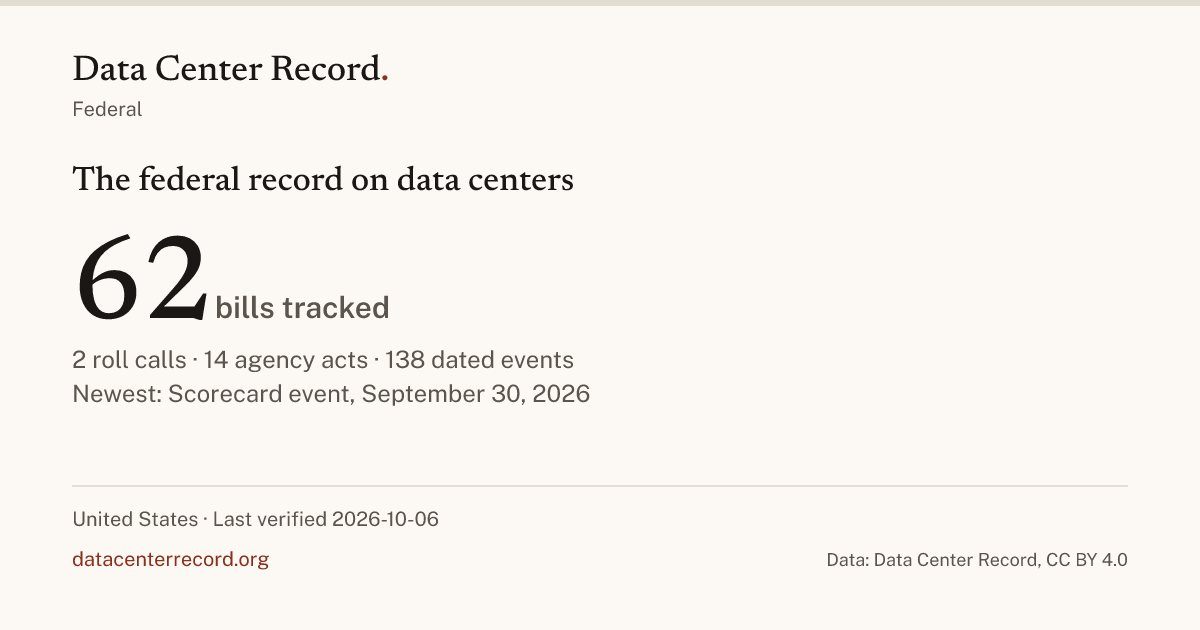
Know of a federal filing, docket, order or ruling on data centers that is missing? Send a tip. State by state, the record is at States.
For researchers
- Row key
- us/united-states
- State code
- US
- Place id
- us
- Rating value
- Not disclosed
- Acts on the row
- 44
- Bills in Congress
- 62